You don’t become a leader overnight—nor are people “born leaders” (despite what some entrepreneurs might have you think). Rather, leadership skills are cultivated throughout your life as you interact with others and participate in clubs, sports, work, or other group activities. That means even if you are an introvert, there are plenty of ways to nurture the leader within. Here are four ways to get involved that will help you develop leadership skills that can enhance your résumé.
1. Find a mentor, be a mentor
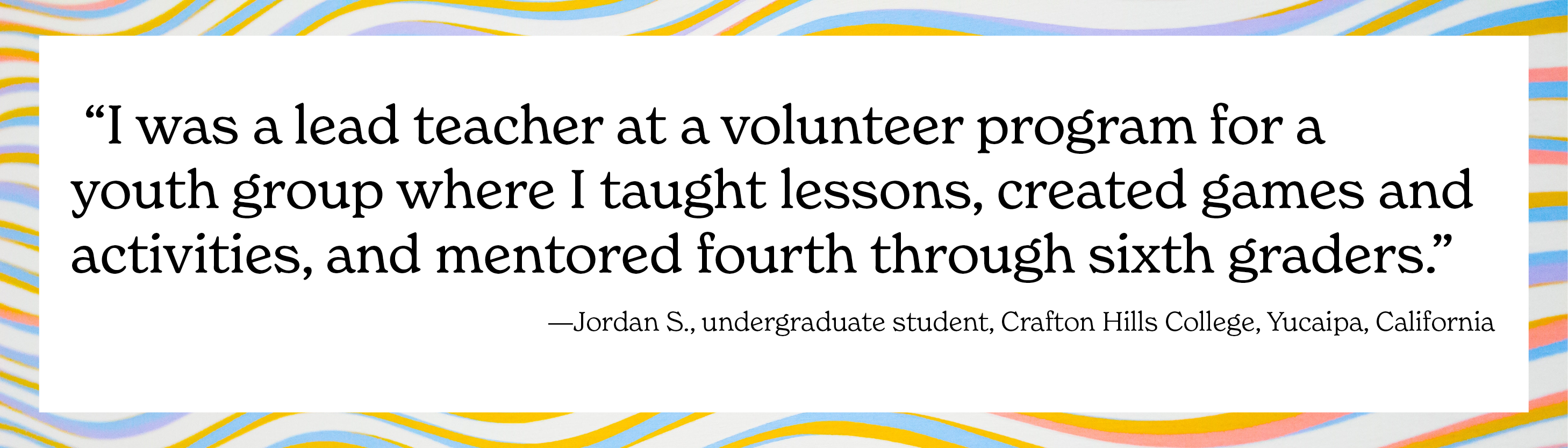
Peer advising and mentoring programs allow you to develop interpersonal skills and lead one person at a time. To find a mentorship program, check in with your college career center or professional organizations relevant to your career goals.
Alternatively, learning from other leaders as a mentee is a great way to understand the steps they took to get where they are today. Approach a professor or other professional and ask if they would consider meeting with you on a regular basis.
How to present this to employers
Include mentorships in your résumé and cover letter and emphasize your interest in learning (as a mentee) and practice (as a mentor).
2. Get involved
When you’re elected or appointed to a specific role in an on-campus club or organization, you’ll be setting goals, managing members, and overseeing activities and events—all great practice for a strong leader. Keep in mind that the longer you keep the role, the better it looks.
How to present this to employers
Track and document your performance. In your résumé, include:
- Relevant numbers (e.g., membership growth and funds raised)
- 2-3 lines of qualitative info (e.g., changes you brought to the organization, local or campus media coverage, positive feedback)
- Stats about any conferences, workshops, or meetings you organized
“I organized my own language club on a whim! I learned that sometimes being an effective leader means jumping on an opportunity or idea quickly and making something of it. My friends were interested in learning elementary Japanese—and I had enjoyed teaching them bits in the past—so I set up a club server on Discord and started hosting small-scale meetings every now and then. Leading the project also meant taking tips from my friends and incorporating those into the types of activities I planned.”
—Akio S., third-year student, Portland State University, Oregon
3. Start a project
Your college or university might have a specialized degree or a major that includes leadership courses and training as requirements for graduation. But if it doesn’t, leadership classes and projects can help you wrap your mind around the concepts (and the prospect of yourself as a leader) and avoid costly mistakes. Alternatively, independent class projects can be opportunities to study or practice leadership development in any field.
How to present this to employers
Your résumé lists your degree, major, minor, and other particular interests. “Include a section to highlight your leadership development entitled, ‘projects’ or ‘community involvement,’” says Robyn Williams, associate director of career services at the University of Central Arkansas. “There you can add your academic projects, research, and/or community projects.”

4. Enroll in a leadership course
There are many online classes you can take that are specifically designed to help you cultivate leadership skills. For example, Coursera offers several leadership courses from universities for free. You can also join groups on Facebook or LinkedIn that are based on your major or interests to stay in the loop on relevant leadership trainings or summits.
How to present this to employers
If the position you are applying for requires leadership experience, call attention to any courses or training you have. In your résumé:
- Cite the course or program high in your list of interests and activities.
- Include dates and a brief summary of the program’s benefits for you.
- Incorporate keywords (e.g., leadership development, initiative, enterprise, resilience).
Online leadership courses: Coursera
Online leadership courses: Alison.com
Article sources
Marni Goldberg, EdS, MA, professor of Recreation, Parks, and Tourism Administration, California Polytechnic State University in San Luis Obispo, California
Todd Gray, Major, associate professor of military science, University of Central Arkansas in Conway
Bill Hendricks, PhD, head of the Department of Recreation, Parks, and Tourism Administration, California Polytechnic State University in San Luis Obispo, California
Chris Newton, workforce outreach coordinator, ISC Constructors in Baton Rouge, Louisiana
Paul Stoltz, PhD, founder and CEO of Peak Learning in San Luis Obispo, California.
Robyn Williams, associate director of career services and cooperative education, University of Central Arkansas, Conway, Arkansas
American Psychological Association. (2014). The road to resilience. http://www.apa.org/helpcenter/road-resilience.aspx
Bates Communication. (n.d.) The Bates model of executive presence.
http://www.bates-communications.com/what-we-do/assessments-expi/the-bates-model-of-executive-presence/
BestCollegesOnline. (2012, April 10). Fourteen fascinating theories from leadership studies. http://www.bestcollegesonline.com/blog/2012/04/10/14-fascinating-theories-from-leadership-studies/
Brunel University London. (2013). Initiative and enterprise. http://www.brunel.ac.uk/services/pcc/students/make-yourself-employable/developing-skills/initiative
Dugan, J. P. & Komives, S.R. (2007). Developing leadership capacity in college students: Findings from a national study. College Park, MD: National Clearinghouse for Leadership Programs. https://nclp.umd.edu/include/pdfs/MSLReport-FINAL.pdf.
Gentry, W., Deal, J.J., Stawiski, S., & Ruderman, M. (2012). Are leaders born or made? Center for Creative Leadership. [pdf] http://www.ccl.org/leadership/pdf/research/areleadersbornormade.pdf
Indeed.com. (2021, July 26). Leadership skills: Definitions and examples. https://www.indeed.com/career-advice/resumes-cover-letters/leadership-skills
Komives, S.R., Lucas, N., & McMahon, T.R. (2013). Exploring leadership: For college students who want to make a difference. San Francisco: Jossey-Bass.
Massachusetts Institute of Technology. (n.d.) Leadership development opportunities. http://sld.mit.edu/opportunities/index.php
Mielach, D. (2012, December 27). 10 ways to define leadership. BusinessNewsDaily.com. http://www.businessnewsdaily.com/3647-leadership-definition.html
Mind Tools (2014). Taking initiative. Mind Tools. http://www.mindtools.com/pages/article/initiative.htm
Myatt, M. (2012, April 4) Ten communication secrets of great leaders. Forbes.com
http://www.forbes.com/sites/mikemyatt/2012/04/04/10-communication-secrets-of-great-leaders/
Northouse, P. (2010). Leadership: Theory and practice. San Francisco, CA: Sage.
Hawkins, K. (2011). Colleges. Real Inspiration, Inc. http://www.keithhawkins.com/colleges/
Shwabel, D. (2014, May 14). Millennial branding student employment gap. http://millennialbranding.com/2012/05/millennial-branding-student-employment-gap-study/
CampusWell survey, March, 2021
University of Melbourne. (n.d.) Tips for effective teamwork. http://www.law.unimelb.edu.au/lasc/professional-skills/tips-for-effective-teamwork