



























Rate this article and enter to win
If exam season is approaching, your class notes may be piling up and your calendar filled with study sessions and finals. Pressure? Ever feel like it’s too much? Some stress is a normal part of facing a challenge, but too much can interfere with your ability to think clearly. Dr. Kerry Ressler, professor of psychiatry at Harvard Medical School, notes that stress can interfere with “cognition, attention, and memory.” The good news: You are not helpless. If stress is the villain bringing you down, resilience is the hero cheering you on. Here’s how to manage your stress, keep calm, and study (and play) on.
Your body & mind on stress
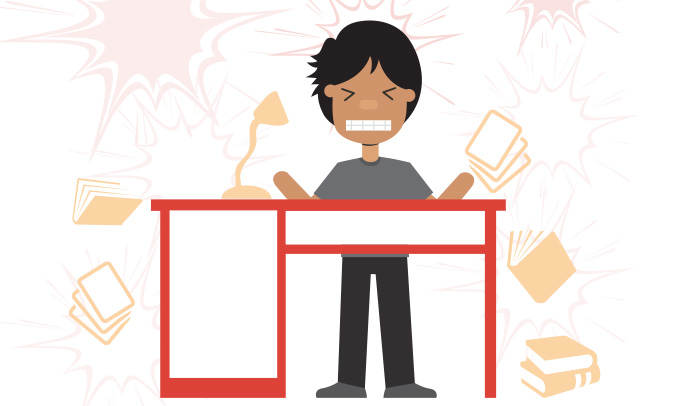
Adrenal glands release stress hormones:
- Heart beats faster
- Blood pressure rises
- Muscles tense
- Feel tired and foggy-headed
- Struggle to remember and learn
- Icky digestion
More information
The adrenal glands produce “fight or flight” hormones. In some situations (e.g., when a tornado is heading your way) these can potentially save your life. These hormones get your body mobilized for action in order to survive (dodge that tornado).
In other situations (e.g., exam nerves) they are not so helpful—more of an overreaction. Your body doesn’t use that extra jolt of energy. Instead of earning tornado survival bragging rights, you’re at risk for the negative side effects of extended stress.
Epinephrine (adrenaline), a hormone, enters your bloodstream and circulates through your body. Here’s what it does:
- Your heart beats faster
- Your blood pressure rises
- Your muscles tense
- Your sweat production increases
- You may feel over-alert and struggle to fall asleep or stay asleep
- You may feel mentally foggy and unable to function and focus in the daytime
Cortisol, a hormone, gets your body mobilized and ready for action in order to survive. But in many cases (e.g., exam prep) this cortisol is not so useful. Elevated cortisol levels for an extended period of time can:
- Impair your memory and learning (and your exam performance)
- Impair your immune function
- Erode your bone density
- Cause digestion problems
- Contribute to weight gain
- Raise your blood pressure
Brain sends distress signal to nervous system
The amygdala, a part of the brain that is key to emotional processing, sends a distress signal to the hypothalamus.
The hypothalamus, a part of the brain that regulates hormones and controls body functions, relays that distress signal via the autonomic nervous system. This manages involuntary body functions such as breathing and blood pressure.
How to turn it around
If exam season is approaching, your class notes may be piling up and your calendar filled with study sessions and finals. Pressure? Ever feel like it’s too much? Some stress is a normal part of facing a challenge, but too much can interfere with your ability to think clearly. Dr. Kerry Ressler, professor of psychiatry at Harvard Medical School, notes that stress can interfere with “cognition, attention, and memory.”
The good news: You are not helpless. If stress is the villain bringing you down, resilience is the hero cheering you on. Here’s how to manage your stress, keep calm, and study (and play) on.
+ Protect your brain from stress
Deep breathing and mindfulness
Deep breathing & mindfulness reduce your stress hormones
Deep abdominal breathing engages the vagus nerve, which signals to slow down the heart rate, lower the blood pressure, and put the brakes on cortisol.
+ 3 Breathing techniques for whenever you feel anxious
“When I feel overwhelmed or stressed, I go outside and find a spot where I can just breathe and clear my mind.”
—Stephanie G., fourth-year undergraduate, California State University, Stanislaus
Mindfulness & meditation are powerful tools for reducing stress hormones and boosting emotional resilience in demanding situations.
Set aside 10–15 minutes a day. Focus on taking deep breaths and recognizing which areas of your body are holding tension. For regular tips and guidance, see Mind your mind, a monthly series on our BetterU pages.
+ Mindfulness for college students
“Using mindfulness techniques has helped me manage my procrastination. It has allowed me to really understand and analyze the situations I am in. For example, if I know my schedule for the upcoming week is going to be especially rough, then I’ll try to finish as much work as I can earlier.”
—Matthew S., second-year undergraduate, Santa Clara University, California
Physical activity
Physical activity manages your stress hormones
Physical activity channels cortisol productively.
Cardio workouts and competitive sports will do the job.
Low-intensity activities (e.g., tai chi and yoga) work too:
Fluid movement + deep breathing + mental focus = calm
Student stories
“I personally use exercise as a de-stressor! You’ll find me more at the gym during exam time.”
—John Handal, fourth-year undergraduate, Redeemer University College, Ontario
“Jogging alone while listening to music at night can really calm you down too.”
—Reza Wang-Lotfi, second-year undergraduate, New Jersey Institute of Technology
Laughter and joy
Laughter, joy, music, & downtime raise your feel-good hormones
Laughter and joy channel cortisol productively.
- They release endorphins (your brain’s feel-good chemicals)
- They are associated with lower levels of stress hormones
Make room for something funny during a stressful study week. A 2023 study found that laughter can lower cortisol levels, suggesting that a comedy movie, funny videos, or a night of laughing with friends may be more than just a distraction. It can also give your stress levels a break.
Music can help you decompress: Putting on music you enjoy may help you relax and improve your mood. Recent research suggests that music can support emotional well-being and stress regulation.
Taking an hour before bed without cramming lets your brain and body slow down. If you get antsy, try reading (no textbooks!).
Student stories
“I recommend an hour of downtime before bed, such as listening to relaxing music (a symphony/orchestra).”
—Amy Neilson, fourth-year undergraduate, Western Washington University
“I find that if I am stressing about an exam or something else school-related, the best way for me to relax at night is to lie in bed and listen to a meditation that lasts for 30 minutes to an hour. They are easily found on YouTube, and they’re great for relaxing when you find reading doesn’t help.”
—Laura Barr, second-year undergraduate, Memorial University of Newfoundland
Your body & mind on resilience
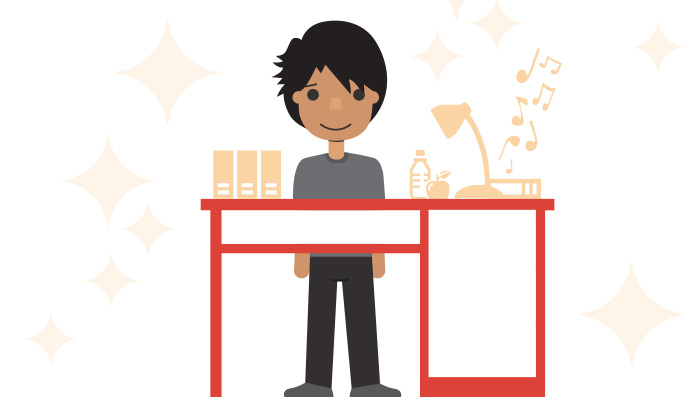
- Lower levels of stress hormones
- Higher levels of feel-good hormones
- Heart beats slower
- Blood pressure lowers
- Feel clear-headed and focused
- Feel rested
- Able to recall information
Your black bag of stress-management techniques
“People who are successful at reducing the negative effects of stress have a variety of tried-and-true techniques. This helps keep their techniques effective over time, and covers different environments and situations,” says Steve Lux, senior health educator at Northern Illinois University.
Your personal “black bag” can include strategies that are effective indoors or out, any time the year, at no cost, and that address either your physical or emotional needs (or both).
Sample black bag
- Mindfulness
- Support group (e.g., Al-Anon)
- Guided relaxation
- Nature or neighborhood walk
- Call friend or therapist
- Church or temple
- Music (e.g., Mozart’s Sonata for Two Pianos in D Major)
Article sources
Harvard Health Publishing. (2021, February 15). Protect your brain from stress. Harvard Health.
Kramer, C. K., & Leitao, C. B. (2023). Laughter as medicine: A systematic review and meta-analysis of interventional studies evaluating the impact of spontaneous laughter on cortisol levels. PLOS ONE, 18(5), Article e0286260. https://doi.org/10.1371/journal.pone.0286260
Zhang, J., Lu, Y., Mehdinezhadnouri, K., Liu, J., & Lu, H. (2025). Impact of music-based interventions on subjective well-being: A meta-analysis of listening, training, and therapy in clinical and nonclinical populations. Frontiers in Psychology, 16, Article 1608508. https://doi.org/10.3389/fpsyg.2025.1608508