


























Growing your own food can be an awesome hands-on science project and a way to better know ourselves and the natural world. “The more we are exposed to different fruits and vegetables and ways to eat them, the more likely we are to find something we like and continue eating it,” says Karen Moses, director of wellness and health promotion at Arizona State University. Gardening can help reduce symptoms of depression and anxiety, with recent research showing it is linked to improved mental well-being and overall quality of life.
Tapping into your inner green thumb can also save you some, well, green. Life can be expensive (especially when you move out for the first time), but growing a few staples in a window box or common outdoor space can help you spice up meals while cutting down on your grocery bill.
These foods (and more) can be grown inside in front of a sunny window:
- Tomatoes
- Carrots
- Microgreens (vegetable seedlings)
- Oregano
- Mushrooms (delicious, but can be stinky)
- Mint
- Rosemary
- Thyme
Check out the Get help or find out more section at the bottom of this article for gardening tips and recipes featuring these and many more vegetables and herbs.
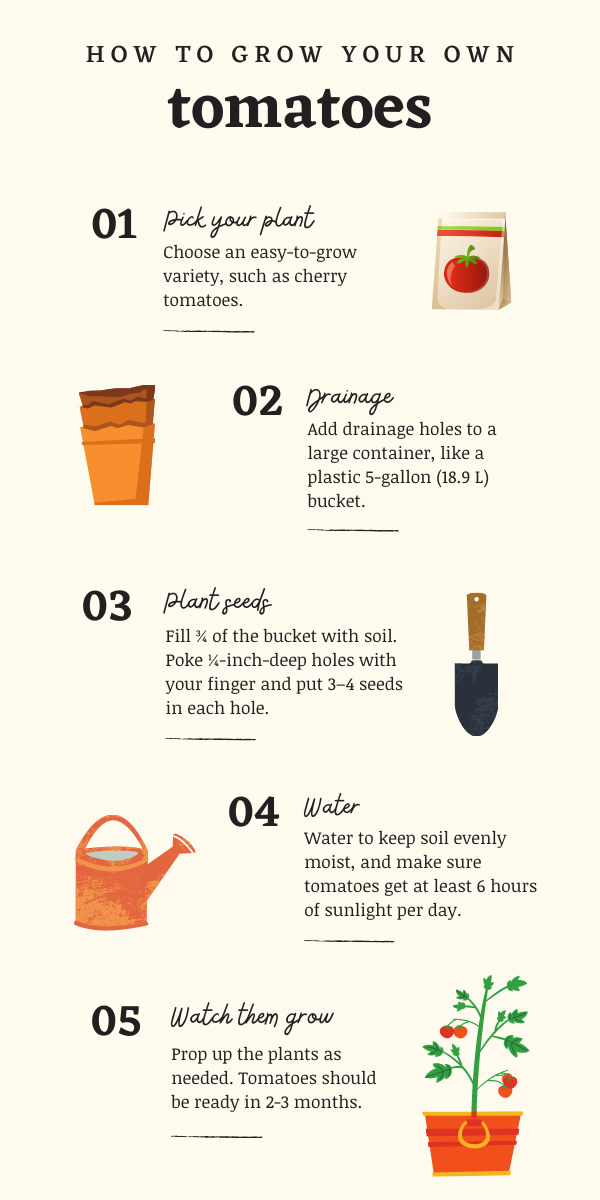
- Choose an easy-to-grow variety, such as cherry tomatoes. Seeds are cheap and can be found online or at home and garden stores. Tip: The best time to start growing tomatoes is late spring or early summer.
- Find a large container. A plastic five-gallon (18.9 L) bucket works great if you add drainage holes.
- Fill about three-fourths of the bucket with soil. Poke quarter-inch-deep holes with your finger and put three to four seeds into each hole. Thin them out as they grow.
- Water the soil often enough to keep it evenly moist, and make sure the bucket is getting at least six hours of sunlight and warmth per day. Tip: It’s best to grow tomatoes in a sunny spot outside or indoors in front of a big window.
- Prop up the plants as needed. The tomatoes should be ready in two to three months. Enjoy them in salads, on homemade pizza, or as is!
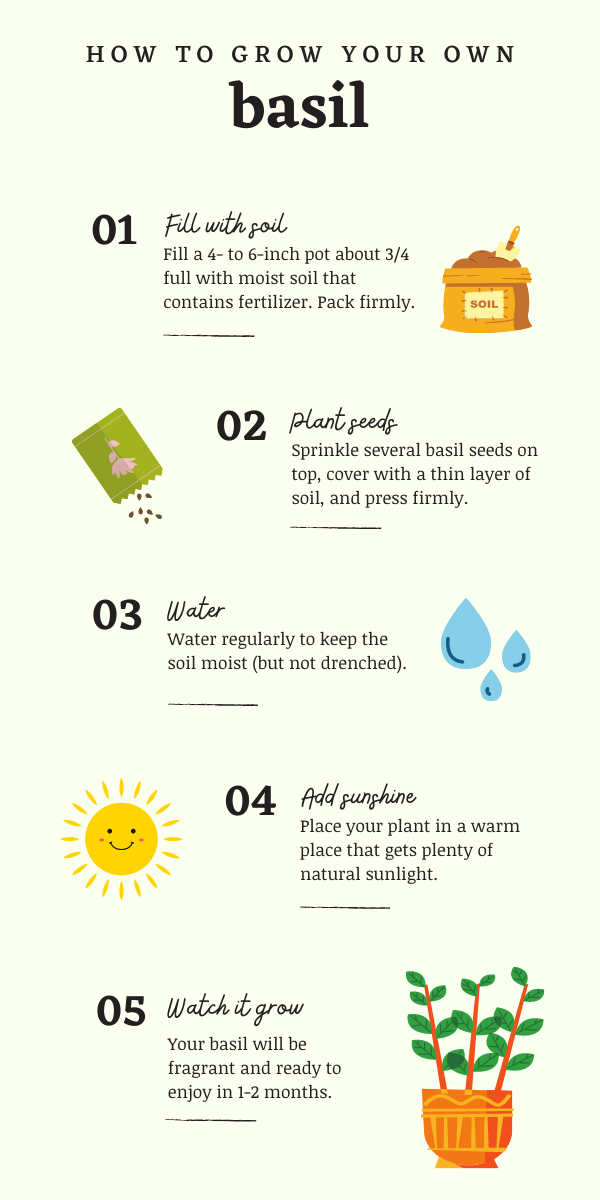
- Find a four- to six-inch pot and fill it with moist, nutrient-rich soil that contains fertilizer. Pack the soil firmly about three-quarters full.
- Sprinkle several basil seeds on top of the soil and then cover them with a thin layer of soil. Press firmly to pack the soil.
- Water your basil plant regularly to keep the soil moist (but not drenched).
- Place your plant in a window (or outdoors) in a warm place that gets plenty of natural sunlight. If that’s not an option, you can place your plant under a grow light for 14 hours per day.
- Your basil will be fragrant and ready to enjoy between one and two months.

Wondering what to do with the fruits—or vegetables—of your labor? Use your homegrown tomatoes and basil to make a simple Caprese salad (layered with creamy mozzarella), top homemade pizza for a fresh-tasting Margherita, or brighten up a salad to let their natural flavors shine. Homegrown produce is so much tastier than store-bought; you may even want to eat the tomatoes straight from the vine!

The nationwide FoodCorps program employs young adults to go into schools and implement evidence-based strategies to make schools healthier places (including teaching students to grow their own food).
It’s a full-time, low-paying gig (the program offers a stipend up to $40,000 per service term, plus health insurance), and a year’s service gets you a $7,395 stipend for tuition or to repay student loans.
Vegetable gardening tips and recipes: Harvest to Table
How to grow microgreens: Gardeners Supply Company
Best mushroom grow kits for beginners: Rural Sprout
Article sources
Karen Moses, EDD, RD, CHES, director of wellness and health promotion at Arizona State University, Tempe.
Cox, R. (2010). Grow your own tomatoes indoors this winter. Retrieved from http://www.colostate.edu/Depts/CoopExt/4DMG/VegFruit/tomatind.htm
Helpguide.org. (2014, December). Are organic foods right for you? Retrieved from http://www.helpguide.org/articles/healthy-eating/organic-foods.htm
Lea, E. (2005). Food, health, the environment and consumers’ dietary choices. Nutrition and Dietetics, 62(1), 21–25. Retrieved from http://onlinelibrary.wiley.com/doi/10.1111/j.1747-0080.2005.tb00005.x/abstract
Miuccio, D. (2021, January). How to grow basil indoors. Gardener’s Supply Company. Retrieved from https://www.gardeners.com/how-to/basil-indoors/8930.html
Naeve, L. (2014, November). Tomatoes. Retrieved from http://www.agmrc.org/commodities__products/vegetables/tomatoes/
Panțiru, I., Ronaldson, A., Sima, N., Dregan, A., & Sima, R. (2024). The impact of gardening on well-being, mental health, and quality of life: An umbrella review and meta-analysis. Systematic Reviews, 13, 45. https://doi.org/10.1186/s13643-024-02457-9
Pittenger, D. (2005). Growing tomatoes in the home garden. Retrieved from http://anrcatalog.ucdavis.edu/pdf/8159.pdf
Soga, M., Gaston, K. J., & Yamaura, Y. (2017). Gardening is beneficial for health: A meta-analysis. Preventive Medicine Reports, 5(1), 92–99. doi: 10.1016/j.pmedr.2016.11.007
US Food and Drug Administration. (2014, September 26). Raw produce: Selecting and serving it safely. Retrieved from http://www.fda.gov/food/resourcesforyou/consumers/ucm114299
VanZile, J. (2021, January). Tips for growing basil indoors. The Spruce. Retrieved from https://www.thespruce.com/grow-basil-indoors-1902741