


























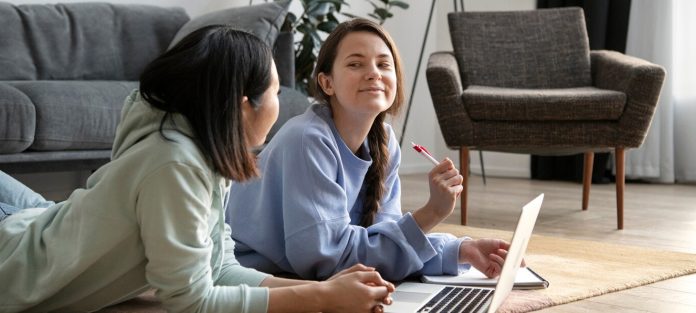
One way to find out what kind of roommate you are is to live with someone for a year, ask them to review your performance, and brace yourself for the verdict. Another way is to take this quiz. Many of these scenarios and responses are based on students’ confessions in CampusWell surveys. Choose the options you think are best to find out how you rank.
Guide to roommate agreements and sample: Nolo.com
How to tell your roommate something’s bothering you without starting a fight: Bustle
Article sources
Shelley Hershner, MD, sleep specialist and assistant professor in neurology, University of Michigan.
Rhonda Richards-Smith, a relationship expert and psychotherapist, Los Angeles, California.
Xu, PhD, professor of psychology, Idaho State University.
Eliasson, A. H., Lettieri, C. J., & Eliasson, A. (2010). Early to bed, early to rise! Sleep habits and academic performance in college students. Sleep and Breathing, 14(1), 71–75. Retrieved from http://link.springer.com/article/10.1007%2Fs11325-009-0282-2
Engle-Friedman, M., Riela, S., Golan, R., Ventuneac, A. M., et al. (2003, May). The effect of sleep loss on next day effort. Journal of Sleep Research, 12(2), 113–124. Retrieved from http://onlinelibrary.wiley.com/doi/10.1046/j.13652869.2003.00351.x/abstract
Gooley, J. J., Chamberlain, K., Smith, K. A., Khalsa, S. B., et al. (2011, March). Exposure to room light before bedtime suppresses melatonin onset and shortens melatonin duration in humans. Journal of Clinical Endocrinol Metabolism, 96(3), E463—E472. Retrieved from http://www.ncbi.nlm.nih.gov/pmc/articles/PMC3047226/
Hershner, S. D. & Chervin, R. D. (2014). Causes and consequences of sleepiness among college students. Nature and Science of Sleep, 6, 73–84. Retrieved from http://www.dovepress.com/causes-and-consequences-of-sleepiness-among-collegestudents-peer-reviewed-article-NSS
Kelly, W. E., Kelly, K. E., & Clanton, R. C. (2001). The relationship between sleep length and grade point average among college students. Journal of College Student Development, 35, 84–86. Retrieved from http://a1.phobos.apple.com/us/r30/CobaltPublic/v4/4a/b9/97/4ab997e8-12b0-22d0-1120e54ea79c3d0e/215-4929907074434892796
King, K. A., Vidourek, R. A., English, L., & Merianos, A. L. (2014). Vigorous physical activity among college students: Using the health belief model to assess involvement and social support. Archives of Exercise Health and Disease, 4(2), 267–279.
National Sleep Foundation. (2011). Sleep in America: Technology use and sleep. Arlington, VA: National Sleep Foundation. Retrieved from http://sleepfoundation.org/sites/default/files/sleepinamericapoll/SIAP_2011_Summary_of_Findings.pdf
Plante, T. G., Coscarelli, L., & Ford, M. (2001). Does exercising with another enhance the stress-reducing benefits of exercise? International Journal of Stress Management, 8(3), 201–213.
Trockel, M. T., Barnes, M. D., & Egget, D. L. (2000). Health-related variables and academic performance among first-year college students: Implications for sleep and other behaviors. Journal of American College Health, 49, 125–131. Retrieved from
http://www.tandfonline.com/doi/abs/10.1080/07448480009596294?url_ver=Z39.88-2003&rfr_id=ori:rid:crossref.org&rfr_dat=cr_pub%3dpubmed&#.U82AgZRdVN4