



























“How can I better prioritize tasks without feeling overwhelmed? I have so many tasks to complete that I end up not doing anything because I don’t even know where to start.”
—Bree N., first-year graduate student, Lenoir-Rhyne University
Learning how to use a few time-management strategies will serve you well beyond college in your professional and personal lives. That said, it’s very normal to feel overwhelmed when thinking about how to organize your time—I often feel the pressure of having too much to do and not enough time to do it.
The following strategies have been effective for my students who have been in your shoes: juggling multiple classes, social and personal tasks, and maybe even a part-time job. When they felt out of control, they said these strategies helped give them a sense of power back.
Pomodoro Technique
This is a great method to use for getting started on a task. Set a timer for 25 minutes and begin the task, whether it’s cleaning your room or writing a paper. Don’t stop until the timer goes off. Then, give yourself a timed five-minute break. Repeat as often as you need to finish the task. I find that the act of simply getting started is enough to kick-start my motivation.
Daily Top Three
At the beginning of your day, make a list of three tasks you need to complete by the end of the day. Write it on a sticky note or somewhere you will see it often during the day. The key to this strategy is to keep the list short and to only write down reasonable goals that you’re likely to complete.
For example:
- Do the readings from psych class.
- Wash bedsheets.
- Apply for scholarship.
Eat the Frog
“Eating the frog” simply means to complete the most unpleasant task on your to-do list first thing in the morning (or as soon as you get back from class, if your mornings are hectic). The phrase was coined by Brian Tracy, an author who has penned a number of books on the psychology behind self-discipline. If you feel your stomach turn when you think about writing that paper on Chaucer, that’s probably the best place to start.
The Eisenhower Matrix
This strategy allows you to sort and prioritize your tasks by placing them into distinct categories. On a sheet of paper, draw a box with four squares and label each quadrant according to the model below. Then review your to-do list: Anything you consider both “urgent” and “important” goes into the top left square. Anything you consider “not urgent” but “important” goes into the top right quadrant, and so on. You can then prioritize your task list to focus your time and attention on the items that are most essential and time sensitive.
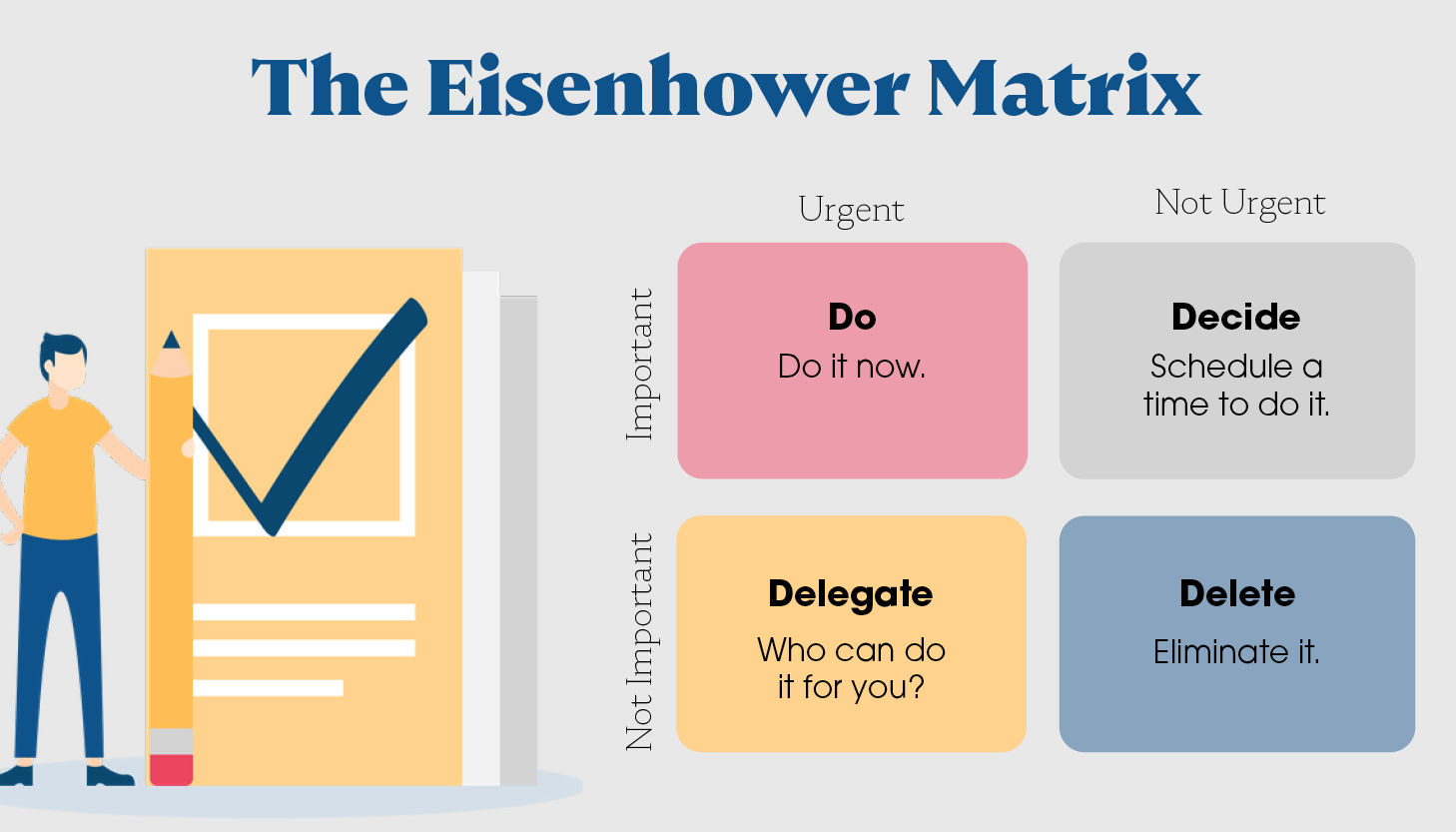
The Eisenhower Matrix
[Top left quadrant]
Important and urgent
Do: Do it now.
[Top right quadrant]
Important and not urgent
Decide: Schedule a time to do it.
[Bottom left quadrant]
Not important and urgent
Delegate: Who can do it for you?
[Bottom right quadrant]
Not important and not urgent
Delete: Eliminate it
Try each of these strategies until you find one—or a combination—that works well for the tasks you need to complete. As an example, I use “Eat the Frog” for paying bills and “The Eisenhower Matrix” for my writing assignments, but you may find that different strategies better complement your working style.