
Key points
- LGBTQ+ centers provide a safe space on campus where LGBTQ+ students can be their authentic selves.
- Campus LGBTQ+ centers foster the academic success and personal growth of LGBTQ+ students and those who work in solidarity with them.
- LGBTQ+ centers can also serve as an important resource for staff, faculty, and other community partners looking to become better allies.
Even though LGBTQ+ students are increasingly more comfortable on college campuses, they still remain members of an underserved minority. As I remember it, being out in college had its freedoms, but it also had its challenges. Campus LGBTQ+ centers (also called LGBT centers, Pride Centers, etc.) make for a safer and more inclusive college environment. They also foster the academic success and personal growth of LGBTQ+ students and those who work in solidarity with them.
“I don’t even know where to begin with how my school’s LGBTQ+ center has helped me,” says Dylan M., a first-year graduate student at Pennsylvania State University in State College, Pennsylvania. “Everyone that works there is so kind and welcoming and willing to listen. They helped me feel comfortable about changing my major in undergrad and have become such important people in my life. Even just knowing that they are around and will find time to talk with me has been such a comfort.”

A LGBTQ+ center is a place on campus where LGBTQ+ folks can connect with each other, as well as with allies, and be our authentic selves in an atmosphere free from discrimination. It also provides a healthy learning environment where students can readily access the various resources that meet their emotional, social, and academic needs, and find support in planning for their futures.
“College students who feel a sense of belonging and connectedness are much more likely to [graduate],” says Luca Maurer, director of the Center of LGBT Education, Outreach and Services at Ithaca College in New York. “As a former college student who experienced a lot of challenges and barriers myself, I know what it’s like when someone sees you for who you are and says they believe in you. A long time ago, I was on the verge of dropping out of college. I only stayed because a staff member demonstrated to me that I mattered, in her eyes, as a member of the college community. I see what I do now, in my job, as a way to pay it forward.”

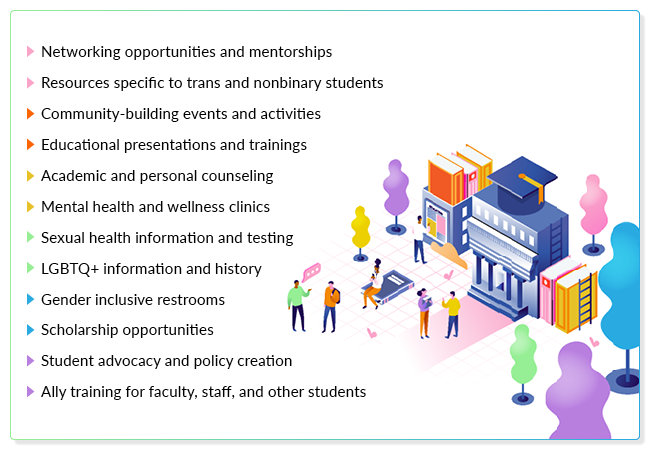
If your school does not have a designated LGBTQ+ center, many of these services may be available at the diversity and inclusion office.
“It opened my eyes to the variety of expressions and identities on campus.”
—Brian H., fourth-year student, University of Maryland, Baltimore County
“It was good to meet other people like me. It’s important to find people who accept you for who you are, so that is why I would tell incoming students to attend meetings. I feel like the world is becoming more welcoming of people who are not straight and cis-gender.”
—Leah E., fourth-year student, Villanova University, Pennsylvania
“It was nice to be able to hang out and know I wouldn’t be judged, and if I had problems, I could talk to people who were more like myself.”
—Kelly C., fourth-year student, University of Science and Arts of Oklahoma, Chickasha
“I love meeting people who are not like me, I consider myself an ally and get a lot of work done in the center. The director is also a great person to seek for advice when the center is open for simple check-ins or deeper conversation as well.”
—Carol C., fourth-year student, University of Maryland, Baltimore County

In addition to being a physical safe space for students, LGBTQ+ centers can help make the entire campus a safe space by way of faculty interventions and policy creation. Some universities produce safe space cards for faculty to post in their offices or encourage staff to wear school-branded rainbow pins that clearly identify who is an ally to new students.
LGBTQ+ centers can also advocate on behalf of students to create or change school policy so all students may fully access everything a college or university has to offer. “When we redesign systems, they benefit everyone,” says Maurer. “We see that in principles of universal design. We see that in higher ed research, that trying to figure out how to reduce bias and oppression and center folks who are on the margins increases access to everyone. That’s good for all students.”

For schools with students who attend at a distance—especially those studying from home during the pandemic—a digital LGBTQ+ center can replicate most of what a physical center can do. Digital LGBTQ+ centers can offer one-on-one counseling and support for students, online drop-in sessions, and access to school resources. The virtual element can also lend itself to additional programming, such as inviting guest speakers who typically would not be able to travel to present at an event. Having an online LGBTQ+ center can also increase accessibility to students with mobility issues or those who might not feel comfortable visiting the center in person because they are not currently out in their community.
Students looking for online LGBTQ+ center services can check their school’s website or access a site like Campus Pride, which provides detailed information about LGBTQ+ services at colleges and universities across the United States.
Building LGBTQ+ friendly college awareness: Campus Pride
Sharing stories of LGBTQ+ resilience: It Gets Better Project
Why we need gender-neutral bathrooms: TED Talks
Crisis intervention and suicide prevention: The Trevor Project
Article sources
Luca Maurer, director of the Center of LGBTQ+ Education, Outreach and Services, and staff member, Women’s and Gender Studies, Ithaca College, Ithaca, New York.
Fowler, N. (2013, December). Shane Windmeyer: Campus Pride founder says LGBT inclusiveness benefits everyone. Insight into Diversity. https://documents.highline.edu/highline/Campus-Pride-Founder-Says-LGBT-Inclusiveness-Benefits-Everyone.pdf
CampusWell survey, November 2020.