Key points
- Dating apps can be a great way to make connections, but using them is also associated with negative emotions like low self-esteem, depression, and anxiety.
- When making a dating profile, set intentions and share thoughtfully.
- When using dating apps, focus on a few connections and remember to take breaks.
The days of love letters and calling on the phone have passed us by—today, the tools for dating are swipes and likes.
Dating apps certainly have their merit. Making a profile on a site like Tinder or Hinge can help you put yourself out there, express what (and who) you are interested in, and widen your dating circles beyond your hometown or college friend group. Dating apps can also feel like the easiest way to meet people—a 2023 Pew Research Center poll found that 53 percent of 18- to 29-year-olds have used a dating app or dating site.
But, like any social media platform, dating apps have their drawbacks. For starters, it’s important to keep safety in mind when meeting a stranger face-to-face. But what about the emotional risks of online dating? Recent studies indicate that using dating apps can have some negative effects on our mental health. That doesn’t necessarily mean we need to delete them, though. Read on to find out how you can better protect your emotional self when online dating.
How does using dating apps affect us emotionally?
 Swiping through endless pictures and profiles on dating apps can feel exciting, but it may actually lead to lower self-esteem, according to a study of more than 1,300 college students (most of whom were female-identifying). In the study, Tinder users reported higher levels of body shame and scrutinizing of their physical appearance compared to non-users. The study also found that male Tinder users reported lower self-esteem levels than males who weren’t on the app.
In addition, a 2020 study of 437 Australians found that users of swipe-based dating apps (like Tinder) reported higher levels of depression, anxiety, and distress compared to study participants who did not use them.
Dating apps can make matches feel like commodities
 When we look at a person’s face and bio on a dating app, we see a two-dimensional version of who they are and decide whether we’re interested—a lot like online shopping. It’s very superficial compared to making a human connection in person, where you can feel the other person’s energy and get a better sense of who they are. “This entire process of perceiving the self and others as commodities is called commodification,” says Marina Thomas, a predoctoral researcher at the University of Vienna, Austria. “It’s dehumanizing and makes us treat other users with less respect.”
Having too much choice can actually backfire, according to Thomas’s research. In her study among adult dating app users, those who had a higher number of potential partner choices actually experienced a higher fear of being single and lower self-esteem compared to those who had fewer choices. It’s the same “choice overload” that happens to consumers in a store—a shopper standing in front of 20 brands of potato chips will have a much harder time making a confident decision than a shopper standing in front of just three—a well-documented phenomenon in consumer research.
“Lots of people end up treating people or conversations as disposable because they can easily keep swiping and find someone else,” says Iris G., a third-year student at Berea College in Kentucky.
Rejection and ghosting on dating apps
 Perhaps the greatest risk of using dating apps is also a risk of dating in general: rejection. Whether the interaction goes down over a chat or face-to-face, getting shot down can sting. So can “ghosting”—when your match or date simply stops responding or even blocks you.
“Ghosting is really common, and it sucks!” says Sydney S.*, a first-year graduate student at Saint Louis University in Missouri. “Ghosting before you go out is one thing, but I’ve met people in person and never heard back again. Just tell me it’s not working!”
Whether you’re a serial swiper or a dating-app deleter, online dating has become a part of our lives, and it’s probably not going away anytime soon. If you decide that dating apps are for you, here are some tips for taking care of your emotional health while you use them.
5 ways to protect your emotional health while using dating apps

“Ask yourself clearly, what am I looking for?” says Dr. Greg Betz, a psychologist who works with students at the University of Hartford in Connecticut. “I think that translates well into ‘Who am I looking for?’ Those are the most important answers.”
 Whether you’d like to pursue a committed relationship or something more casual, be explicit about that in your dating profile and in messages. This could help save you and others from potential heartache and will start your interactions from a place of openness and honesty.
If you’re not looking for hookups, be sure to make that known. “Start slow and tell everyone you match with you want to meet new people and your goal is to meet and make friends, not one-night stands,” suggests Miriam H., a second-year student at El Camino College in Torrance, California. “Think of it as a favor that you were able to [communicate] this sooner,” she says, which can save you from a messy situation later on.

Your age, interests, and favorite cheesy pickup line are dating profile staples. But remember that once you’ve made that profile, it’s public, and anyone using the app can come across it. “[Students should] recognize that they don’t have to share everything all at once,” says Dr. Bryant Ford, director of Counseling and Psychological Services at Brown University in Providence, Rhode Island. If there is information that you don’t want all of the internet to know, such as your relationship history, job, or school affiliation, save those topics for an in-person meet-up once you’ve established some mutual trust.

“Instead of creating an endless list of faceless matches that you can’t tell apart, restrict your swiping and invest in fewer connections,” says Thomas. Spending more time chatting with fewer people can help your connections feel more human and less like a game.
To avoid commodifying your matches, or being commodified yourself, try starting with three people that you’re interested in chatting with, and focus your time and energy on communicating with just them. If these connections fizzle out, you can always go back to swiping.

“Especially with all of that choice, people think, ‘I’m going to find the perfect person, I’m going to find the one,’” says Dr. Betz.
If you expect to find your perfect match, you may be setting yourself up for failure. Instead, Dr. Betz recommends imagining that dating apps are a tool to help you put yourself out there socially, just like joining a club or practicing a sport. Maybe someone great will come along, and maybe not, but you’ll meet people and grow your dating experience along the way.
To increase the likelihood of making meaningful connections, look for someone that is a compatible match in areas that are important to you. Consider a few questions, such as:
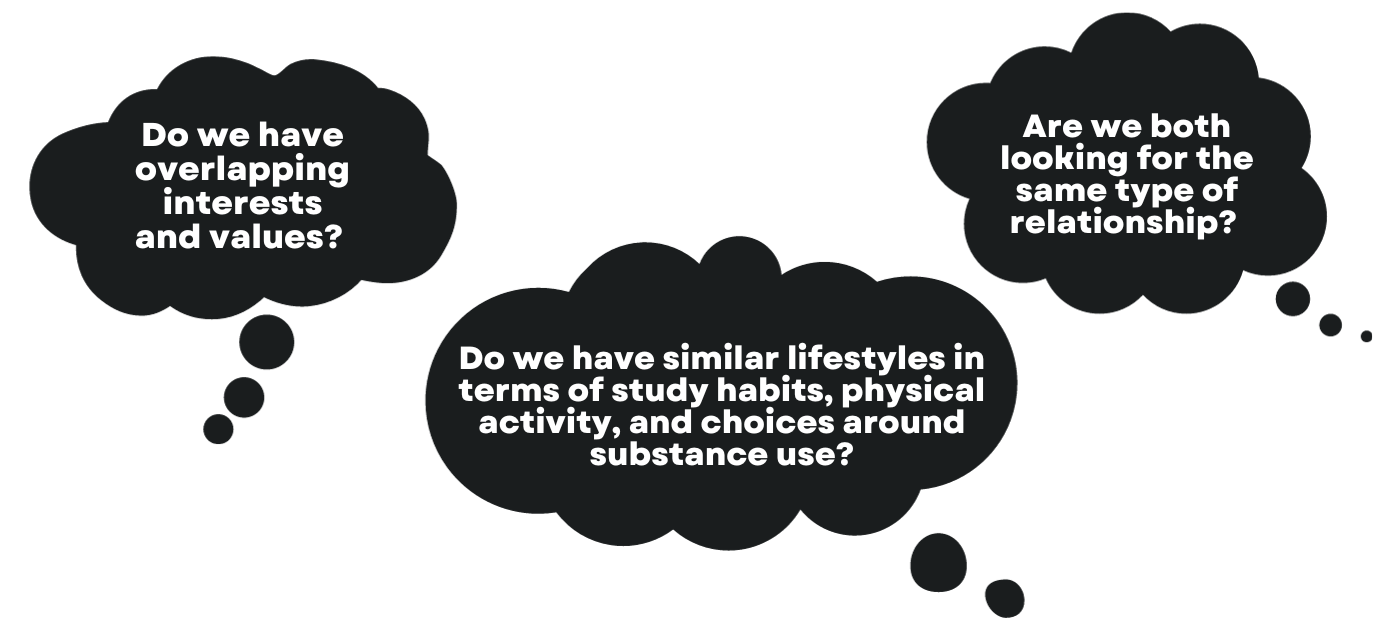
Saving your right-swipes for people who answer “yes” to these questions can help you find stronger connections.

If you ever feel yourself getting stressed or irritated while swiping, try turning off notifications or deleting the app and turning to another activity: Take a walk with a friend, call someone you love, engage in one of your hobbies, or grab a meal at your favorite café. Wait to check your notifications until you are feeling more calm and centered.
“I talk to my friends if I feel particularly upset after using an app and stop using it [to] take a break,” says Ellie*, a first-year graduate student at the University of California, San Diego.
If you find that, more often than not, using dating apps is making you feel a bit “off,” consider whether they are right for you at this moment in your life. Stepping away from the app for a few hours, a couple of days, or even longer can help put things into perspective.
Whether or not you’re on dating apps, keep putting effort into your in-person connections. Spend time socializing with your friends and acquaintances and doing the things you love, especially if they have a social element. Meeting friends of friends or finding a match through a shared activity are classic ways to meet potential partners that will never go out of style.
*Names changed
I asked Tinder for my data. It sent me 800 pages.: The Guardian
The toll of dating app burnout: The New York Times
How to use dating apps without hurting your mental health: Time
How well online dating really works: The Washington Post
Guide to mental health helplines: National Institute of Mental Health
Article sources
Greg Betz, PsyD, psychotherapist, University of Hartford, Connecticut.
Bryant Ford, PhD, director, Counseling and Psychological Services, Brown University, Providence, Rhode Island.
Marina Thomas, predoctoral researcher, University of Vienna, Austria.
American Psychological Association. (2016, August 4). Tinder: Swiping self esteem? [Press release]. https://www.apa.org/news/press/releases/2016/08/tinder-self-esteem
CampusWell survey, May 2023.
Holtzhausen, N., Fitzgerald, K., Thakur, I., Ashley, J., et al. (2020). Swipe-based dating applications use and its association with mental health outcomes: A cross-sectional study. BMC Psychology 8, 22. https://doi.org/10.1186/s40359-020-0373-1
McClain, C., & Gelles-Watnick, R. (2023). From looking for love to swiping the field: Online dating in the U.S. Pew Research Center. https://www.pewresearch.org/internet/2023/02/02/the-who-where-and-why-of-online-dating-in-the-u-s/
Thomas, M., Binder, A., & Matthes, J. (2022). The agony of partner choice: The effect of excessive partner availability on fear of being single, self-esteem, and partner choice overload. Science Direct, 126. https://www.sciencedirect.com/science/article/pii/S0747563221003009