
Toward the end of each semester, I was in the habit of listing out everything I needed to complete before break: assignments, move-out process, connecting with friends, making plans for my days off, etc. The list was endless, and I always felt overwhelmed. Little things, like making my bed or keeping up with laundry, began to fall by the wayside.
The resulting clutter made it harder than ever for me to stay organized. My physical space was in disarray, so all the other areas of my life were as well. While I felt like I was the only one living in chaos, it turns out that difficulty navigating clutter is way more common than most people realize.
Spring cleaning season is the perfect time to evaluate the clutter in your life and think about how decluttering can help free up some physical and mental space.
Clutter just means owning too many things…right?
Turns out, clutter is more than that. “Clutter is a perception of overabundance in somebody’s life that inhibits them or has a negative impact on them in some way, shape, or form,” says Helena Lucia Swanson, PhD Candidate in Community Psychology at DePaul University in Chicago, Illinois.
And it’s not just physical. There’s also “digital clutter,” which takes the form of “disorganized digital belongings, such as emails, documents, unused software, and even hardware and other physical technology,” according to Devki Patel, Consumer Research and Psychology Graduate Student at DePaul. For example, I have at least 30 tabs open in Firefox on my phone, and 10 different ones on my computer—seeing all those tabs lined up spikes my anxiety, even if they’re all things I want to read or follow up on.
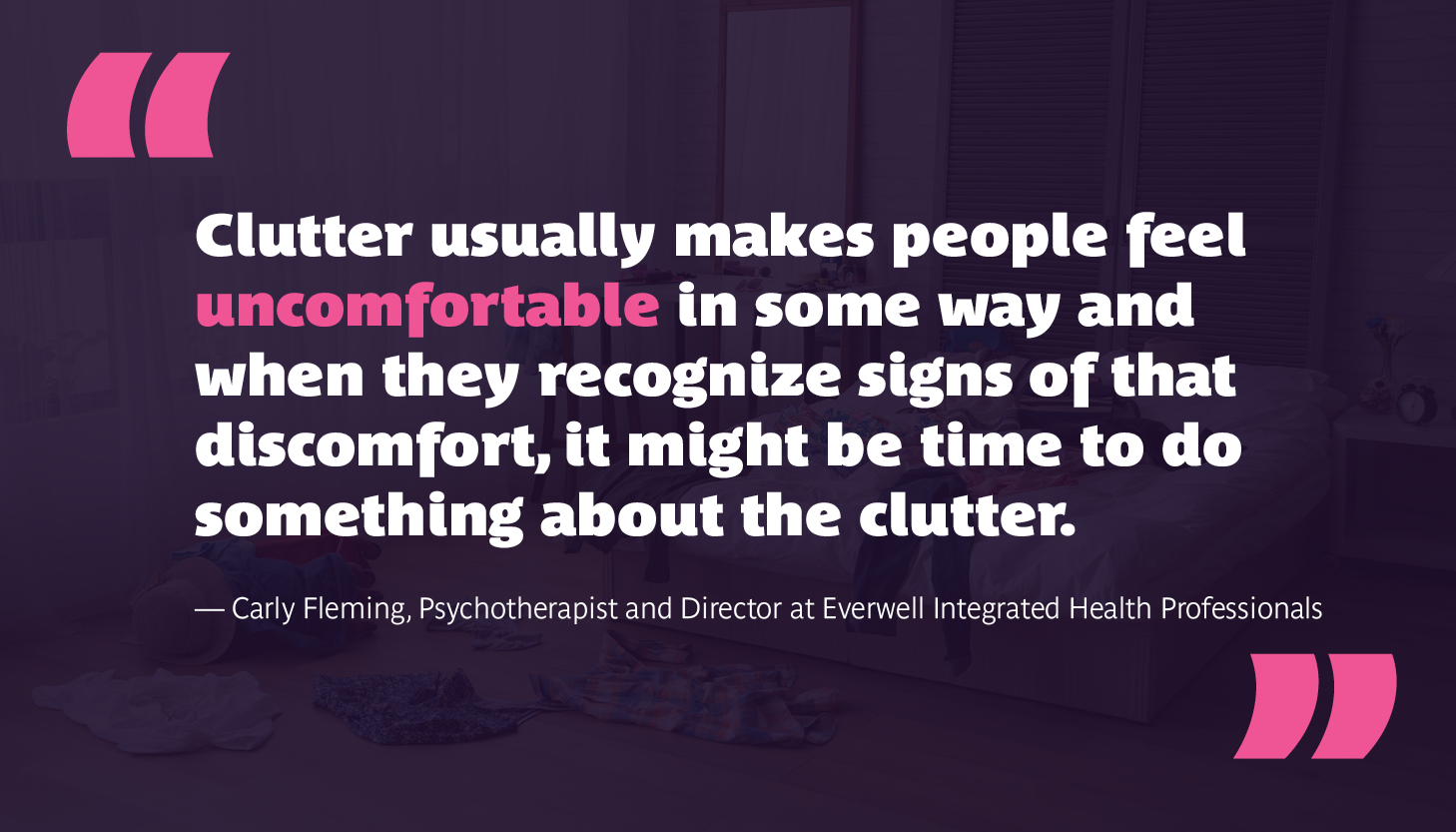
Clutter—whether physical or digital—can make people feel uncomfortable. When it does “it might be time to do something about the clutter,” says Carly Fleming, Psychotherapist and Director at Everwell Integrated Health Professionals in Hamilton, Ontario.
The relationship between clutter and mental health
While clutter can be dismissed as a problem that isn’t serious, research shows that the connection it has to our mental processes is significant. Our emotions and cognitive processing (i.e., seeing the big picture vs. getting lost in small details) can be affected by orderliness and disorderliness, as found in a study published in 2019 in PsyCh Journal.
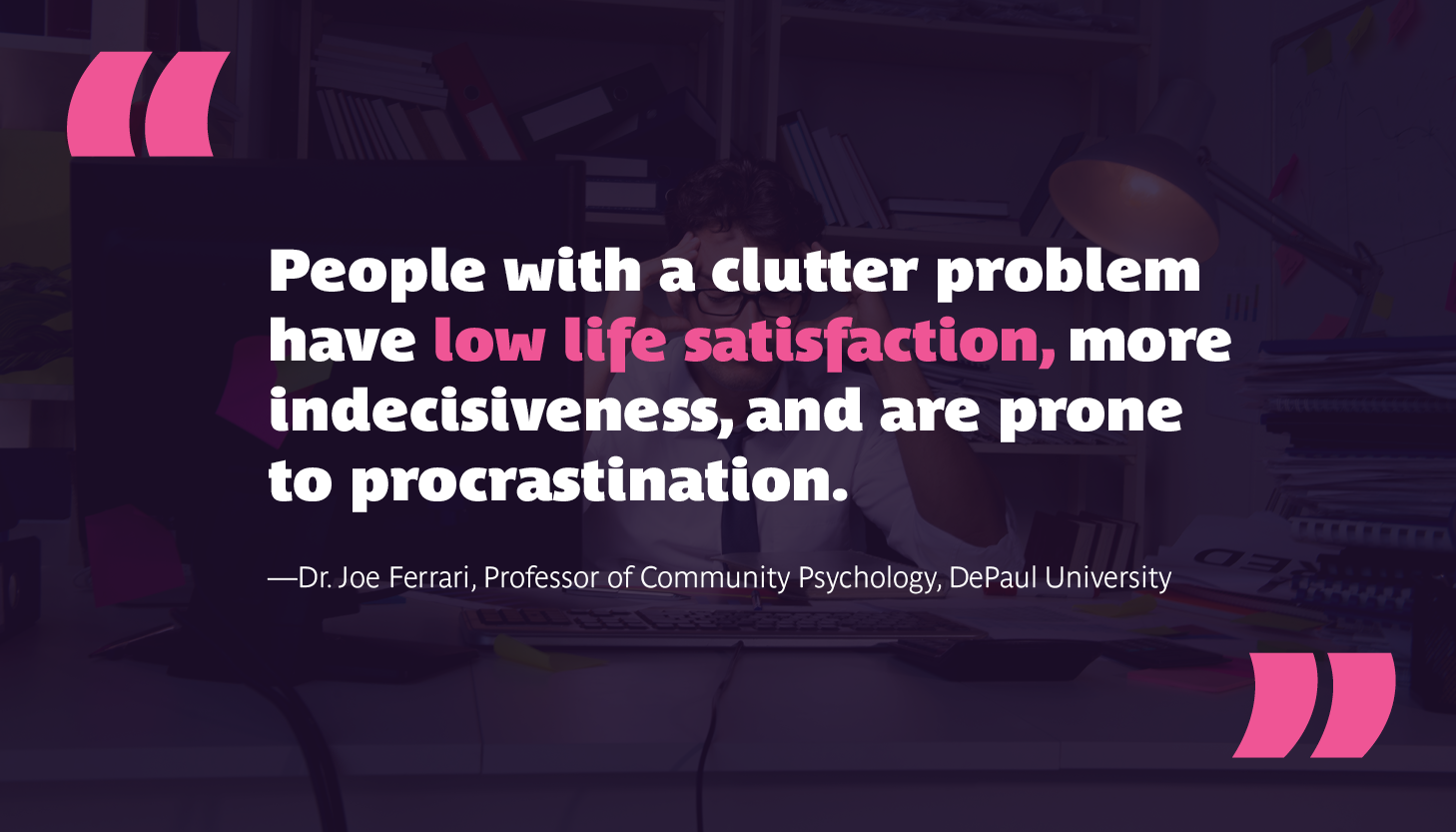
Other research indicates similar findings: For example, clutter has a negative impact on perceived well-being in one’s home, according to a 2016 study published in the Journal of Environmental Psychology. Put more simply, “People with a clutter problem have low life satisfaction, more indecisiveness, and are prone to procrastination,” says Dr. Joe Ferrari, Professor of Community Psychology at DePaul.
And that difficulty with making decisions (such as what to throw out, donate, or keep) can make the clutter cycle harder to break. “What we’ve figured out is that indecision or decision anxiety contributes to someone’s inability to declutter their spaces,” says Swanson. This self-perpetuating cycle means clutter can continue to accumulate, even when you don’t want it to.
Taking decluttering from theory to practise
Decluttering might seem like an insurmountable task when you have a million other things on your plate and don’t know where to begin. But like all things, the best way to tackle any problem is to just get started. Use these tips to restore some order to your space.
Figure out your “why”
“You have to know why you want to declutter,” says Swanson. “Knowing the core ‘why’ helps get you through the tough times.”
There are plenty of reasons why someone might want to tackle the clutter in their space:
“A cleaner environment helps me focus better.”
—Kirsten G., second-year student, Mount Royal University, Calgary, Alberta
“I declutter whenever people visit, or just whenever I feel good and have free time.”
—Conlan C., senior, Metropolitan State University of Denver, Colorado
“I like to know where my stuff is at.”
—Christopher A., graduate student, University of the Pacific, Stockton, California
Personally, decluttering helps me manage my anxiety around all the things I can’t control in the rest of the world. When I’m exposed to a lot of digital clutter from news and social media about situations I can’t help fix, organizing my space reminds me to focus on the small things I can control.
“Most post-secondary students don’t live alone so their own relationship to clutter isn’t the only thing they need to consider,” says Fleming. “I would recommend that they spend a bit of time talking with the people they live with about what their preferences for order, organization, and cleanliness are. Once everyone has a good sense of the other people’s preferences, they can work together to create a plan that is a compromise for everyone.”
Establish a support system
“I would recommend people seek a supportive environment,” says Swanson. Talk to friends, neighbours, or your roommate and team up to dedicate some time each week to declutter. Knowing that you’re not going at it alone is helpful, especially since there can be stigma around having a cluttered space. Plus, having accountability will encourage you to declutter, even when you don’t want to.
Choose a starting point
The only place to start is at the beginning, but when it comes to decluttering, that starting point can be difficult to find. “The first step to decluttering is deciding which areas of your home have the most clutter—places where you know have been keeping more items than you have space for,” says Patel. “For myself, the method that works the best is to pick one small area to focus on, like a cabinet, closet, or a few drawers.”
This could also be a particular surface you want to clear off (e.g., your desk) or a category of items (e.g., your clothes). When I’m focused on spring cleaning, I like to start with seasonal things that I’m putting away for the winter. It’s easy to move clutter around by tossing it into a box for nine months, but when it’s time to unpack, I find myself overwhelmed all over again. In other words: I remind myself that it’s better to put things away in an organized fashion so that I can focus on the fun of unpacking holiday decorations next year!

Organize first
Dr. Ferrari works with the Institute for Challenging Disorganization (ICD), which recommends people start with organization. This can be literally everything, but often it’s easier to start with a specific category, like clothes or books or video games. Once it’s all laid out, don’t touch the things you’re trying to get rid of: “Consumer psychologists have found that if you go to the store and touch something, you’re more likely to buy it,” says Dr. Ferrari. “Declutter coaches say the same thing. You need someone else to hold things up and ask, ‘Do you need this?’”
When thinking about what to keep and what to part with, considering necessities versus wants can be a good place to start. You do need clothes, but are 15 cardigans really necessary? If the answer is no, acknowledge that as a place you can cut back.
Take breaks
“Burning out is common for folks who take on too much, so pacing yourself is key,” says Patel. “Reward yourself at every step to build up that positive feedback loop and motivate yourself to keep going.”
Small rewards could be pausing to read a few pages of a book, going on a walk with a friend or pet, or even just vocalizing to yourself that you’ve done a good job. Decluttering can be a tiring process, so set realistic goals for yourself and recognize the hard work you’re doing. “Start small,” says Linda Y., a freshman at Wake Technical Community College in Raleigh, North Carolina. “Something is better than nothing. Once you start, you will have more motivation to keep going.”
How decluttering helps your mental health: Centre for Addictions and Mental Health
Why decluttering is good for your body, mind and soul: Everwell Counselling
Why it pays to declutter your digital life: BBC
Article sources
Joe Ferrari, PhD, Professor of Community Psychology, DePaul University, Chicago, Illinois.
Carly Fleming, M.Ed, RP, Psychotherapist and Director, Everwell Integrated Health Professionals, Hamilton, Ontario.
Devki Patel, Graduate Student and Research Associate, DePaul University, Chicago, Illinois.
Helena Lucia Swanson, PhD Candidate in Community Psychology, DePaul University, Chicago, Illinois.
American Psychiatric Association. (n.d.). What is hoarding disorder? https://www.psychiatry.org/patients-families/hoarding-disorder/what-is-hoarding-disorder?_ga=2.245842308.1682120269.1639540606-406978377.1639540606
Festinger, L. (1957). A theory of cognitive dissonance. Stanford University Press.
Li, K., Yang, H., Wang, X., Zhang, T., et al. (2019). Seeing the forest in order and the trees in disorder: Environmental orderliness versus disorderliness affects the perceptual processing style. PsyCh Journal, 9(4), 472–489. https://doi.org/10.1002/pchj.309
McDonald, S. M. (2012). Perception: A concept analysis. International Journal of Nursing Knowledge, 23(1), 2–9. https://10.1111/j.2047-3095.2011.01198.x
Sedera, D., & Lokuge, S. (2018). Is digital hoarding a mental disorder? Development of a construct for digital hoarding for future IS research. Association for Information Systems. https://aisel.aisnet.org/icis2018/behavior/Presentations/27/
Tullett, A. M., Kay, A. C., & Inzlicht, M. (2014). Randomness increases self-reported anxiety and neurophysiological correlates of performance monitoring. Social Cognitive and Affective Neuroscience, 10(5), 628–635. https://doi.org/10.1093/scan/nsu097