Key points
- Using alcohol as a coping mechanism to numb emotions can sometimes lead to alcohol use disorder.
- The COVID-19 pandemic has increased risk factors for alcohol misuse (e.g., anxiety, loneliness, stress, depression).
- There are a variety of coping strategies to help deal with difficult emotions that don’t involve alcohol.
Note: The legal drinking age is 21.
Life can be tough—especially for those dealing with trauma, mental illness, loneliness, anxiety, or stress—and it’s not uncommon for alcohol to become a tool for numbing negative feelings. In a recent CampusWell survey, one in four student respondents said they have used alcohol to reduce stress.
“For some people, alcohol is just part of social occasions,” says Dr. Laura Hill, prevention researcher, professor of human development, and senior vice provost at Washington State University in Pullman. “For others, it’s a coping mechanism that can actually create new problems.”
The COVID-19 pandemic hasn’t helped, either. Drinking rates have risen as people try to navigate the uncertainty of our new world.
“My alcohol consumption skyrocketed during the pandemic,” says Alice W.*, a fifth-year graduate student at Portland State University, Oregon. “I’m currently taking a break from alcohol.”
Using alcohol as an avoidant coping strategy
“An avoidant coping strategy is anything someone does to avoid uncomfortable situations or emotions,” says Dr. Hill. “That could actually be a good thing—for example, avoiding political talk with certain friends or family to avoid conflict is a useful strategy. But avoiding [our emotions] does not help us resolve the underlying problem.”
Some emotions and issues that might make some people more likely to use alcohol as a coping strategy include:
- Isolation and loneliness
- Stress
- Worry or fear
- Unresolved trauma
- Boredom
- Anger
- Frustration
- Depression
As noted, the COVID-19 pandemic has only increased the prevalence of the negative emotions listed above. Research shows that time spent isolated at home has led to increased stress, depression, and anxiety on a global scale. What’s more, cutting back on social gatherings didn’t necessarily equate to cutting back on alcohol consumption during the pandemic. In a survey conducted by the Canadian Centre on Substance Use and Addiction, one in five respondents reported that their alcohol use has increased since the start of the pandemic. Another major survey of US adults noted a 14 percent increase in alcohol consumption overall since the start of the pandemic.
“I used to only drink with friends, but when we were quarantined due to the pandemic, it didn’t feel weird to drink alone,” says Julian F.*, a recent graduate from University of California, Los Angeles. “Now it’s become a habit, though, and I’ve noticed that I drink more often.”
Social isolation hasn’t been the only factor. “Housing and food insecurity, reduced employment or the loss of jobs, missed milestones, as well as the passing of loved ones has contributed to a decline in overall well-being,” says Pat Aussem, a licensed professional counselor and master addictions counselor, and associate vice president of consumer clinical content development at Partnership to End Addiction.
Consider this a time to be good to ourselves and pay extra attention to self-care and healthy habits.
How can you tell if you’re drinking too much?
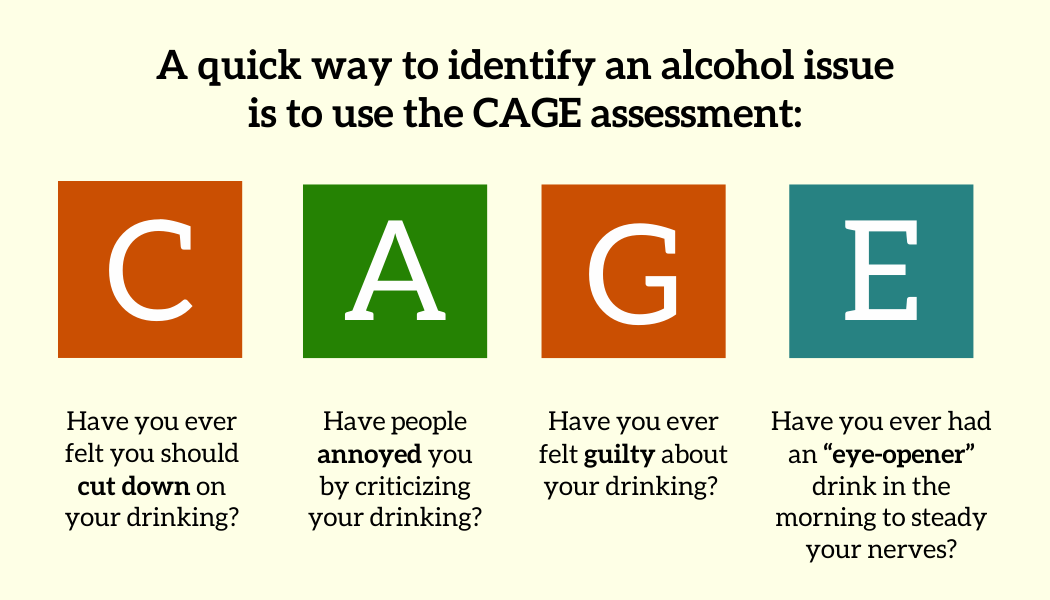
According to Aussem, a quick way to identify an alcohol issue is to use the CAGE assessment:
C. Have you ever felt you should cut down on your drinking?
A. Have people annoyed you by criticizing your drinking?
G. Have you ever felt guilty about your drinking?
E. Have you ever had an “eye-opener” drink first thing in the morning to steady your nerves or to get rid of a hangover?
Answering “yes” to one or more of these questions is a heads-up that you might need to schedule a session with a substance use counselor or therapist. Check in with yourself honestly and ask:
- Does my social life revolve around alcohol?
- Am I relying on alcohol to feel more confident or be able to express myself?
- Have I been missing commitments (work, class, or social plans with family and friends) due to hangovers?
- Is my physical or mental health suffering?
What to do if alcohol is an issue
If you’re drinking to tune out negative emotions, it’s time to learn some healthy coping strategies. Without these, you’re likely to fall back into the same pattern of alcohol misuse. One 2020 study of a small group of young adults who were undergoing treatment for anxiety and mood disorders showed that using positive coping skills helped reduce their alcohol use on days when they reported being in a bad mood.
Below are just some examples of healthy coping strategies, but the list is almost endless. Just be cautious of anything that could become harmful, like shopping (if you’re blowing your budget) or video games (if you’re spending more time in virtual reality than in real life).
Healthy coping strategies

- Talking with someone you trust
- Going for a walk (alone or with a friend)
- Exercising or playing a sport
- Taking a bath
- Playing with a pet
- Journaling or jotting down your thoughts
- Playing an instrument
- Making some art
- Creating a music playlist
- Reading a book or watching a movie
- Doing a breathing exercise or meditation
- Volunteering or doing something thoughtful for someone else
Small changes for a big impact
If cutting out alcohol cold turkey seems overwhelming or next to impossible, start with smaller goals and consider reaching out to a friend, family member, or other loved one to support you along the way. “Some people take a 30-day abstinence challenge and, if they’re successful, slowly reintroduce alcohol back into their lives,” says Aussem. “If the person isn’t successful, it may mean that it’s time to take a closer look at the role alcohol plays in the person’s life.”
Being sober curious means questioning what your lifestyle might look like if you cut out alcohol—and there are plenty of tips for doing so, whether temporarily or permanently. Who knows? When you get a taste of the benefits—like better sleep, physical and mental health, academic performance, relationships, and more—you might just decide that cutting down on alcohol (or even nixing it completely) isn’t so impossible after all.
National hotline: Substance Abuse and Mental Health Services Administration
11 ways to curb your drinking: Harvard Health
Article sources
Pat Aussem, licensed professional counselor (LPC), master addictions counselor (MAC), associate vice president of consumer clinical content development, Partnership to End Addiction, Morristown, New Jersey.
Laura Hill, PhD, prevention researcher, professor of human development, and senior vice provost, Washington State University, Pullman, Washington.
CampusWell survey, December 2021.
Cook, M. A., Newins, A. R., & Dvorak, R. D. (2020). Coping motivated alcohol use: The role of social anxiety and dissociation. Substance Use & Misuse, 56(2), 275–285. https://doi.org/10.1080/10826084.2020.1861630
Helle, A. C., Watts, A. L., Trull, T. J., & Sher, K. J. (2019). Alcohol use disorder and antisocial and borderline personality disorders. Alcohol Research: Current Reviews, 40(1), arcr.v40.1.05. https://doi.org/10.35946/arcr.v40.1.05
Huff, C. (2021, January 1). Drinking, coping and COVID-19. American Psychological Association. https://www.apa.org/monitor/2021/01/alcohol-covid
Kristofferson, M. (2021, August 4). Stressed out and locked-down during pandemic, New Yorkers craved alcohol, YSPH study finds. Yale School of Public Health. https://ysph.yale.edu/news-article/stressed-out-and-locked-down-during-pandemic-new-yorkers-craved-alcohol-ysph-study-finds/
Omnibus Research. (2020, May). Boredom and stress drives increased alcohol consumption during COVID-19: Nanos poll summary report. Canadian Centre on Substance Use and Addiction. https://www.ccsa.ca/boredom-and-stress-drives-increased-alcohol-consumption-during-covid-19-nanos-poll-summary-report
Opara, I., Malik, S., Lardier, D. T., Gamble-George, J., et al. (2021). Alcohol use cravings as a mediator between associated risk factors on increased alcohol use among youth adults in New York during the COVID-19 pandemic. Alcoholism Treatment Quarterly, 39(4), 415–429. https://doi.org/10.1080/07347324.2021.1950091
Pollard, M. S., Tucker, J. S., & Green, H. D. (2020). Changes in adult alcohol use and consequences during the COVID-19 pandemic in the US. JAMA Network Open, 3(9). https://doi.org/10.1001/jamanetworkopen.2020.22942
Ryan, B. E., Colthurst, T., & Segars, L. B. (2009). College alcohol risk assessment guide: Environmental approaches to prevention. Higher Education Center for Alcohol and Other Drug Prevention, Education Development Center. https://files.eric.ed.gov/fulltext/ED514315.pdf
Shah, S. M., Mohammad, D., Qureshi, M. F., Abbas, M. Z., et al. (2020). Prevalence, psychological responses, and associated correlates of depression, anxiety, and stress in a global population, during the coronavirus disease (covid-19) pandemic. Community Mental Health Journal, 57(1), 101–110. https://doi.org/10.1007/s10597-020-00728-y
Spear, L. P. (2015). Adolescent alcohol exposure: Are there separable vulnerable periods within adolescence? Physiology & Behavior, 148, 122–130. https://doi.org/10.1016/j.physbeh.2015.01.027
Steffen, J., Schlichtiger, J., Huber, B. C., & Brunner, S. (2021). Altered alcohol consumption during COVID-19 pandemic lockdown. Nutrition Journal, 20(1). https://doi.org/10.1186/s12937-021-00699-0
Stevenson, B. L., Blevins, C. E., Marsh, E., Feltus, S., et al. (2020). An ecological momentary assessment of mood, coping, and alcohol use among emerging adults in psychiatric treatment. American Journal of Drug and Alcohol Abuse, 46(5), 651–658. https://doi.org/10.1080/00952990.2020.1783672
Zozobrado, M. (2021, September 27). Why being “sober curious” is the latest self-care trend. CampusWell. https://www.campuswell.com/sober-curious-benefits/#1626890521121-6feba033-b313