
Rate this article and enter to win
The pings of social media. The buzz of a text. The nearby conversation of strangers or the mental chatter of your own mind. Distractions are everywhere and take countless forms. As a result, focusing on schoolwork—or any task—can feel like an uphill battle. However, the ability to concentrate is a skill and, just like with playing a sport or learning an instrument, focus can be strengthened with practice.
How meditating can strengthen your focus “muscle”
 During meditation, we give the mind an opportunity to settle by focusing on the breath. The breath becomes an anchor or focal point for attention. Inevitably, the mind will wander. Thoughts may try to rehash the past, rehearse for the future, or convince you to tackle a to-do list. That’s OK. That’s normal.
Every time the mind pulls you toward a distraction is a chance to practice focus. Whenever you notice that you’ve become distracted, you can gently return to the breath. Even if you are distracted one thousand times, those are one thousand opportunities to strengthen the focus “muscle.”
Meditations that cultivate focus can include any number of anchors for attention, such as a feeling in the body, a sound in the room, or even an object like a candle. However, the breath is a popular focal point because it is free, requires no equipment, and is always with you—whether you are in class, on vacation, or at the grocery store.
The science behind breathwork
Controlled breathing, as we will practice in this meditation, can enhance relaxation and focus. In an analysis of studies on this topic, researchers found that slow, controlled breathing is linked to increased comfort, relaxation, and alertness. In addition, researchers who examined the effects of deep breathing (also known as diaphragmatic or “belly” breathing) found that adult participants coached in deep breathing exercises over a period of eight weeks experienced a decrease in the stress hormone cortisol and a significant improvement in sustained attention.
4-7-8 breath guided meditation
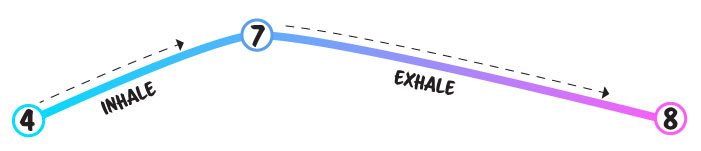
This meditation will guide you through a controlled breathing practice called the 4-7-8 breath. This technique uses a deep inhale as we count to four, a pause or hold of the breath as we count to seven, and a longer, slower exhale as we count to eight. We will repeat this pattern four times. Whenever you become distracted during the meditation, simply return to the breath and the counting.
To begin, find a quiet and comfortable place to sit for a few minutes without interruptions. Try sitting upright, with your back straight, hands resting comfortably, and your eyes closed. During the meditation, if the 4-7-8 pattern feels uncomfortable, feel free to modify the count. The 4-7-8 ratio is more important to the process than the exact number of seconds. When practiced over time, this controlled breathing meditation can promote focus, as well as relaxation—perfect for use before a study session or exam.
[ Music ]
Hello, and welcome to this meditation where we will be practicing the 4-7-8 breath for focus and relaxation.
I will be guiding you through the practice where we will be inhaling for a count of four, holding the breath for a count of seven, and exhaling for a count of eight.
If at any point during the meditation, your mind wanders away from the breath and the counting, that’s absolutely fine. That’s what minds do. Simply invite yourself back to the sound of my voice and back to the counting.
Similarly, if the count of 4-7-8 is uncomfortable for you, if you can’t tolerate the 4-7-8 count, feel free to adjust the count to a comfortable ratio.
[ Pause ]
Let’s begin by finding a comfortable posture.
See if you can sit with a straight spine and a soft front.
Allow your hands to rest in a comfortable position.
And if you feel safe, allow the eyes to gently close.
Let’s begin by gathering the attention around the breath and taking a few deep breaths. Inhaling, fully filling up the lungs.
[ Pause ]
And a long, smooth exhale.
[ Pause ]
And just a couple of more times like that.
Inhaling.
[ Pause ]
And a longer, slower exhale, allowing the muscles of the face to relax and be at ease.
[ Pause ]
And then when you’re ready, just releasing the control of the breath.
Allow the breath to fall back into its very own rhythm.
Your breath knows exactly how to breathe you, letting it settle.
And as the breath begins to settle, we can invite all of the muscles of the face to soften, unclenching the jaw.
Relaxing the muscles of the forehead.
[ Pause ]
Softening the corners of the eyes.
[ Pause ]
Letting go any tension in the neck and the shoulders.
[ Pause ]
Seeing if the shoulders can drop away just a bit more from the ears.
[ Pause ]
Softening the hands —
[ Pause ]
— and relaxing the belly.
[ Pause ]
Allowing the waistline to expand just a bit more as you exhale.
[ Music ]
Taking a moment now to tune in to your natural breath.
[ Pause ]
Where do you feel your breath most distinctly?
[ Pause ]
Perhaps it’s the rising and falling of the belly.
[ Pause ]
Maybe you feel it at the chest.
[ Pause ]
Or a tickle of air under the nose.
Just taking a moment to tune in to your natural breath.
If any thoughts arise, any distractions, that’s OK.
Just invite your attention back to your breath.
[ Pause ]
Just like you’re guiding a small child or friend in need.
With care, with kindness, returning to the breath.
[ Pause ]
And now I’ll begin to guide you into the breathing practice.
So begin with a very full exhale.
[ Pause ]
Releasing every drop of air.
[ Pause ]
And then let’s begin with an inhale. Two, three, four, hold.
Two, three, four, five, six, seven, exhale. Two, three, four, five, six, seven, eight, inhale.
Two, three, four, hold. Two, three, four, five, six, seven, exhale
Two, three, four, five, six, seven, eight, inhale.
Two, three, four, hold. Two, three, four, five, six, seven, exhale.
Two, three, four, five, six, seven, eight, inhale. Two, three, four, hold.
Two, three, four, five, six, seven, exhale. Two, three, four, five, six, seven, eight, inhale.
Hold.
[ Pause ]
Exhale.
[ Pause ]
Inhale.
[ Pause ]
Continuing at your own pace.
[ Pause ]
And take one more of 4-7-8 breath. And after the next cycle, just letting your breath settle into its own rhythm.
[ Music ]
And taking a few more moments to feel the breath as it naturally is without manipulating it or changing it.
[ Pause ]
And when the mind wanders, just bringing it back. The magic is in the return, returning to the breath.
[ Music ]
And as we move toward the end of the meditation, taking your time to exit by feeling the weight of the body.
Noticing the touchpoints with the surface beneath you.
Where your feet contact the floor.
[ Pause ]
Noticing the weight of your sit bones.
[ Pause ]
Feeling the texture of the clothing on your skin.
Perhaps noticing there are different temperatures around the body.
Is there a coolness of air on your face?
[ Pause ]
Beginning to invite a little bit of movement back into the body.
Flexing the toes, wiggling the fingers.
[ Pause ]
And then at the sound of the bells, beginning to blink the eyes open.
[ Pause ]
[ Bell Rings ]
[ Music ]
[ Bell Rings ]
[ Music ]
Thank you for your practice today. Have a wonderful day.
GET HELP OR FIND OUT MORE
App with simple and straightforward free guided meditations: Headspace
App with thousands of free meditations in a variety of styles: Insight Timer
Suggestions and descriptions of controlled breathing practices: Dr. Weil
25 mindfulness-based stress reduction exercises: Positive Psychology
Article sources
Ma, X., Yue, Z. Q., Gong, Z. Q., Zhang, H., et al. (2017). The effect of diaphragmatic breathing on attention, negative affect and stress in healthy adults. Frontiers in Psychology, 8, 874. https://doi.org/10.3389/fpsyg.2017.00874
Zaccaro, A., Piarulli, A., Laurino, M., Garbella, E., et al. (2018). How breath-control can change your life: A systematic review on psycho-physiological correlates of slow breathing. Frontiers in Human Neuroscience, 12, 353. https://doi.org/10.3389/fnhum.2018.00353