
Rate this article and enter to win
When it comes to goals, setting them sounds way easier than achieving them—saying you’re going to start meal prepping healthy lunches every Sunday is a snap compared to actually putting in the time in the kitchen. In a CampusWell survey, 41 percent of students said not having enough time was the number one thing keeping them from achieving their goals.
Research shows that how you set your goals makes a huge difference in the likelihood that you’ll actually accomplish them. “For goals to be effective, they should be well-defined, as specific as possible, and generally quantifiable,” says Franklin Porter, PhD, a psychologist in New York.
If you don’t set goals in a way that’s realistic or achievable, Dr. Porter says, they can backfire. For example, setting out to run a marathon in a month when you’ve never run longer than a 5K will probably end in you feeling frustrated and disappointed (and sore). “If a goal is set that the individual cannot reasonably attain, there is the risk that the failure would make one feel bad or worse about oneself, and diminish motivation to continue striving to meet the goal,” Porter says. Frustrated with the failure, you might be tempted to swear off running for good.
That doesn’t mean you have to set the bar low. You can (and should!) still set big goals; you just need to go about it the right way. Use the following method to set—and accomplish—powerful goals.
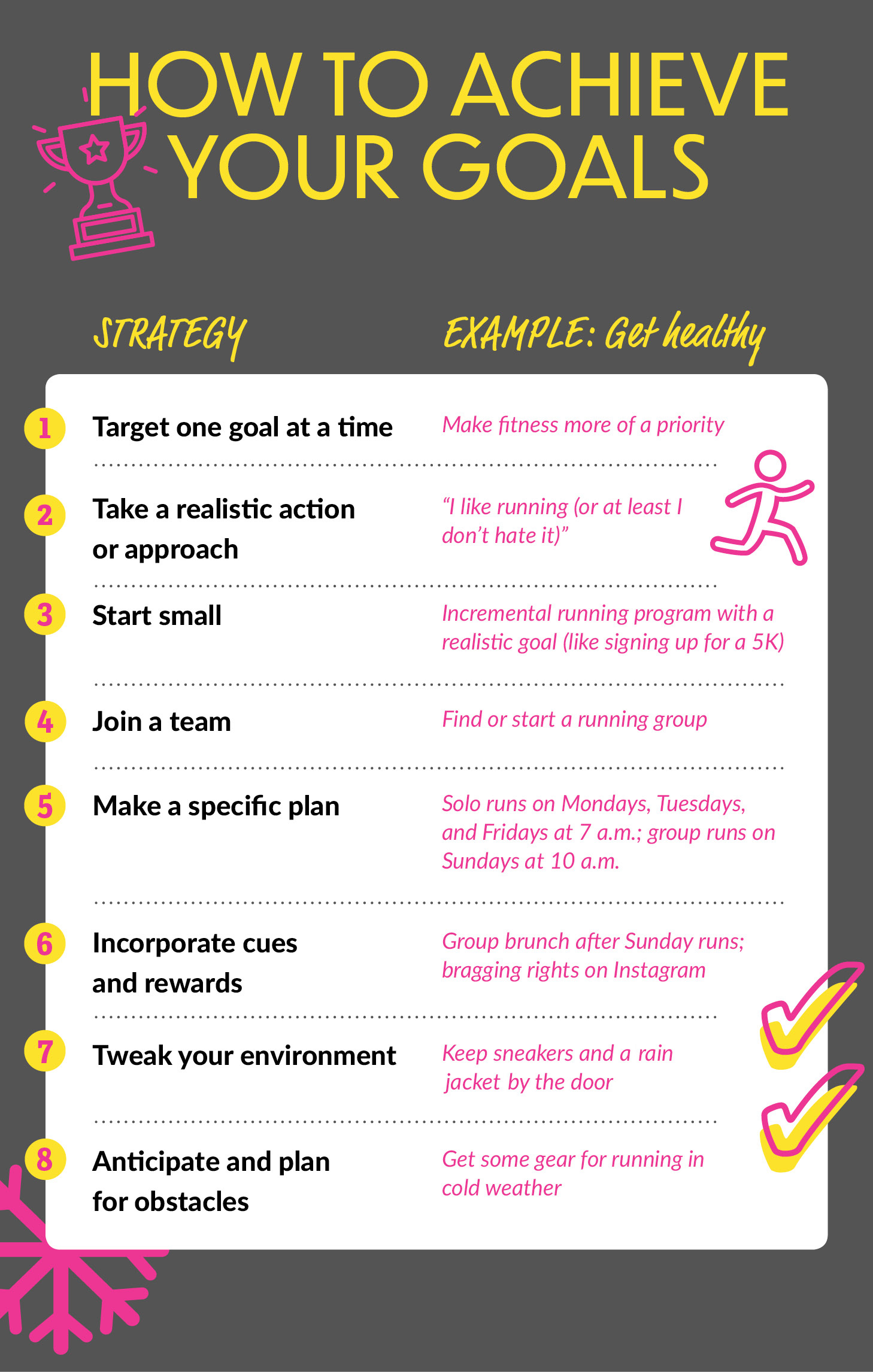
Example goal: Get healthier
Strategy: Target one goal at a time
Example: Make fitness more of a priority
Strategy: Take a realistic action or approach
Example: I like running (or at least I don’t hate it)
Strategy: Start small
Example: Incremental running program with a realistic goal (like signing up for a 5K)
Strategy: Join a team
Example: Find or start a running group
Strategy: Make a specific plan
Example: Solo runs on Mondays, Tuesdays, and Fridays at 7 a.m.; group runs on Sundays at 10 a.m.
Strategy: Incorporate cues and rewards
Example: Group brunch after Sunday runs; bragging rights on Instagram
Strategy: Tweak your environment
Example: Keep sneakers and a rain jacket by the door
Strategy: Anticipate and plan for obstacles
Example: Get some gear for running in cold weather
The science of goals: CampusWell
Make your goals smart: California Business Journal
Golden rules of goal setting: MindTools
Unlock your full potential: The ultimate guide to setting and achieving life goals: Goalcast
Article sources
Khinlei Myint-U, MBA, product director for patient engagement, Iora Health, Boston, Massachusetts.
Franklin Porter, PhD, psychologist and psychotherapist, New York City.
Ashraf, N., Karlan, D., & Yin, W. (2006). Tying Odysseus to the mast: Evidence from a commitment savings product in the Philippines. Quarterly Journal of Economics, 121(2), 635–672.
Ayres, I. (2010). Carrots and sticks: Unlock the power of incentives to get things done. New York City, New York: Bantam.
Crombie, A., Ilich, J. Z., Dulton, G. R., Panton, L. B., et al. (2009). The freshman weight gain phenomenon revisited. Nutritional Review, 67(2), 83–94.
Dzewaltowski, D. A., Estabrooks, P. A., & Glasgow, R. E. (2004). The future of physical activity behavior change research: What is needed to improve translation of research into health promotion practice? Exercise and Sport Sciences Reviews, 32(2), 57–63.
EdX. (2014). Unlocking the immunity to change: A new approach to personal improvement. Retrieved from https://www.edx.org/course/harvardx/harvardx-gse1x-unlocking-immunity-change-940#.Uz4iXFctaaU
Kang, J., Ciecierski, C. G., Malin, E. L., Carroll, A. J., et al. (2014). A latent class analysis of cancer risk behaviors among US college students. Preventive Medicine, 64, 121–125.
CampusWell surveys, June 2014, November 2016, and January 2020.