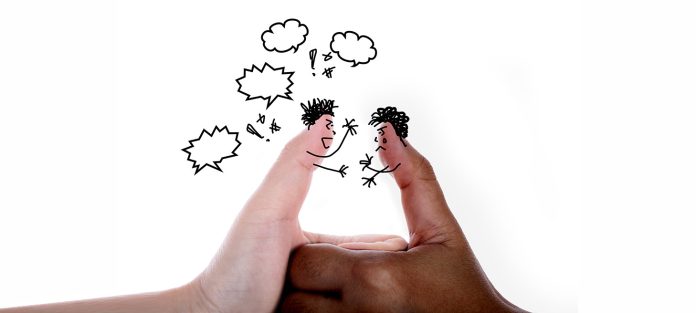
In recent years, it’s become more commonplace to call out blatantly racist, homophobic, sexist, or otherwise prejudiced comments and actions against historically marginalized communities. But when these words or actions are less overt, they can be harder to spot and are therefore more difficult to correct. These smaller and often-overlooked moments of prejudice are called microaggressions.
“Microaggressions are these everyday verbal and nonverbal digs,” says Joi Thailoan Ngo Torres, an inclusion manager who has been exploring microaggressions and how they’re connected to other forms of biases for the last 15 years. These flippant comments (e.g., asking an American-born person of color, “What country are you from?”) may seem harmless, but when an individual repeatedly experiences small taunts aimed at their identity (both in their everyday interactions and in the media), it can have a detrimental effect on their mental and physical health.
Here’s what a microaggression can look like:
 “I look white, so I’m often told I ‘don’t look Mexican,’ which feels very dismissive of my culture and heritage.”
—Beatriz S., third-year graduate student, Johns Hopkins University in Maryland
“I’ve definitely been targeted as an Asian in terms of being [called] ‘exotic’ and my foods being [called] ‘weird.’”
—Sasha J.*, fourth-year undergraduate, University of Rhode Island
“As a female in STEM, I have [been] told, ‘You only got this job because you’re a girl.’ Even when they’re joking, it is still very frustrating.”
—Audrey R.*, a fifth-year student at Queen’s University at Kingston in Canada
Other common microaggressions include:
 Asking to touch or making unprompted comments about a Black or African American person’s hair.
- Repeatedly misgendering a trans or gender-nonconforming person.
- Telling a person of color, “You’re so articulate,” which implies people of color are not well-spoken.
- Making or laughing at a joke that reinforces religious, racial, gender, and other identity stereotypes.
As uncomfortable as microaggressions can be in the moment, calling them out when they happen isn’t easy. It’s not always worth your time or mental energy, but there may be situations when it feels important. Here are some steps to consider when deciding whether a microaggression is worth responding to.
How to address microaggressions
In A Guide to Responding to Microaggressions, Dr. Kevin Nadal, a professor who studies microaggressions at John Jay College of Criminal Justice in New York City, outlines three steps to take before reacting to a microaggression: Determine what the microaggression is, whether it’s worth responding to, and (if so) how you will do so.

Because microaggressions are often subtle in nature, they can be difficult to identify in the moment. You may notice it by a gut feeling that something isn’t right, or by the way others react. If you’re unsure, you can recount the situation to a trusted friend or family member for insight.
Of course, you may want to address the microaggression right away, without asking others’ perspectives. If that’s the case, ask yourself: Should I respond to this microaggression?

In an ideal world, every injustice would receive a quick and proper response. However, our world is far from perfect, and we as humans don’t have the capacity to address each and every microaggression we witness or experience.
Not responding can be due to a number of reasons. Doing so may put you (or your job/role) in danger, or perhaps you value this person and are worried about straining the relationship. There are a number of reasons you might pause before speaking up; the important takeaway is that not engaging is a valid response. It’s OK and encouraged to prioritize your safety and well-being.
Conversely, consider whether you’re OK with not responding. If you let the comment slide, will it continue to take up space in your mind? Does it feel like you’re compromising your standards? If so, it might be worth it to speak up. Only you can make that decision.

When you decide to respond, think about how you’ll go about it. Here are some options:
Ask for clarification
“Asking ‘What did you mean when you said that?’ or saying ‘Help me understand what makes you say that’ are helpful responses when you are in a space to lead with curiosity,” says Torres.
Empathize, then explain how you learned better
“I used to think the same thing, but then I learned…” is a gentle way to let them know you understand where they’re coming from while simultaneously encouraging them to change their thinking.
Be direct and tell them how it made you feel
Using “I” statements (e.g., “I felt hurt by what you said”) instead of accusing the person might help the conversation go more smoothly. However, there’s no guarantee they’ll be receptive. Keep this in mind if you choose to engage openly with the person.
In a group setting, pose other possibilities
“When offensive or harmful language is being used in a group, you can say something like, ‘I suggest we use this word instead,’” says Torres. Worried someone will be upset and feel called out? Tack on “This term is more inclusive and caring and compassionate than that term,” she adds.
All of the above options involve expending mental energy and, understandably, victims of microaggressions don’t always want to do that. For a less direct engagement that doesn’t require conversation, send them an article on microaggressions. They can read it at their leisure, you can provide as much context as you’d like, and if it’s done virtually, that can provide some much-needed distance.
“I didn’t mean it like that!”
If you point out a microaggression as being problematic, people will often respond quickly with something along the lines of “I didn’t mean it like that.” The challenge with microaggressions is that there’s a good chance they’re telling the truth, and they really didn’t mean it to be harmful—but that doesn’t stop the damage.
“No matter the intention, [microaggressions] communicate a negative notion based on a person’s actual or perceived identity,” says Torres.
People who use microaggressions thoughtlessly will often insist that a lack of awareness means an equal lack of damage toward the target, but that simply isn’t the case. As students shared in our survey, even “jokes” are hurtful.
“It’s not that big of a deal; you’re overreacting.”
Actually, it is a big deal, and people aren’t overreacting when they point out or respond to microaggressions. A 2020 study published in the journal Cultural Diversity & Ethnic Minority Psychology found that young adult study participants who experienced frequent ethnic microaggressions showed a blunted cortisol response, which is associated with worsened mental and physical health.
A 2019 review of multiple studies described the impact microaggressions can have on those who experience them, including a higher risk of low self-esteem, substance use, and suicide. In a small 2011 study, participants who identified as LGBTQ reported feeling unsafe, sad, and embarrassed after experiencing both direct and indirect microaggressions.
The research is clear that microaggressions carry serious adverse effects. More importantly, people in historically marginalized communities have been living with these negative consequences for years. At the end of the day, it comes down to listening to underserved communities. When they say they’re hurting, believe them.

What if the conversation doesn’t go well?
It would be lovely if every time someone was called out for a microaggression, they acknowledged their wrongdoing, apologized, and everyone learned and grew from the experience.
Realistically, we know that’s not how life works. So what can you do when you’re trying to address a microaggression, but the situation is escalating? “If you are close and you do have a relationship, it might be important to say, ‘Look, I feel like we’re both getting really emotionally charged right now…so maybe we need to table this and talk another time,’” said Dr. Nadal in an NPR interview.
Another tip? “Ask yourself, ‘What am I looking for from this interaction?’” says Torres. “‘Do I want these microaggressions to stop? Do I want to make this person look bad? And is what I’m looking for a fair resolution to expect right now?’” Knowing what result you want can guide how you engage, whether it’s responding or simply walking away.
Additionally, think about whether or not you’re the right person to address the microaggression. “If you’re tired, if you’re trying to protect yourself, or if you just don’t want to engage, there are sometimes other people who are better to do the heavy lifting,” says Torres. “That’s when you tap in an ally.”
Finally, “Sometimes you can literally just not answer the question they asked,” she says. “You can answer the question you want to answer, or say, ‘None of your business.’ You don’t have to feel trapped by someone else’s assumptions.”

It’s important that victims of microaggressions seek support after the incident. Whether calling it out in the moment or circling back to something that was said a few days prior, “Always be aware of yourself and your mental health when having these conversations,” says Dr. Nadal. “If you’re a person of a historically marginalized group, we want you to be alive and we want you to be healthy in order to continue this fight toward justice.”
If you’ve been on the receiving end of a microaggression, reach out to people you trust for support, or check in with your school’s diversity center or ombudsperson to see what resources are available. You can also reach out to a helpline, such as the Racial Equity Support Line offered through the Lines for Life organization.
*Name changed for privacy
Interview with Kevin Nadal on microaggressions: NPR
When and how to respond to microaggressions: Harvard Business Review
Article sources
Joi Thailoan Ngo Torres, inclusion manager, Austin, Texas.
Barber, S., Gronholm, P., Ahuja, S., Rüsch, N., et al. (2020). Microaggressions towards people affected by mental health problems: A scoping review. Epidemiology and Psychiatric Sciences, 29, E82. doi:10.1017/S2045796019000763
Harrison, C., & Tanner, K. D. (2018). Language matters: Considering microaggressions in science. CBE Life Sciences Education, 17(1), fe4. https://doi.org/10.1187/cbe.18-01-0011
Lee, H., & Hicken, M. T. (2016). Death by a thousand cuts: The health implications of black respectability politics. Souls: A Critical Journal of Black Politics, Culture, and Society, 18(2-4), 421–445. https://doi.org/10.1080/10999949.2016.1230828
Limbong, A. (2020, June 9). Microaggressions are a big deal: How to talk them out and when to walk away. NPR. https://www.npr.org/2020/06/08/872371063/microaggressions-are-a-big-deal-how-to-talk-them-out-and-when-to-walk-away
Majeno, A., Urizar, G. G., Halim, M., Nguyen-Rodriguez, S. T., et al. (2021). Examining the role of ethnic microaggressions and ethnicity on cortisol responses to an acute stressor among young adults. Cultural Diversity & Ethnic Minority Psychology, 27(1), 135–144. https://doi.org/10.1037/cdp0000401
Nadal, K. L. (2014). A guide to responding to microaggressions. The City University of New York. https://advancingjustice-la.org/sites/default/files/ELAMICRO%20A_Guide_to_Responding_to_Microaggressions.pdf
Nadal, K., Wong, Y., Issa, M.-A., Meterko, V., et al. (2011). Sexual orientation microaggressions: Processes and coping mechanisms for lesbian, gay, and bisexual individuals. Journal of LGBT Issues in Counseling, 5, 21–46. doi:10.1080/15538605.2011.554606.
Williams, M. T. (2020). Microaggressions: Clarification, evidence, and impact. Perspectives on Psychological Science, 15(1), 3–26. https://doi.org/10.1177/1745691619827499
Williams, M. T. (2020). Psychology cannot afford to ignore the many harms caused by microaggressions. Perspectives on Psychological Science, 15(1), 38–43. https://doi.org/10.1177/1745691619893362
Wong, G., Derthick, A. O., David, E. J., Saw, A., et al. (2014). The what, the why, and the how: A review of racial microaggressions research in psychology. Race and Social Problems, 6(2), 181–200. https://doi.org/10.1007/s12552-013-9107-9