When you grow up as a person of color (POC) in the US, you may not understand why you’re treated differently. You are American, and you believe you deserve to experience the world the way your white neighbors do. Yet you learn from an early age that you are different, and you lose your innocence—fast.
If you are a white person in America, it’s your responsibility to learn what POC experience—to catch up on all the growing up we had to do as children. And if it makes you feel sad, overwhelmed, or like life is desperately unfair, remember that those are the feelings POC deal with every single day. You have to keep going. If you are now beginning to put in the work of anti-racism, then you’ve been lucky enough to have been shielded from the reality of others’ experiences for too long. I know my experience is just one of millions, but I would love for you to read it, digest it, ask questions, and learn. Here’s my story.
Learning I was an “other”
My first “grown-up” playdate was in kindergarten. I was excited to have made plans all by myself to hang out with my new best friend. We were in my basement, scribbling in crayon on the walls, when my friend informed me (in a matter-of-fact tone) that my grandmother scared her. I didn’t have the vocabulary to explain why this hurt me, so I replied timidly—and in my elementary innocence, I accepted her fear. But I was old enough to recognize what made my Nani scary: her foreignness.
This was the first moment I felt uncomfortable in my own skin, the first time I became aware of my otherness. My friend had unintentionally made me ashamed of the woman who raised me, a non-English speaker who dressed in a salwar kameez and a bindi. I didn’t want my friend to think my family was scary. For that reason, I didn’t want to be Indian  anymore. I stopped bringing Indian food to school for lunch. I wished my Nani would adopt the Western clothing of my more Americanized immigrant parents. My heart ached when I didn’t dare wear mehndi at weddings because it would last for too many weeks. I couldn’t come to school with my culture etched onto my skin, outing me as the outsider that I already clearly was.
When school began to fail me
In third grade, my teacher mispronounced the name of the South Asian country Bangladesh. I remember my hand shaking as I raised it to correct her. I was nervous to draw attention to my brown skin, but I was excited to share a piece of information that I held. I thought I was smart and important and that my teacher would be proud of me. So it stung when she responded, visibly irritated by my comment, “That doesn’t matter.” She was someone in a position of power, someone I respected. Not only did she speak the language of colonizers, but she held the indifference of them, too. She made me feel like I was neither smart nor important. I was not supposed to speak up or draw attention to myself. Where I came from didn’t matter. I didn’t matter.
When my culture became a trend
I internalized that idea, carrying it with me through middle school and into high school. It was around that time that Indian culture became trendy. It wasn’t just that thicker eyebrows and fuller lips (features I was self-conscious of in childhood and early adolescence) were “in.” It became trendy to visit countries where the children looked like my family—a practice known as “voluntourism,” where a group of (mostly white) students would go to nonwhite countries and do minimal work, take pictures, let the kids love them, and then abandon them. It was also then that the commercialization of yoga led to its  explosion in mainstream culture—where it was marketed to able-bodied white women who were suddenly chanting and surrounding themselves with “om” signs—enjoying the benefits while having no concept of the intense religious and cultural importance behind the philosophy and sacred sound, nor a full understanding of its South Asian roots.
Cultural appropriation was everywhere. Non-Indians were buying mandala tapestries and getting “henna” tattoos at the beach, wearing elephant pants to school, and putting money into the hands of white co-opters. While my friends got to wear my culture as a costume, I didn’t dare draw attention to my own Indianness. I would stay out of the sun, rationalizing that I looked better in the winter. I was waiting until the day I could get plastic surgery to look less Indian. Part of me believed that if I never mentioned I was Indian, no one would notice. I subconsciously thought that at some point, I’d successfully assimilate—that I’d grow up and become a white woman, because that’s all I knew womanhood to be.
Facing identity challenges in high school
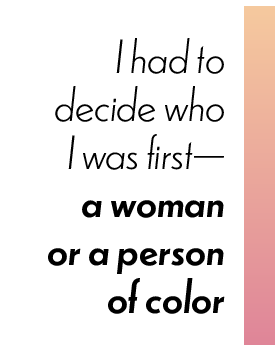 In high school, every “courageous conversation” we had about gender implicitly excluded my perspective—and this was a school that was considered feminist and progressive. While I felt so far removed from the experiences of my white peers, I had no space to receive recognition that that feeling was valid. No one asked for my perspective or experience, and it felt like a social faux pas to even bring it up. When issues that affected the intersections of my identity arose, I had to decide who I was first—a woman or a person of color—a choice I should never have had to make.
Deciding on my future and finding self-acceptance
When I was considering where to attend college, I was scared to choose Georgetown because I worried my skin would get too dark. I tan fast and it doesn’t fade, and it’s sunny in DC. But I’m grateful that I accepted. At Georgetown, I was finally in an environment where I felt I could be a woman and be brown. I met people who helped me celebrate myself and reconcile the fact that I would never be what I had once desperately hoped for: America would never look at me and consider me simply American. It took 19 years of my life to begin to acknowledge that I was Indian, to speak those words out loud to others. I began to let myself say the words I needed to say: I was let down by my education; I was let down by those I grew up around; I feel like my formative years were stolen from me. The systems that were supposed to educate me, form me, mold me, and raise me never had the space for me.
Where do we go from here?
No matter what racial or ethnic background we come from, it is our responsibility to educate ourselves on the experiences that people from marginalized groups have been dealing with their whole lives. This is something I’m working on too. Surrounding yourself with those perspectives, while centering and uplifting Black, people of color, and indigenous (BIPOC) voices, is a great way to begin this journey. Here are some tips to get you started:
How to Be an Antiracist by Ibram X. Kendi
So you want to talk about race by Ijeoma Oluo
Article sources
Aisha Tipnis, personal narrative.