
Key points
- An elevator pitch is a concise but powerful introduction highlighting your top skills and experiences to potential employers.
- Learning how to market yourself during spontaneous networking opportunities can give you a leg up in your career.
- LinkedIn can be used to deliver digital elevator pitches to contacts in your chosen industry.
You probably won’t meet a prospective employer for the first time on an elevator, but wherever it happens, you’ll likely only have a couple of minutes to make an impression. That’s just enough time for an “elevator pitch”: a concise and powerful introduction that answers some of the questions an employer might ask while also highlighting your top skills and experiences. A well-crafted elevator pitch will show the person you’re speaking to that you have something valuable to offer them or their organization.
It pays to know how to market yourself and your ideas quickly and effectively—especially if you’re about to enter the job market or preparing for graduate school. After all, you never know who you may run into or be spontaneously introduced to. Read on to learn how to master your own elevator pitch so you’ll be ready to take advantage of networking opportunities on the fly.
Components of an elevator pitch
Although the term “elevator pitch” implies that you will have a captive audience, most networking opportunities happen in places where the other person can easily disengage (like in the hallway during a school open house, at a busy job fair, or even at a social event, like a friend’s wedding reception). You’ll need to spark their interest and offer value as quickly as possible.

1. Introduction
Let the other person know who you are and that you appreciate the chance to talk.
“Hello, I’m (first and last name). It’s good to meet you (or see you again).”
2. Information
Tell them what you do or what you’re studying. Make sure what you say reveals your ability to provide them with something valuable.
“I’m a (job title/description) working in (industry/field) with a special interest in (project type of interest to your audience).”
3. Value proposition
This is the part of the elevator pitch where you “sell” yourself. What kinds of skills or experiences do you have that line up with what their organization might be looking for?
“Your project or company interests me/aligns perfectly with my expertise in (topic). I’d love to discuss it with you or your team.”
4. Call to action
What do you want right now? An interview or introduction? Express interest and suggest a next step.
“Could we make an appointment this week to discuss how I might be the right fit for the role/project?”
or
“Could we grab a coffee this week so I can ask you a few questions about the industry/company/project?”
How to create your pitch
Just as you would write a college entrance essay, start your elevator pitch with purpose. What is your main objective? What do you want your short introduction to tell the listener?
“While the content of your elevator pitch is crucial, nothing is more important than how you deliver it,” says Garen Jemian, a career coach and consultant in Montreal, Canada. “Once you’ve finished, whoever you’re talking to should like you enough to want to hire you.”
Expert tips
- The key to a great pitch is to write plenty of them. Expect to write at least 10 drafts before selecting the one you like most.
- There is no perfect formula for your elevator pitch. Allow it to evolve as you use it and learn about its impact.
- Once you’ve got a draft you like, keep cutting the fluff until each word is engaging and impactful. Keep only what they need to know about you.
- The final decisive factor in hiring is likeability. If all else is equal, a hiring manager will most likely select the candidate they liked the most. The energy and personality you exude during your pitch is just as significant.
- Confidence is key. Practice saying your pitch and refine it over time so it sounds natural. You can even ask a friend to step in and role-play, then have them provide feedback about your tone.
Tips from real students
In a recent CampusWell survey, over 33 percent of students said they’d used an elevator pitch to network. Here are their pointers.
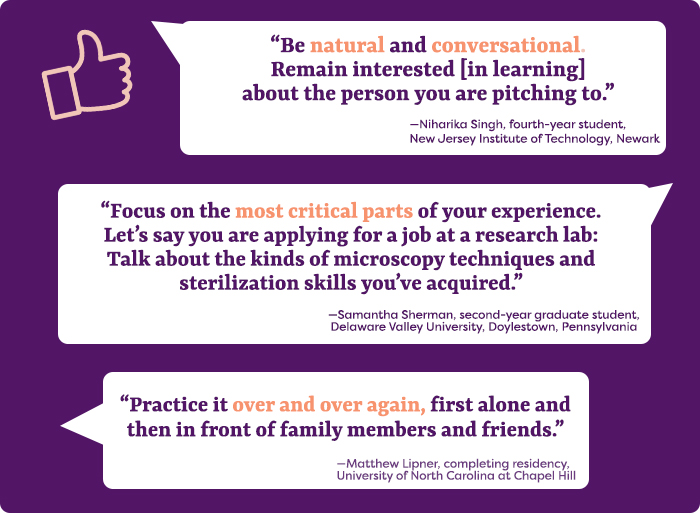
“Be natural and conversational. Remain interested [in learning] about the person you are pitching to.”
—Niharika Singh, fourth-year student, New Jersey Institute of Technology, Newark
“Focus on the most critical parts of your experience. Let’s say you are applying for a job at a research lab: Talk about the kinds of microscopy techniques and sterilization skills you’ve acquired.”
—Samantha Sherman, second-year graduate student, Delaware Valley University, Doylestown, Pennsylvania
“Practice it over and over again, first alone and then in front of family members and friends.”
—Matthew Lipner, completing residency, University of North Carolina at Chapel Hill
Overcoming jitters
Do you clam up at the very thought of networking? You aren’t alone.
“Most people I meet have a hard time selling themselves as adults, let alone as students,” says Jemian. “Start networking with people you already know and have absolutely no trouble talking to, like friends, relatives, or acquaintances. Get them to introduce you to people (virtually or in real life)—this can ‘soften the blow’ and make things easier when you’re new to networking.”
LinkedIn elevator pitches
“A great place to not only practice but begin your networking efforts is to reach out to alumni of your school on LinkedIn,” says Timothy Lo, career coach and founder of Your Next Jump in Fairfax County, Virginia. “Connect with those that are in organizations and roles that you would like to see yourself in 5, 10, or 20 years from now. Ask them if they’d be willing to let you buy them a coffee or meet with you over Zoom for 15 minutes. Don’t ask for a job, but ask them good questions about the organization and what it’s like to work in that type of environment and in that role. Come to the conversation with good questions.”
I’ve been reading a little bit about the innovations that Booz Allen Hamilton has been doing in machine learning. This article I came across was really fantastic. Could you tell me a little bit more about the company’s upcoming deep learning projects?
“Maybe only 1 or 2 people out of 10 will actually respond to your LinkedIn inquiry. But by establishing these conversations, you have essentially invited yourself to an informal interview,” says Lo. “Make sure to thank them after the meeting. You’ve now opened the door to reach out to them in the future if an interesting role opens up within their organization.”
The takeaway? Your elevator pitch may be short, but it has the potential to take your career to the next level—now and after graduation.
How to create an elevator pitch with examples: The Balance Careers.
Tips for perfecting your elevator pitch: Business News Daily.
Garen Jemian, career coach and consultant, Montreal, Canada.
Timothy Lo, career coach and founder, Your Next Jump, Fairfax County, Virginia.
How to give an elevator pitch (with examples). (n.d.). Indeed. https://www.indeed.com/career-advice/interviewing/how-to-give-an-elevator-pitch-examples
Lagorio-Chafkin, C. (2010, May 24). How to master your elevator pitch. Inc. https://www.inc.com/guides/2010/05/mastering-business-elevator-pitch.html