In high school, it felt like all I did was sit at a desk. I didn’t play any sports, and the only exercise I got was walking between home and school each day. This sedentary lifestyle led to me developing lower back pain at the tender age of 15. It became so bad that it was distracting me from my classes and homework.
I tried several exercises to help my back heal and to feel better in general, but nothing felt like a good fit: Running was boring and sweaty; tennis required constant access to a partner; swimming was too cold; going to the gym felt intimidating.
Finally, after getting inspired by videos of people doing gravity-defying feats with just their body weight (check out Barstarzz on YouTube or Instagram to have your mind blown), I decided to try out calisthenics.

Calisthenics is any exercise that uses only your body weight as resistance. These types of workouts are not only convenient (no gym membership or equipment required) but also effective at increasing strength and overall body awareness.
The most popular calisthenics exercises are pull-ups and push-ups, but calisthenics can be so much more than that. Built on top of those foundational exercises are skills like the one-arm push-up and one-arm pull-up, which can take years to achieve.

Don’t let that discourage you—before you get to the more difficult moves, you can practice a series of exercises known as progressions, which are essentially your path to success.

Progressions are sets of increasingly difficult movements that allow you to effectively stimulate your muscles when the basic movements (such as a classic pull-up or push-up) become too easy. Moving on to the next progression in a series is similar to adding pounds to a dumbbell or advancing to trickier yoga poses in order to continue increasing strength or flexibility. Reaching new progressions is not only fun but also extremely motivating.

Keep it consistent.
Finding the time to consistently work out is crucial. In fact, it almost doesn’t matter what kind of routine or exercise you do; as long as you do it consistently, you will become stronger and more physically fit. I know people who became incredibly strong just from doing reps of pull-ups and dips consistently for years. This is where calisthenics wins hands-down over free weights, because of its accessibility. You don’t have to build an hour-long gym session into your day—rather, you can work out during study breaks, between classes, or whenever, wherever.
Don’t push yourself too hard.
As intense as calisthenics can be, you don’t want to go too hard too fast. Aside from making injury more likely, it can lead to burnout. In the beginning, try to focus on enjoying your workouts and creating a routine that you look forward to each day.
Invest in essential equipment—or don’t.
The beauty of calisthenics is you can start out with no equipment at all. But if you have room in your budget, the one piece of equipment I’d highly recommend is a doorway pull-up bar for pulling exercises. Otherwise, you can just use the ledge of a table or the overhang of a stable bunked bed. Get creative!

Recommended workout routine to get started:
Monday-Wednesday-Friday: Upper body
4 sets of 10 push-ups at your current progression*
4 sets of 10 pull-ups at your current progression
Tuesday-Thursday: Legs
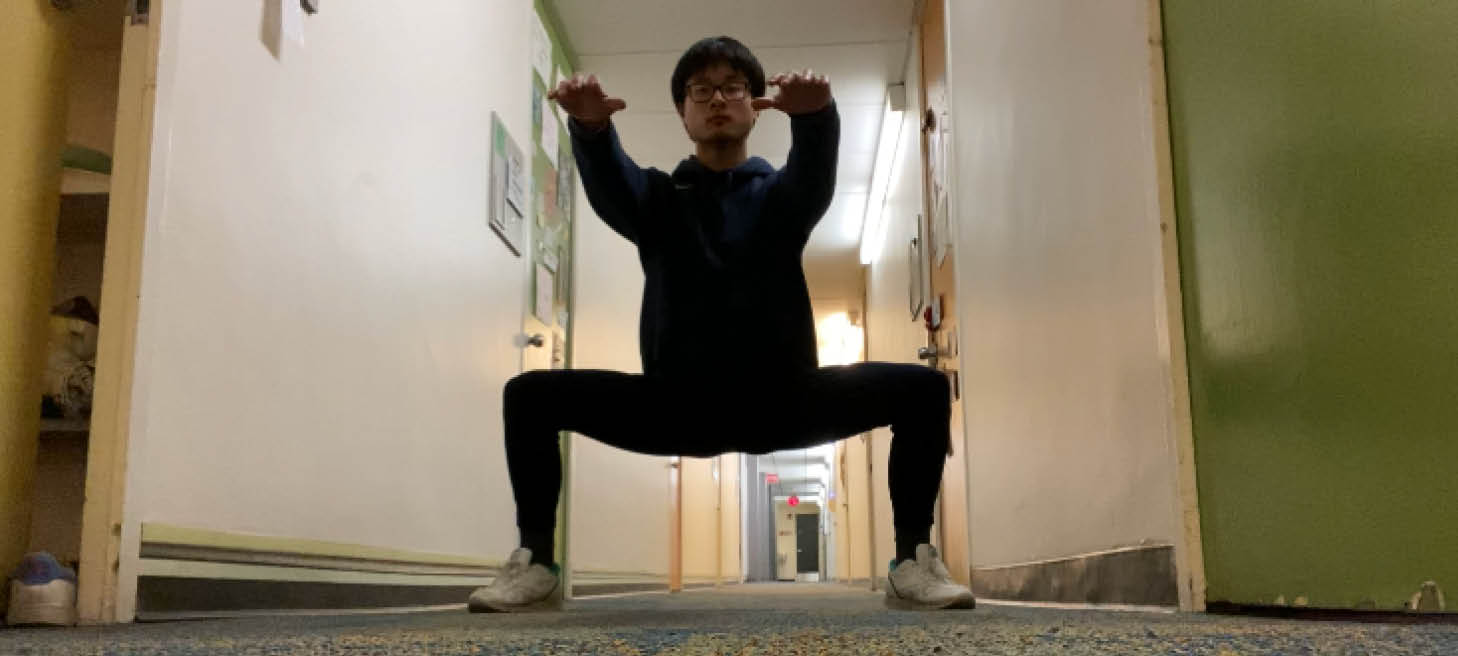
4 sets of max. hold horse stance (i.e., holding the pose for as long as you can)
Saturday-Sunday: Rest
*Your current progression is a movement you can perform for at least 15 reps.
Seems almost too simple, doesn’t it? That’s why it works! You really don’t have to do anything fancy; just stick to a few movements and work on them consistently.
Here is a list of push-up progressions you can work toward, in order from least to most difficult. Check out the video for my demonstration of each push-up variation. Once you’ve mastered one progression (i.e., being able to do 15 reps), you can move on to the next. Note that you can make each variation easier by performing the move on your knees.
- Incline push-ups (Adjust the incline to change the difficulty.)
- Classic push-ups
- Diamond push-ups
- Clapping push-ups
- Sphinx push-ups
- Archer push-ups
- One arm push-ups
Round out your upper body workouts with these pull-up variations. Among these, the bodyweight rows and L-sit pull-ups are the most accessible, even if you only have a table to hang from.
Code Embed: Cannot use CODE2 as a global code as it is being used to store 169 unique pieces of code in 183 posts
- Bodyweight rows (Change your angle to the ground to adjust the difficulty.)
- Classic pull-ups
- L-sit pull-ups
- Clapping pull-ups
- Muscle-ups
- Archer pull-ups
- One arm pull-ups (You’ll see in the video that I can only do this move with the assistance of one finger from the other hand.)
Starting out, this is the only leg workout you really need. In fact, in some martial arts schools, this is the only leg workout they do. It not only builds incredible amounts of strength but also improves your core stability.