


























Key points
- Social justice is an ideology that encourages equitable opportunities for all individuals in a society. It is often supported by social activism.
- Social activism—working to bring about political, structural, or social changes in society—can take many forms, such as phone banking, fundraising, and volunteering.
- Being involved in social activism can help develop professional skills like communication, recruitment, and event planning.
If you’re on social media at all, you’ve probably seen posts related to social justice, such as causes to learn about and organizations looking for support. These posts broadly fall under the umbrella of “social activism.”
For a long time, I didn’t understand what social activism meant or what participating in it might look like. Did I need a background in politics? Was I really supposed to just pick up the phone and call my representatives? Who are my representatives, anyway? What would that conversation even sound like?
What I did know is that I felt drawn to getting involved to help make the world more equitable. If you’re feeling a similar drive, here’s some of what I learned about getting started with social activism.

“I define activism pretty broadly,” says Alma Raymer, innovation manager at PelotonU, an Austin-based nonprofit that supports nontraditional college students in their pursuit of higher education. “It’s about organizing around issues of social justice in the wider world,” she says. “One-on-one conversations, organizing students for an event, and joining a national organization are all ways you can be socially active.”
Knowing that the definition can be this expansive opens up a lot of possibilities, but it can be tough to figure out the specifics of getting involved. Every single cause that’s out there won’t resonate with you, and sifting through all the options can feel overwhelming. Luckily, social activism isn’t “one size fits all”—the causes you focus on and how you lend your support will stem from your own passions and interests.
 “Find something you truly care about and brainstorm the best ways you feel you can make a real difference,” says Jay F., a fourth-year student at Metropolitan State University of Denver in Colorado.

First, think about the causes you care about most. What gets you fired up or feeling passionate? Animal rights, the housing crisis, climate change, racial justice, voter registration, local laws, public education—the list of possibilities is endless. Check out your campus clubs and student orgs to see if there are already groups at your school for causes you care about.
Once you’ve identified a few potential causes, take a moment to write down some of the skills you have and how they might be useful. Here are a few ideas:
 Speak multiple languages? Look into volunteering at an event as a translator.
- Familiar with coding? Help a nonprofit build their website to promote their cause.
- Comfortable navigating tense conversations? Help your friends brainstorm how they can talk about social activism with less-than-receptive audiences.
- Passionate about data analysis? Offer to review important data points that an organization can use to apply for grants.
- Excellent writer? Help them write those grants.
- Great at social media? Offer to create posts for an organization that could use some help.
Once you’ve done this, think about how your skills and passions intersect. This can help guide you toward the cause or the type of organization you’d like to get involved with.
“Connecting into an existing activist network can be empowering,” says Grace Lee, senior specialist of activism and outreach at the World Wildlife Fund, a nature conservation organization that works in nearly 100 countries around the globe. “It’s a great way to meet like-minded people who are there to support and motivate you.”

Write to your government reps
One of the most common ways people talk about getting involved with social activism is by writing a letter, postcard, or email to a government official, but this can be intimidating if you’ve never done it before and aren’t sure what to say.
If you’re writing to an official without a script, here’s a general template of the information you’ll want to include:
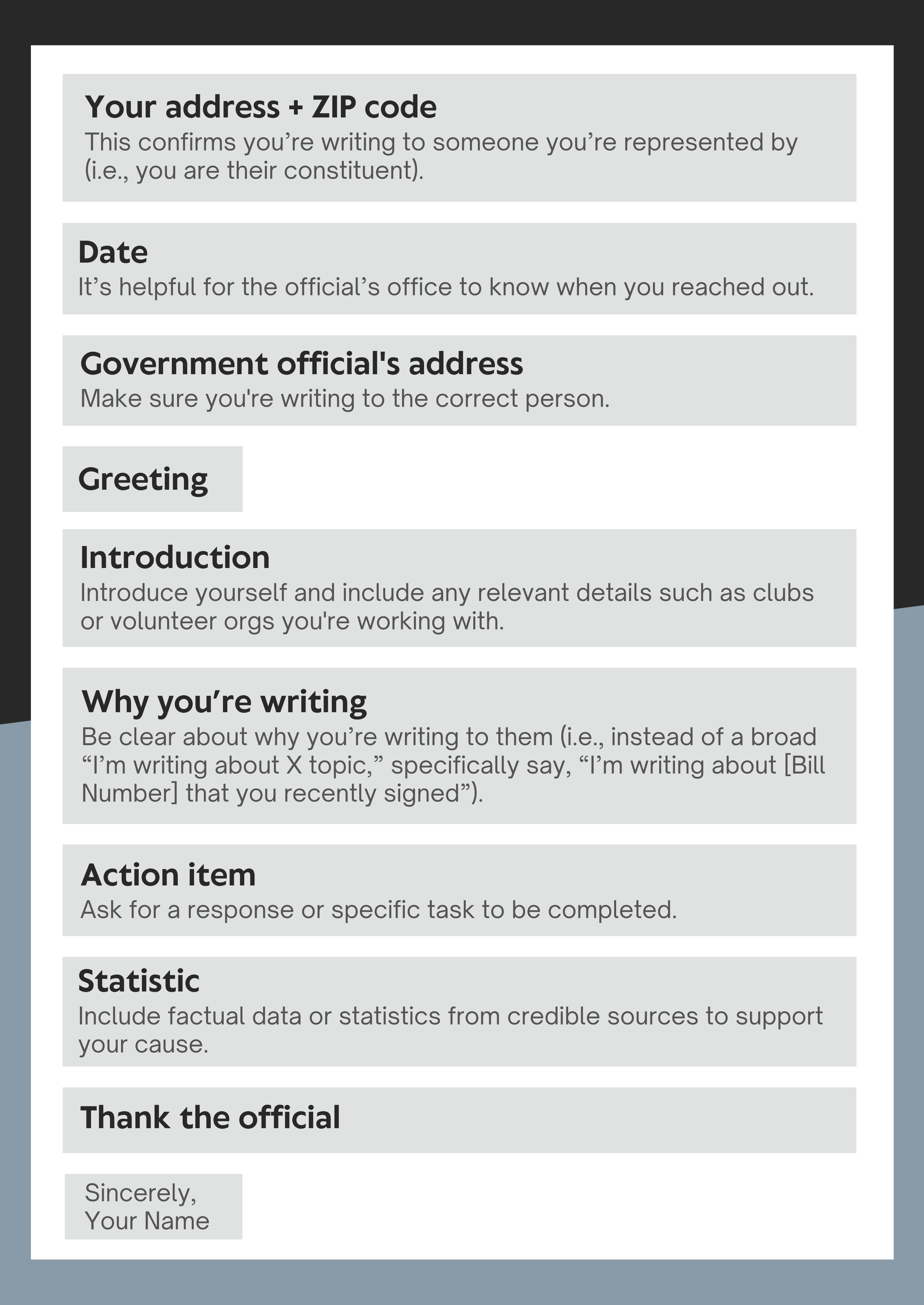
- Your address or ZIP code: This confirms you’re writing to someone you’re represented by (i.e., you are their constituent).
- Date: It’s helpful for the official’s office to know when you reached out.
- Government official’s address: Make sure you’re writing to the correct person.
- Greeting
- Introduction: Introduce yourself and include any relevant details such as clubs or volunteer orgs you’re working with.
- Why you’re writing: Be clear about why you’re writing to them (i.e., instead of a broad “I’m writing about X topic,” specifically say, “I’m writing about [Bill Number] that you recently signed”).
- Action item: Ask for a response or specific task to be completed.
- Statistic: Include factual data or statistics from credible sources to support your cause.
- Thank the official
- Your signature
It can be confusing knowing who to specifically reach out to when getting started. The answer will ultimately depend on your end goal. For example, if you’re working on a local issue, such as advocating for low-income housing, it might make more sense to speak with city officials rather than state or federal representatives. If a nationwide organization is already working on the issue you’re passionate about, start by connecting with the local chapter in the city nearest to you—or see which student orgs on campus might be working toward this same goal. They already have the infrastructure and resources in place; all you need to do is help out where needed.
Join a phone or text banking campaign
 Find an organization for a cause you believe in and volunteer for their phone or text banking. This involves calling or texting people about a cause, gathering information on their stance on the cause, and/or providing next steps for them to take. The organization will give you a list of people to reach out to.
Calling an official’s office works much the same way as writing a postcard: Give them your name and address (a ZIP code usually suffices), and then let them know why you’re calling and what you’re requesting of the official. You’ll likely talk with an aide who’ll make a note of your message to be passed along to the official. Keep your message succinct, since government offices get a lot of calls.
If you’re phone or text banking or writing postcards on behalf of an organization, they’ll usually provide a script like the ones above—just with the blanks filled in (other than your name and where you live, of course).
When connecting with others—especially government representatives—it’s important to consider your mindset. Reach out when you’re feeling levelheaded and calm. Sometimes new laws get passed that hit close to home and incite an emotional reaction. While it might feel satisfying in the heat of the moment to call a government office and put an office aide through the wringer, it probably won’t be very productive. Once you’re in a place where you can discuss the issue calmly and suggest reasonable solutions or alternatives, it’s a good time to reach out.
Attend an in-person demonstration
Marches and other demonstrations for social justice have become more common in the past few years, and many people feel invigorated by the camaraderie of these events. These can be organized on campus, in a town or city, or nationwide.
These events are often set up through social media to have the widest reach. There might be a Facebook or Meetup page with all the details: when the demonstration will take place, where it will begin and end, and a general program. There’ll also likely be information on what to expect and tips for how to engage safely during the event, such as wearing a mask, bringing food and water, and wearing comfortable shoes.

Here are a few things I’ve learned from attending demonstrations:
- Go with someone else if you can.
- Make a plan for where to meet up if you’re separated from your group.
- Plan for the weather (e.g., don’t forget sunscreen or rain gear, depending on the forecast).
- Know what emergency services are nearby.
If the above examples don’t grab your attention, there are plenty of other ways to get involved.
Organize or donate to fundraisers
For nonprofits, donations are essential. They need money to pay employees, provide resources, organize events, and more. Think about what types of fundraisers you could put together. For example, you can go old-school with a bake sale, or you can ask a local (or on-campus) restaurant to donate a percentage of its profits on a specific day and then promote the restaurant to get people in the door. Restaurants tend to like this because it provides them with good publicity and introduces potential new customers.
If you don’t have the capacity to organize a fundraiser, consider donating to causes you care about—even five dollars helps. You can also reach out to family and friends to ask for donations (usually I’ll do this in lieu of birthday or holiday presents).
Engage in digital activism
Social media is a staple these days, so use it. This doesn’t necessarily mean reposting the same images or news stories you’ve already seen a bunch of other people share. Instead, use it more actionably. For example, if you’re at a demonstration, sharing real-time updates and safety tips can help other attendees plan and coordinate—just avoid posting pictures of demonstrators unless you have their explicit consent. Or donate to a fundraiser, share the link, and encourage others to do the same.
Create art
Music, slam poetry, painting—there are endless ways to express your passion for social activism through art. You can sell your creations to raise money for your chosen cause, exhibit them to raise awareness, or gift them to others to help start conversations.
Use the power you have
Looking into the face of social activism challenges can be overwhelming. “Start small,” says Lee. “As individuals, we shouldn’t and realistically can’t be aiming to change everything, but that doesn’t mean we should do nothing.”
Remember that you don’t always have to do something big or loud, like shouting into a megaphone at a rally. If quieter conversations are more your thing, talk with friends and family about the causes you care about. Be intentional about where and how you spend your money, and donate to organizations if and when you can. If events are being organized, show up in support.
Figure out what you’ve got space for
Every time I sign on to social media, I find new information about social activism causes. But if this happens in the middle of the workday when I’m taking a break, I can’t just drop everything and take action.
Instead of doing something as soon as you hear about a cause, think about what you can handle. “What’s sustainable for you might not be sustainable for someone else,” says Raymer. “If work, exams, or family already have you at your limit, it’s OK to take a step back. Activism isn’t about guilt for the day you didn’t do something. It’s about how you can be intentional and impactful with your actions.”

Getting connected with social activism organizations can be both personally and professionally fulfilling. “Social activism widens your networking circle,” says Raymer. “Volunteering can lead to internships and employment.”
Volunteering with social activism organizations might also give you more concrete ideas about your future career path—especially in terms of what you like or dislike. “[It’s] a great way to try on different hats (e.g., advocacy, marketing, communications, field work, fundraising, research),” says Diane Dotson, national outreach manager for Defenders of Wildlife, a nonprofit committed to conservation efforts for wildlife and their habitats in North America.
It might take some time to figure out what form of activism is most fulfilling for you, but it’s certainly worth it. “Do it,” says Rebecca I., a second-year graduate student at Quinnipiac University in Hamden, Connecticut. “Be part of something bigger than yourself.”
The four roles of social activism: The Commons
5 types of activism: Human Rights Careers
How social justice slideshows took over Instagram: Vox
Activism on social media varies by race and ethnicity, age, political party: Pew Research Center
Article sources
Diane Dotson, national outreach manager, Defenders of Wildlife, Washington, DC.
Grace Lee, senior specialist of activism and outreach, World Wildlife Fund, Gland, Switzerland.
Alma Raymer, innovation manager, PelotonU, Austin, Texas.
Campbell, B. (2021). Social justice and sociological theory. Society, 58, 355–364. https://doi.org/10.1007/s12115-021-00625-4
Lin, J. (2020, September 2). Can professional development align with social justice?. The Tech. https://thetech.com/2020/09/02/mcat-in-a-revolution
National Conference for Community and Justice. (n.d.). Social justice definitions. https://www.nccj.org/resources/social-justice-definitions
Pachamama Alliance. (n.d.). What is social justice? https://www.pachamama.org/social-justice/what-is-social-justice
Phillips-Alvarez, L. (2019, October 1). 10 facts about social activism. The Borgen Project. https://borgenproject.org/10-facts-about-social-activism/
ProLiteracy. (n.d.). Call your representative. https://www.proliteracy.org/Get-Involved/Letters-for-Literacy/Phone-Scripts-and-Marketing-Messaging
Reid, A. & Sehl, K. (2020, July 7). Genuine social media activism: A guide for going beyond the hashtag. Hootsuite. https://blog.hootsuite.com/social-media-activism/
Sequeira, S. (2022, April 19). What is phone banking? A simple guide to get you started. CallHub. https://callhub.io/what-is-phone-banking/
Thorpe, D. (2018, August 29). How to organize the perfect fundraising gala. Forbes. https://www.forbes.com/sites/devinthorpe/2018/08/29/how-to-organize-the-perfect-fundraising-gala/?sh=6d9076fd79df
TSDF. (2016, March 24). What is social justice?. The San Diego Foundation. https://www.sdfoundation.org/news-events/sdf-news/what-is-social-justice/
United Nations. (n.d.). World day of social justice. https://www.un.org/en/observances/social-justice-day
United States House of Representatives. (n.d.). Find your representative. https://www.house.gov/representatives/find-your-representative
United States Senate. (n.d.). Contacting U.S. senators. https://www.senate.gov/senators/senators-contact.htm
USAGov. (2019, May 30). How to contact your elected officials. https://www.usa.gov/elected-officials
Working America. (n.d.). Strategic tactic guide: Host a postcard party. https://www.workingamerica.org/30days/tactics/postcardparty