



























Key points
- Stalking is experienced more commonly by college-aged students than any other age group.
- Learning to identify signs of stalking behavior can help you and others navigate uncomfortable or potentially harmful situations.
- There are many on- and off-campus resources available to help you navigate instances of stalking.
College life is exciting. You’re meeting new friends, discovering new places to hang out, and living independently, often for the first time. This can be exhilarating, but it can also open you up to new risks, like unwanted attention in the form of stalking.
In fact, 18- to 24-year-olds experience stalking more than any other age group, according to the Stalking Prevention, Awareness, and Resource Center. And it’s not always strangers with binoculars hiding in a bush—40 percent of reported stalking crimes are done by a current or former intimate partner and 42 percent by an acquaintance.
These numbers might seem daunting, but they don’t have to limit enjoyment, independence, or discovering new places with new friends. Understanding what stalking behavior looks like, and how to spot it in yourself and those around you, can help you stay safe and comfortable.
Know the definition of stalking
It’s tempting to think that persistence pays off in the dating scene, especially when rom-coms are always glamorizing grand, romantic gestures—like showing up at someone’s bedroom window unannounced to declare your love. But this might also lead to a lot of confusion when it comes to understanding the difference between genuine interest and stalking, according to Dr. Shelly-Ann Collins Rawle, a licensed psychologist based in Long Beach, California.
“The distinction lies in consent and boundaries,” says Dr. Collins Rawle. “Stalking can be defined as a pattern of unwanted, obsessive attention by an individual or group towards another person. [It’s] intended to intimidate, harass, or control and often creates distress, fear, or concern for the safety of the person being stalked.”
In August 2020, the Department of Education added stalking* to its definition of sexual harassment. Prior to this, there was little legal protection for students with regard to stalking. Now, it’s covered under Title IX as a federal civil rights law, which means that colleges and universities must address instances of stalking when they are brought to the attention of the Title IX office on campus—if they don’t, they run the risk of losing federal funding from the government.
*Note that Title IX only covers cyberstalking when it occurs during school-related activities or if school property (e.g., a library computer) is used.
Recognize the signs of stalking behavior
Unfortunately, signs of stalking behavior aren’t always cut and dry. “Think about courtship behaviors as existing on a continuum from something like ‘desirable’ on one end to ‘stalking’ on the other end,” says Dr. Timothy Valshtein, an assistant professor of psychology at Yeshiva University’s Stern College for Women in New York. Where your behavior falls on that spectrum is determined by culture and societal norms—what’s considered appropriate behavior, where or how you met, and whether romantic interest is reciprocated, explains Valshtein.
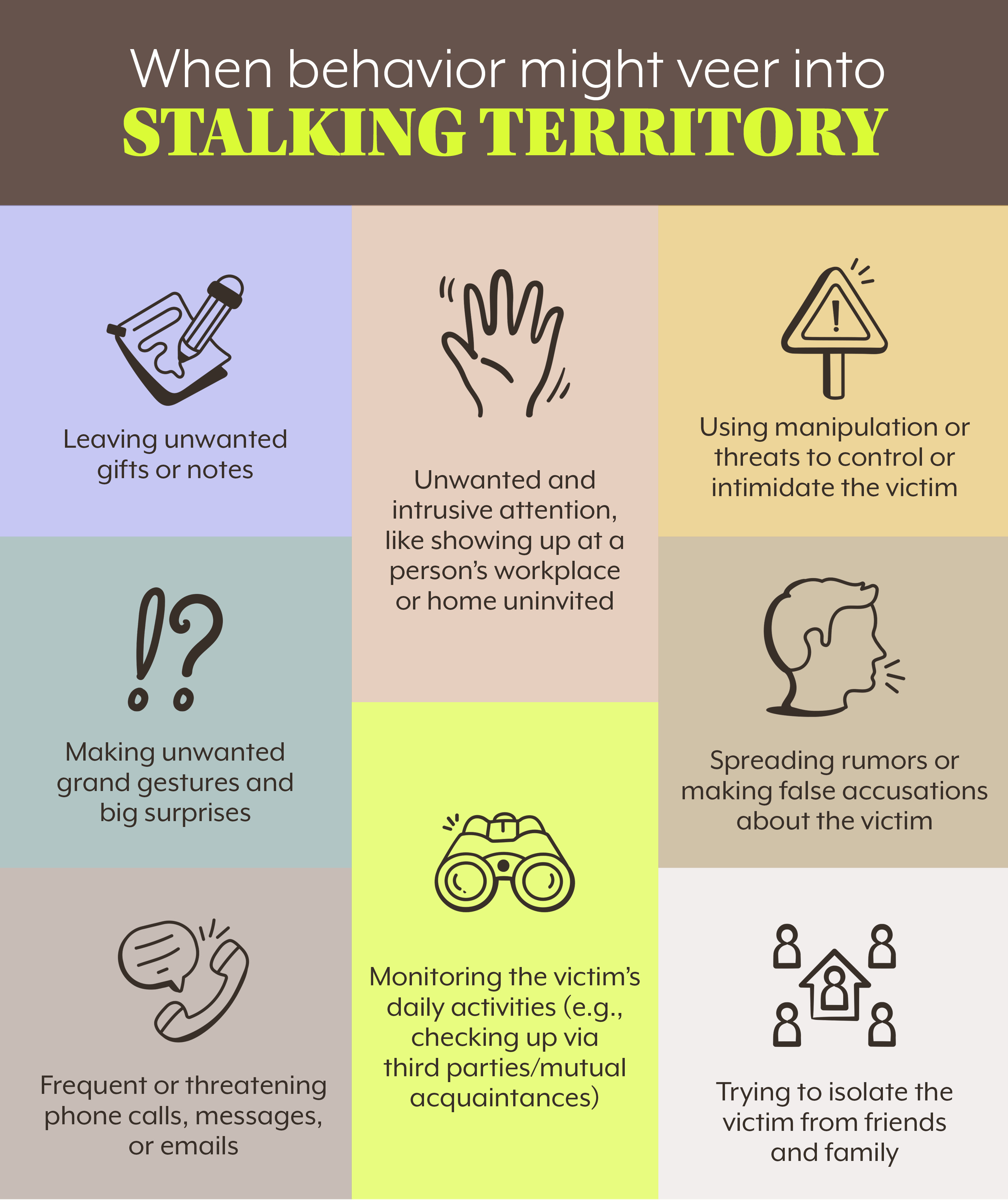
When behavior might veer into stalking territory:
- Leaving unwanted gifts or notes
- Making unwanted grand gestures and big surprises
- Unwanted and intrusive attention, like showing up at a person’s workplace or home uninvited
- Frequent or threatening phone calls, messages, or emails
- Using manipulation or threats to control or intimidate the victim
- Monitoring the victim’s daily activities (e.g., checking up via third parties/mutual acquaintances)
- Spreading rumors or making false accusations about the victim
- Trying to isolate the victim from friends and family
“Cyberstalking shares similarities with physical stalking but occurs primarily online,” says Dr. Collins Rawle. “The same kind of persistence, preoccupation, and unwelcome advances are at play, only now they unfold on the internet,” adds Dr. Valshtein.
Some of these behaviors might include:
- Sending frequent, unwanted emails, messages, or comments on social media
- Spreading false information or rumors about the victim online
- Hacking into a person’s accounts or devices
- Tracking or monitoring a person’s online activities or physical location through digital means
- Creating fake profiles to harass or impersonate someone
- Posting personal or intimate information about the victim without consent
What to do if you’re being stalked
If you’re feeling uncomfortable, threatened, or harassed, it’s important to trust your instincts. Here are a few actions you can take to prioritize your safety:

Consider setting your social media profiles to private mode. Sharing personal information publicly online is already a gamble when it comes to digital safety, so keeping a low profile has benefits beyond blocking unwanted attention from a stalker. In some instances, fully deactivating your accounts and stepping away from social media may be the best option, says Dr. Valshtein.
“One way that many people protect their identity [on social media] is by not including their full or last name on their profiles or usernames,” says Bea A., a third-year student at the University of California, Berkeley. “Only using your initials or replacing your middle name with your last name can make things harder for stalkers.”

If you feel confident that your safety is not at risk, clearly stating that you are not interested in the person can sometimes go a long way. “Confronting them early on really helped,” says Sophia D., a second-year student at the University of California, Berkeley. “It took away their power over me and helped me feel more safe and confident.”

Dr. Valshtein suggests creating a folder on your phone or computer with screenshots of conversations that made you feel uncomfortable, as well as times and locations where the person showed up unannounced. “If it comes to the point of legal action, this [may be] evidence that will help make your case stronger,” he says.

It can be confusing to receive unwanted attention, but know that by setting boundaries, you aren’t doing anything wrong. Reaching out to trusted family and friends or on-campus counseling services can provide you with some extra support and make you feel less alone—while equipping you with an extra layer of protection. “Always let someone know what is happening and what the person looks like,” says Natalia M., a fourth-year student at Northern Illinois University in Dekalb.

When your safety feels threatened, consider bringing it to the attention of on- and off-campus authorities. “Report to campus security, local law enforcement, or other relevant authorities [such as the Title IX office],” says Dr. Collins Rawle.
“Support is important at any stage of surviving a criminal act, and telling someone else what you are feeling or experiencing is a great first step,” adds Sergeant Kelsey Anderson of the University of Wyoming Police Department in Laramie, Wyoming. “I always tell people that even if I cannot help at the specific juncture of the process, looping in those who I know can [help] take some of the burden from the individual.”

What to do if you or a friend show signs of stalking behavior
Advice for what to do if you’re being stalked is a bit easier to find online and on campus than advice for what to do if you spot stalking behavior in yourself or others. So what can you do if you think that you—or someone you know—are crossing the line?

“Ask close friends or family for honest feedback on your behavior,” suggests Dr. Collins Rawle. “If you notice such behavior in a friend, approach the topic with care and concern, offering support and suggesting they seek professional guidance.”
 Rejection is a normal part of life, and learning how to cope with it is an important skill. While it can hurt to feel rejected, it doesn’t mean that you’ve failed. In fact, unrequited feelings from a romantic interest can provide opportunities to grow and expand your horizons by meeting new people.

“Counseling or therapy can offer insights into underlying issues and provide strategies for behavioral change,” says Dr. Collins Rawle. Working with a therapist can help you develop strategies to achieve your goals, both in your romantic life and otherwise. “Falling head over heels for someone is a completely normal feeling,” says Dr. Valshtein. “However, acting on those feelings in ways that come at the expense of another person’s autonomy and comfort are when things become problematic.”
Stalking and cyberstalking: Vincennes University
3 things everyone should know about stalking: University of Colorado Boulder
Article sources
Sergeant Kelsey Anderson, University of Wyoming Police Department, Laramie, Wyoming.
Shelly-Ann Collins Rawle, PhD, NCC, CAODTS, licensed psychologist, California State University, Long Beach, California.
Timothy J. Valshtein, PhD, assistant professor of psychology, Yeshiva University, Stern College for Women, New York, New York.
CampusWell survey, November 2023.
Stalking Prevention, Awareness, and Resource Center. (n.d.). Stalking and Title IX: The basics. https://www.stalkingawareness.org/wp-content/uploads/2021/11/Campus-Stalking-Title-IX-Basics.pdf
Stalking Prevention, Awareness, and Resource Center. (n.d.). Stalking fact sheet. https://www.stalkingawareness.org/wp-content/uploads/2019/01/SPARC_StalkngFactSheet_2018_FINAL.pdf