
Rate this article and enter to win
When it comes to getting the most out of lectures, effective listening is a crucial skill to have. But when else do you need to be opening your ears?
In a CampusWell survey, 65 percent of students said they just want to be listened to during times of distress. Sometimes what people need most is the opportunity to talk. So how can you demonstrate that you’re really hearing what other people say?
Listen carefully
Active listening refers to the goal of truly understanding what someone says. Facilitating a conversation where the speaker feels heard is a crucial part of good communication. “Sometimes people are just waiting for their turns to speak,” says James D., a third-year undergraduate at Temple University in Philadelphia. “It feels like what you’re saying is just going in one ear and out the other.”
 Dean M., a student at University of Ontario Institute of Technology in Canada, suggests, “If you care about someone, show it.” Here are some basic techniques:
- Allow silence in conversation so the speaker has time to reflect.
- Ask open-ended questions. These lead to more descriptive answers rather than just a “yes” or “no.”
- Paraphrase the speaker’s words to show that you’re listening and to confirm that you understand what they are saying.
- Summarize the conversation. This again serves as validation for the speaker and an opportunity to clarify anything you’ve misunderstood.
What your body says
In our survey, many students ranked eye contact as the most important part of a conversation. “I look directly at the person I’m talking to so he or she knows I’m paying attention,” says Sarah R., a fourth-year undergraduate at Colorado State University in Fort Collins.
Here are some body language tips:
- Keep your posture open by uncrossing legs and arms.
- Remove physical barriers between you and the speaker.
- Lean toward the speaker (slightly) to display interest in what they are saying.
- Maintain eye contact.
- Nod silently to show agreement or encouragement.
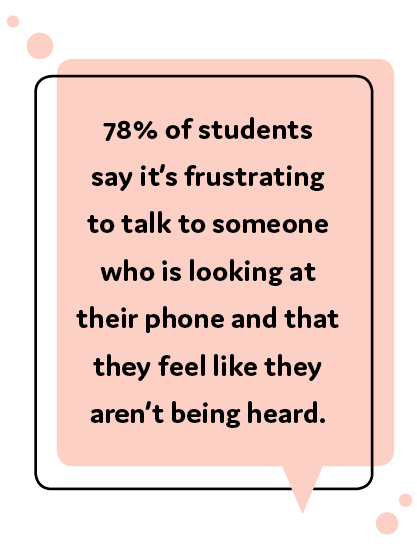
- Avoid looking at phone or device screens during the conversation.
Take this quiz to find out how good you are at reading body language
 Increase understanding
Effective communication combines welcoming body language with active listening skills. Practicing these helps ensure that not only do the people you speak with feel heard, but also that you get the most from conversations.
“Make eye contact. Nod [to show] you agree or understand what they are saying, and offer input or questions to keep the conversation going.”
—Alex B., second-year graduate student, St. Clair College, Windsor, Ontario, Canada
Try out these active listening techniques in your next convo
| Action | Purpose | Examples |
|---|---|---|
| Nonverbal Encouragement | Let the speaker know you’re listening without the need to interrupt. Provide silent validation of the speaker’s feelings. |
Leaning in Maintaining eye contact |
| Clarification | Confirm the listener accurately understands what’s being said. Offers the speaker an opportunity to correct any misunderstandings. |
“It sounds like you’re feeling…” “What I hear you saying is…” “Am I understanding correctly?” |
| Paraphrasing | Demonstrates careful listening without parroting back what the speaker said. Allows the speaker to hear what they’ve said. This may prompt clarification. |
“So what I think I hear you saying is…” “I understand that…” “It seems like you…” |
| Summarizing | Pulls together the discussion’s main ideas. Creates a shared basis for future discussion and/or action. |
“It sounds like the main issues are…” “The things you would like to have happen are…” |
Become a better listener: PsychCentral
10 steps to effective listening: Forbes
Find out how well you read other people (quiz): The Greater Good Center at UC Berkeley
Article sources
Dr. Isis Artze-Vega, assistant director, Center for the Advancement of Teaching, Florida International University, Miami, Florida.
Artze-Vega, I. (2012 October 1). Active listening: Seven ways to help students listen, not just hear. Faculty Focus. Retrieved from http://www.facultyfocus.com/articles/teaching-and-learning/active-listening-seven-ways-to-improve-students-listening-skills/
Taft College. (n.d.). Active listening skills.
Retrieved from http://www.taft.cc.ca.us/lrc/class/assignments/actlisten.html
University of Missouri. (n.d.). Attributes of good listening. Retrieved from http://web.missouri.edu/~campbellr/Leadership/chapter6.htm
The George Washington University. (n.d.). Organizational development & effectiveness, active listening. Retrieved from http://ode.hr.gwu.edu/active-listening
HelpGuide.org. (2018, October). Nonverbal communication.
Retrieved from https://www.helpguide.org/articles/relationships-communication/nonverbal-communication.htm/
U.S. Department of State. (n.d.). Active listening. Retrieved from http://www.state.gov/m/a/os/65759.htm