


























Rate this article and enter to win
It’s easier than ever to share video content on the internet, especially on social media platforms like TikTok, Instagram, and Facebook. While this has been a positive way to give more people around the world an outlet to voice their stories and opinions, it also presents an “open stage” for fake news—aka misinformation—to be shared. And fake news isn’t just bothersome—it’s dangerous. It can undermine science and sway judgement on important decisions, hurting both individuals and society as a whole.
“Misinformation can lead to behavior that hurts people’s happiness and health,” says Dr. Elizabeth Loftus, a misinformation researcher and professor of psychological science at the University of California, Irvine. “It’s crucial to stop and think before you share. Spreading misinformation multiplies the problem.”
What is misinformation? Simply put, it’s false or inaccurate information. Misinformation is often used to refer to content that’s false (or partly false) but wasn’t necessarily posted with the intent to deceive.
Disinformation, on the other hand, is when someone publishes false information with the goal of misleading or deceiving people. As you can imagine, what starts out as disinformation often turns into misinformation as well-meaning viewers share inaccurate videos on their social media feeds.

Many of us believe in and share information we see on the internet without verifying it against other sources. In a recent CampusWell survey, over 60 percent of respondents said they only sometimes fact-check content before they share it.
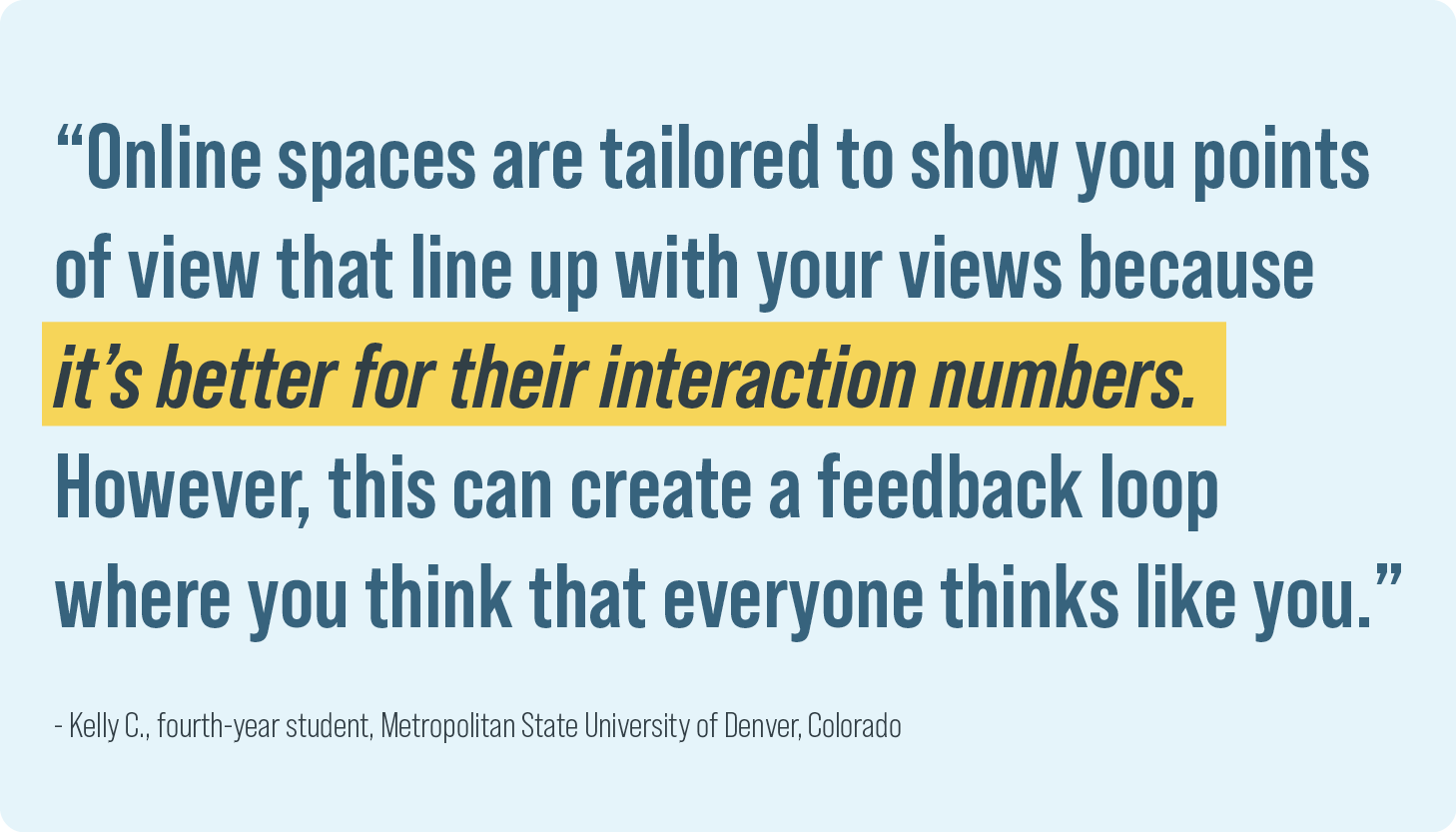
“Online spaces are tailored to show you points of view that line up with your views because it’s better for their interaction numbers. However, this can create a feedback loop where you think that everyone thinks like you,” says Kelly C., a fourth-year student at Metropolitan State University of Denver in Colorado.
“I usually don’t check sources for what I’m sharing because I consider myself a decent judge of what seems fake,” says Ross L., a graduate student in Miami, Florida.
“I think it’s important to fact-check because anyone can say things online, even when they’re not qualified to,” says Micaela H., a fourth-year student at Weber State University in Ogden, Utah. “I look up the credentials of the person, check references, look at the website it came from and how recent it is.”
Unfortunately, we all tend to believe that we’re better at spotting falsehoods than we actually are. On top of that, as humans we are naturally drawn to familiarity, which means we’re less likely to question (and more likely to believe) anything we see or hear several times. It’s a phenomenon called the “illusory truth effect” and it boils down to the fact that the more times someone is exposed to content that is factually incorrect without challenging it, the more it eventually feels like truth.
According to research, when falsehoods and real facts are served side by side, it’s especially difficult to distinguish the difference. In one study co-authored by Dr. Loftus, more than 3,000 participants viewed six news stories—two fake and four factual—about campaign events related to the 2018 abortion vote in Ireland. Participants were asked if they’d heard of the news stories before or had any memories about them. Almost half of participants said they remembered something about at least one of the fabricated events and one third reported remembering something specific about the false event—even though none had been exposed to the false stories before the study. Bottom line: Even our memories can be false, so it’s extra important to fact-check.

You can debunk incorrect information after it has spread, but you can also inoculate yourself against fake news with a tactic called “prebunking.” In a nutshell, this means learning tactics to question the content you consume and spot false information. While there’s no one-click fact-checker for video content, there are ways to assess the trustworthiness of what you’re viewing. Protect yourself and your social network from fake news by asking yourself the questions below, inspired by the Washington Post’s guide to videos with manipulated content.
“Fact-checking videos is a challenging task. It helps to ask ourselves questions to understand the content and our reaction to it: Who made it and why? Who might benefit and who might be harmed by this message? How does it make me feel and why?” says Dr. Panayiota Kendeou, professor of educational psychology at the University of Minnesota, Twin Cities. “We can also check and evaluate any supporting source and fact-check the claims made in the video.”

OK, we can all agree that there has been some pretty wild stuff happening in the world over the past couple of years—so that even mainstream media coverage has seemed more intense than usual. Still, there are a few red flags to watch out for when consuming online content. If you notice any of these, it’s a sign to dig deeper and validate sources.

- The headline seems unbelievable or overly sensational (aka “clickbait”). Misinformation and disinformation are designed to be attention-grabbing so that the content is convincing and shareable.
- It makes you feel extreme emotions (e.g., angry, sad, elated).
- It doesn’t follow journalistic rules of integrity (e.g., it victimizes, exaggerates, and/or blames without a legal conviction).
- It’s missing data such as an author, date, or supporting sources for facts claimed within the text.

Have any legitimate media outlets shared this video footage?
 We tend to naturally believe that video footage we’re watching is accurate, but there have been plenty of instances of swapped or misrepresented footage (for instance, a video clip labeled as one event but from a completely different time or location). An example of this, as shown by the Washington Post, was when a post claiming that Hondurans were being paid to cross the US border ahead of the 2018 midterm elections was accompanied by a video clip of an unrelated crowd in Guatemala.
Could this video clip be taken out of context?
Using only a select part of a video can also fall under the category of missing context. This is like a lie by omission—you can skew how something looks by not sharing the whole story. A popular example of this is when a video of a fan singing to Celine Dion in her car went viral because of the pop star’s humorously unimpressed expression. A longer version of the video was eventually released showing Dion smiling and fist-bumping her fan for the serenade.
What might have been edited out?

Similar to above, deceptive editing of video content (such as rearranging and splicing) can takeout important facts and ultimately change the message. For instance, in filming an interview or press conference, showing only part of the respondent’s answer can skew the tone and even make a “yes” seem like a “no” (or vice versa).
Does anything appear doctored?
A skilled video editor can use software to edit visuals and/or audio. It’s not always easy to spot—look for any blurring, warped shapes, or coloring that seems “off.” This deepfake video of President Obama was created to raise awareness of just how believable these videos can be.
Are there any deception tactics in this video?
 Stats show that you can become less susceptible to believing fake news if you recognize the disinformation “tricks” (exaggerating, omitting, manipulating, etc.). An online game called Bad News was designed to teach users how to identify falsities and misinformation (see the “Get Help or Find Out More” section below to play). Researchers at the University of Cambridge found that playing it even once helped study participants “prebunk” fake news.
What are my own biases?
Wherever you are on the political spectrum, it’s important to recognize your own biases. You’re especially vulnerable to misinformation when it aligns with your pre-existing views (a term referred to as “confirmation bias”). You can take an online quiz to find out what your biases are. From there, make an effort to consider other points of view on issues where you may be biased.

Lots of misinformation surrounding COVID-19 vaccines has been shared online, which is a current example of how fake news can have very real consequences.
“Unsupported and false claims about the vaccine lead people to be afraid and to take steps that are harmful to themselves, their loved ones, and society,” says Dr. Loftus.
When it comes to COVID-19 misinformation, you can protect yourself against myths by reading up on the facts before you’re exposed to fake news (a good example of “prebunking”). Check out the Center for Inquiry’s Coronavirus Resource Center for legitimate interviews and fact-checked content related to the virus and vaccine. You can also check out CampusWell’s guide to reliable medical websites to find factual sources for health information.
Game to help you identify misinformation: Bad News
Websites for fact-checking: CSI Library
Reliable news and fact checks about Covid-19: Center for Inquiry
Quick guide to debunking misinformation: Climate Change Communication
Reality check online game: Media Smarts
How to spot fake news and deepfake videos: Clicknetwork
Article sources
Panayiota Kendeou, PhD, professor, Department of Educational Psychology, University of Minnesota, Minneapolis.
Elizabeth Loftus, PhD, cognitive psychologist and human memory researcher, professor, Department of Psychological Science; Department of Criminology, Law and Society, University of California Irvine, California.
Abrams, Z. (2021, March 1). Controlling the spread of misinformation. Monitor on Psychology 52(2), 44. https://www.apa.org/monitor/2021/03/controlling-misinformation
Basol, M., Roozenbeek, J., & van der Linden, S. (2020). Good news about bad news: Gamified inoculation boosts confidence and cognitive immunity against fake news. Journal of Cognition, 3(1), 2. http://doi.org/10.5334/joc.91
Ciampaglia, G. L., & Menczer, F. (2018, June 21). Biases make people vulnerable to misinformation spread by social media. Scientific American. https://www.scientificamerican.com/article/biases-make-people-vulnerable-to-misinformation-spread-by-social-media/
Gebel, M. (2021, January 15). Misinformation vs. disinformation: What to know about each form of false information, and how to spot them online. Business Insider. https://www.businessinsider.com/misinformation-vs-disinformation
Greifeneder, R., Jaffe, M., Newman, E., & Schwarz, N. (2021, February 23). The psychology of fake news: Accepting, sharing, and correcting misinformation. OAPEN: Online Library and Publication Platform. https://library.oapen.org/handle/20.500.12657/46921
Hopf, H., Krief, A., Mehta, G., & Matlin, S. A. (2019). Fake science and the knowledge crisis: Ignorance can be fatal. Royal Society Open Science, 6(5). https://doi.org/10.1098/rsos.190161
Lewandowsky, S., Cook, J., & Lombardi, D. (2020). Debunking Handbook 2020. Databrary. http://doi.org/10.17910/b7.1182
Murphy, G., Loftus, E. F., Grady, R. H., Levine, L. J., & Greene, C. M. (2019). False memories for fake news during Ireland’s abortion referendum. Psychological Science, 30(10), 1449–1459. https://doi.org/10.1177/0956797619864887
Pennycook, G., Cannon, T. D., & Rand, D. G. (2018). Prior exposure increases perceived accuracy of fake news. Journal of Experimental Psychology: General, 147(12), 1865–1880. https://doi.apa.org/doiLanding?doi=10.1037%2Fxge0000465
Sinclair, C. (2021, March 18). Seven ways to avoid becoming a misinformation superspreader. The Conversation. https://theconversation.com/7-ways-to-avoid-becoming-a-misinformation-superspreader-157099
WP Company. (2019, June 25). The Washington Post’s guide to manipulated video. Washington Post. https://www.washingtonpost.com/graphics/2019/politics/fact-checker/manipulated-video-guide/