
Content warning: This article discusses topics, including sexual trauma, that may be disturbing to some readers.
Key points
- Health care providers with training in trauma-informed care (TIC) can help patients feel psychologically and physically safer in a care setting.
- TIC recognizes that trauma is something that has happened to a person—rather than the trauma defining who they are as a person.
- Seeking a trauma-informed provider can be particularly helpful for those who have survived sexual trauma, such as sexual assault or abuse.
After experiencing a traumatic event like sexual violence (e.g., sexual assault or abuse), you may wonder: “How can I deal with feelings and symptoms that I think are related to what happened to me?” Although there are multiple resources a survivor can turn to when seeking help, it’s a good idea to consider whether that resource is trauma-informed or not.
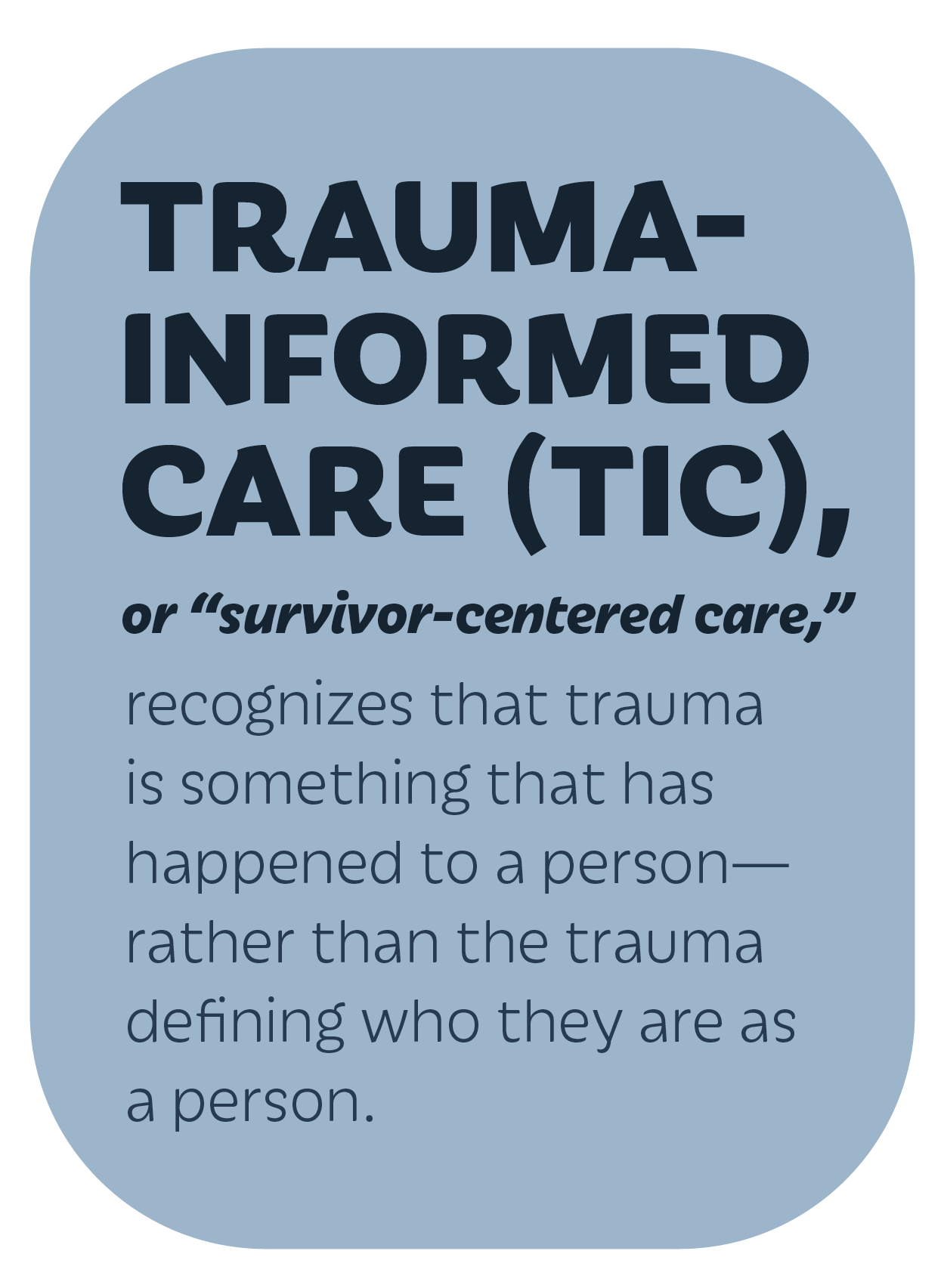
Trauma-informed care (TIC), or “survivor-centered care,” is a therapeutic approach that recognizes that trauma is something that has happened to a person—rather than the trauma defining who they are as a person.
What are the goals of trauma-informed care?
 Recognizing the role of trauma in the healing process
- Empowering the survivor and making them feel safe
- Establishing trust and collaboration between survivors and their providers
- Creating and upholding boundaries
- Emphasizing the patient’s choice and voice
- Incorporating identity (e.g., gender, culture) when providing care
- Building tools to cope with inadvertent/accidental retraumatization*
- Learning how to explore or experience healthy intimate relationships
*Retraumatization refers to reliving the emotional and physical reactions that may have accompanied a traumatic experience. This can occur when a survivor is exposed to an event that consciously or subconsciously reminds them of their traumatic experience. It is a common symptom of people living with post-traumatic stress disorder (PTSD).

In a review of studies that examined existing research on TIC among survivors of physical and sexual abuse, TIC was found to:
- Help minimize patient distress
- Maximize patient feelings of autonomy and empowerment
- Enhance patient relationships with their providers

“Humans all around the world, for all of time, have been exposed to traumatic events that threaten their sense of safety and well-being. This [often] leads to a common set of outcomes,” says Dr. Alexandra Laifer, licensed clinical psychologist and trauma-informed caregiver. According to Dr. Laifer, these outcomes include things like:
- Reexperiencing the traumatic event through intrusive thoughts, memories, dreams, or flashbacks
- Feeling high levels of anxiety, depression, anger, and/or irritability
- Difficulty thinking and concentrating
- Trouble sleeping
- Feeling on high alert much of the time
- Experiencing other uncomfortable sensations that may lead people to isolate, avoid, and withdraw from their lives
How to find a trauma-informed practitioner
Survivors of sexual trauma often use therapy to help identify and reflect upon challenges, emotions, and experiences, and to learn ways to cope with symptoms and heal. It may take some time to find a therapeutic practice or provider who is a good fit for each survivor’s needs and circumstances, but it’s worth the effort.
To find a TIC provider, start by searching online. “College students who are seeking trauma-informed care should include the word ‘trauma’ in their search box and look for providers who have clearly indicated that they have specialized training in trauma [or] actively work with people who present with trauma,” says Dr. Laifer. For example, some practitioners obtain a certificate in trauma-informed care or specific types of trauma therapies, which teach them how trauma manifests in a person’s body, emotions, beliefs, and relationships and trains them to incorporate this approach into their practice. You can also use the online search tools provided by Psychology Today and the American Psychological Association, which both have filters for searching for TIC practitioners. 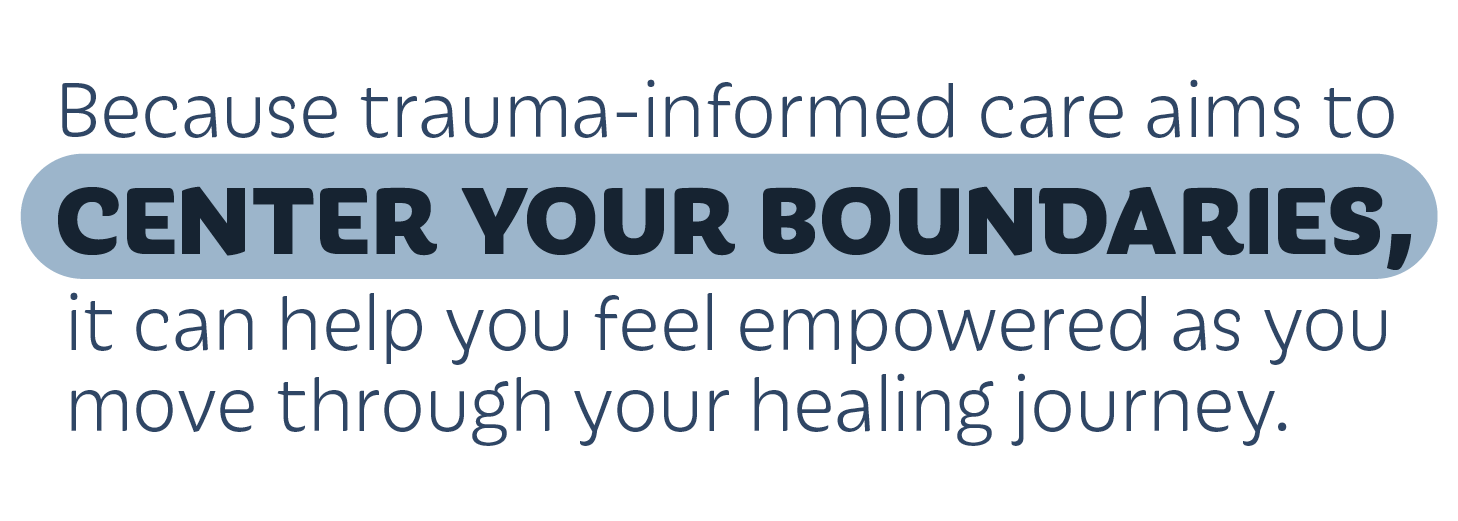 “Providers often have an online bio listing their specializations,” says Alison V., a fifth-year undergraduate student at Marquette University in Milwaukee, Wisconsin. “Reading through these can guide finding a great match for each person’s specific needs and personality type.”
Your on-campus health center or local Planned Parenthood may also be able to point you in the direction of low- or no-cost care if paying for therapy is a concern. Remember that therapists are always obligated to maintain patient-provider confidentiality unless their patient is at risk of hurting themselves or someone else.
Questions to ask a potential therapist
It may be beneficial to explore the following questions with a practitioner to assess whether they offer TIC and whether their approach is a good fit:
- How does trauma influence someone’s life, and how does this influence your treatment?
- How do you create a safe and empowering environment for those who’ve experienced sexual trauma?
- If you’re willing to disclose, do you have lived experience of sexual trauma? (Not all providers will be willing to share, and that’s OK, but having lived experience provides a deeper understanding that can help them help you. Note that you are only asking whether or not they have lived experience, not what happened to them.)
- How do you develop a safe and trusting relationship with your clients?
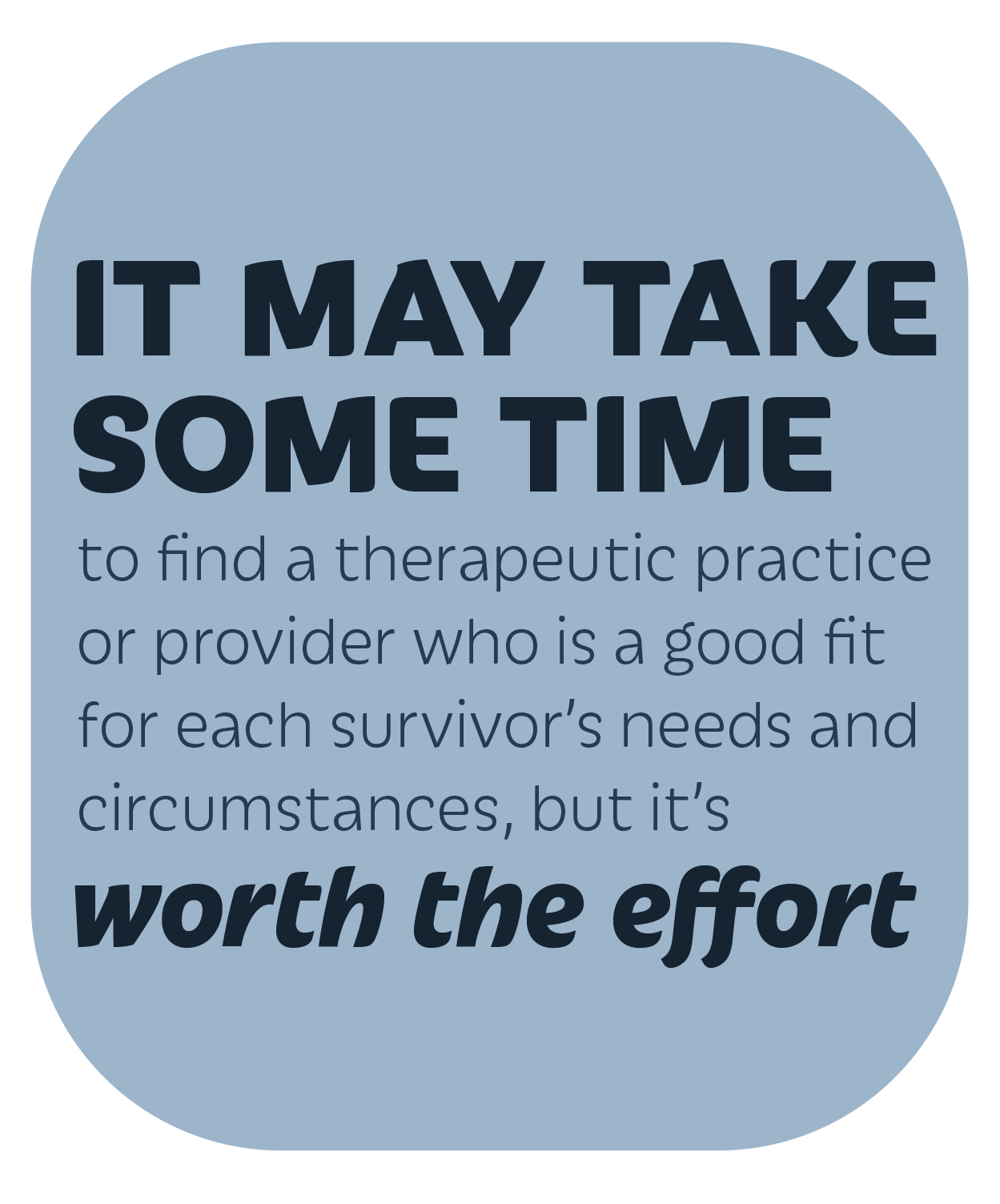
Remember: Healing is not a linear process. It ebbs and flows based on a person’s needs, desires, and life circumstances. Because TIC aims to center your boundaries and agency, it can help you feel empowered as you move through your healing journey.
Find trauma-informed, sliding scale, holistic healing practitioners: The Breathe Network
Learn more about trauma-informed care: Trauma-Informed Care Implementation Resource Center
Thriving in the Wake of Trauma: A Multicultural Guide by Thema Bryant-Davis (AltaMira Press, 2008)
Article sources
Alexandra Laifer, PhD, licensed clinical psychologist and trauma-informed caregiver, Oceanside, California.
Bryant-Davis, T., Chung, H., & Tillman, S. (2009). From the margins to the center: Ethnic minority women and the mental health effects of sexual assault. Trauma, Violence, & Abuse, 10(4), 330–357. https://doi.org/10.1177/1524838009339755
Cantor, D., Fisher, B., Chibnall, S., Townsend, R., et al. (2017). Report on the AAU campus climate survey on sexual assault and sexual misconduct. Association of American Universities. https://www.aau.edu/sites/default/files/AAU-Files/Key-Issues/Campus-Safety/AAU-Campus-Climate-Survey-FINAL-10-20-17.pdf
Kessler, R. C., Aguilar-Gaxiola, S., Alonso, J., Benjet, C., et al. (2017). Trauma and PTSD in the WHO world mental health surveys. European Journal of Psychotraumatology, 8(sup5). https://doi.org/10.1080/20008198.2017.1353383
Kilpatrick, D. G., & Acierno, R. (2003). Mental health needs of crime victims: Epidemiology and outcomes. Journal of Traumatic Stress, 16(2), 119–132. https://doi.org/10.1023/A:1022891005388
Koss, M. P., Bailey, J. A., Yuan, N. P., Herrera, V. M., et al. (2003). Depression and PTSD in survivors of male violence: Research and training initiatives to facilitate recovery. Psychology of Women Quarterly, 27(2), 130–142. https://doi.org/10.1111/1471-6402.00093
Krebs, C., Lindquist, C., Berzofsky, M., Shooks-Sa, B., et al. (2016). Campus climate survey validation study final technical report. Bureau of Justice Statistics Research and Development Series. https://www.bjs.gov/content/pub/pdf/ccsvsftr.pdf
Krebs, C. P., Lindquist, C. H., Warner, T. D., Fisher, B. S., et al. (2007). The campus sexual assault (CSA) study: Final report. National Institute of Justice. https://www.ncjrs.gov/pdffiles1/nij/grants/221153.pdf
Krieger, N. (1999). Embodying inequality: A review of concepts, measures, and methods for studying health consequences of discrimination. International Journal of Health Services, 29(2), 295–352. https://doi.org/10.2190/M11W-VWXE-KQM9-G97Q
Lindquist, C. H., Barrick, K., Krebs, C., Crosby, C. M., et al. (2013). The context and consequences of sexual assault among undergraduate women at Historically Black Colleges and Universities (HBCUs). Journal of Interpersonal Violence, 28(12), 2437–2461. https://doi.org/10.1177/0886260513479032
Loya, R. M. (2015). Rape as an economic crime: The impact of sexual violence on survivors’ employment and economic well-being. Journal of Interpersonal Violence, 30(16), 2793–2813. https://doi.org/10.1177/0886260514554291
Reeves, E. (2015). A synthesis of the literature on trauma-informed care. Issues in Mental Health Nursing, 36(9), 698–709. https://doi.org/10.3109/01612840.2015.1025319
Suliman, S., Mkabile, S. G., Fincham, D. S., Ahmed, R., et al. (2009). Cumulative effect of multiple trauma on symptoms of posttraumatic stress disorder, anxiety, and depression in adolescents. Comprehensive Psychiatry, 50(2), 121–127. https://doi.org/10.1016/j.comppsych.2008.06.006
Ullman, S. E., Filipas, H. H., Townsend, S. M., & Starzynski, L. L. (2007). Psychosocial correlates of PTSD symptom severity in sexual assault survivors. Journal of Traumatic Stress, 20(5), 821–831. https://doi.org/10.1002/jts.20290
Ullman, S. E., & Long, S. M. (2008). Factor structure of PTSD in a community sample of sexual assault survivors. Journal of Trauma & Dissociation, 9(4), 507–524. https://doi.org/10.1080/15299730802223370