Rate this article and enter to win
Key points:
- Vaping introduces toxins into your mouth that can lead to poor oral health.
- To protect your teeth, the best defense is to quit.
- If you’re not ready to quit, rinse or brush after vaping and get frequent dental checkups.
“While it is true that vaping may be less harmful than traditional cigarettes, this does not mean that they are safe,” says Dr. Alec S. Eidelman, a postdoctoral research fellow in the Department of Oral Health Policy and Epidemiology at Harvard School of Dental Medicine in Boston, Massachusetts.
How vaping affects your oral health
The American Dental Association (ADA) urges people to quit smoking and vaping. The ADA says that vaping could be just as dangerous to your teeth and gums as smoking cigarettes.
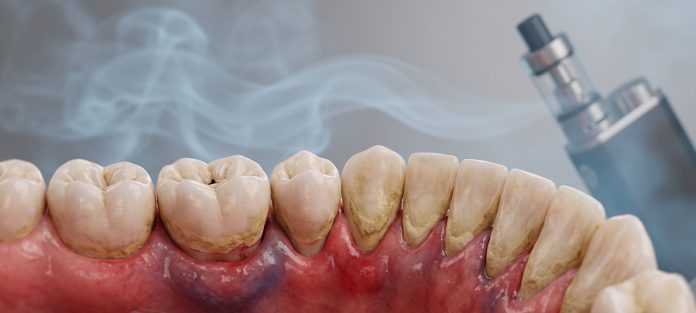
“The dental concerns for vaping are very similar to those seen with cigarette smoking. Exposure to nicotine and added chemicals can dry the mouth and cause changes in the oral tissues,” says Brittany Akl, registered dental hygienist and program operations coordinator for the Oral Health Improvement Program at the Texas Department of State Health Services in Austin.
 “The saliva in our mouths is the body’s best and most abundant defense mechanism,” says Dr. Eidelman. However, any negative impact to the amount of saliva or introducing toxins to saliva weakens its ability to maintain oral health and fight off bad bacteria and infection.
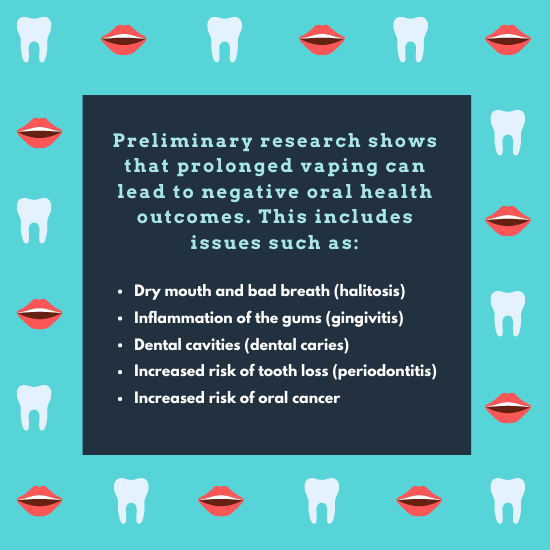
As the amount of bacteria increases, “eventually, in the long term, it can lead to cavities, tooth loss, bad breath, and increased risk of oral cancer,” says Dr. Smruti Pushalkar, research scientist and adjunct assistant professor in the Department of Molecular Pathobiology in the College of Dentistry at New York University.
Dr. Pushalkar’s research found that both cigarette and e-cigarette users had a higher rate of gum disease and infection compared to nonsmokers.
Vaping adds toxins to your mouth
“The most worrisome aspect of vaping is not having certainty of what chemicals are in each vaping product and how they will affect the development of every aspect of the body from long-term vaping exposure,” says Dr. Eidelman.
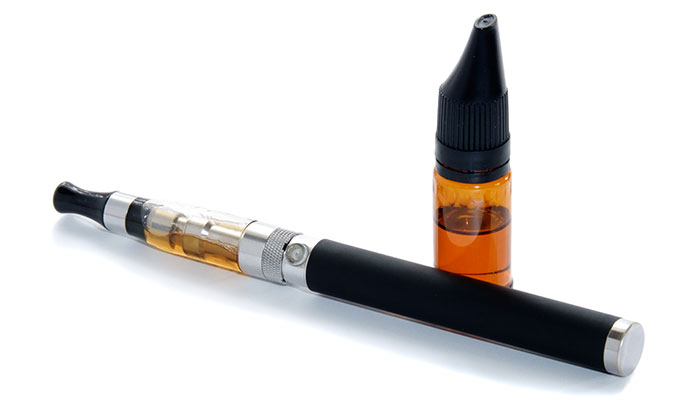
 While what’s in vaping liquids varies, we know they usually contain nicotine and other toxic compounds, often at high concentrations. Research has shown that flavored vaping liquids like bubble gum have the highest concentrations of toxic chemicals. (Vaping with flavored liquids is so popular that researchers at the University of California, San Francisco, estimate that there are over 10,000 flavors currently available.)
“I used [vaping] as a way to relieve stress, then I felt what it did to my body and quit. I wish I would have been better educated on what health issues are associated with smoking anything,” says Megan P., a student at the University of Wyoming in Laramie.
Over time, the effects of vaping can lead to tooth loss and cancer
“The earlier someone starts and the longer they practice vaping, the greater likelihood of adverse dental and overall health outcomes,” says Dr. Jeffrey L. Ebersole, professor and associate dean of research at the University of Nevada, Las Vegas, School of Dental Medicine.
The onset of dental issues due to vaping varies based on many factors.
“Dry mouth or bad breath can be immediate. Things like tooth decay and [gum] disease can begin in just a few months, especially if you also have poor health, poor oral hygiene, additional substance use, or an unhealthy diet. Oral cancer takes longer to develop,” says Akl. “Imagine the amount of exposure [you] will have throughout [your] life.”
For healthier teeth, rinse, get checkups, and quit vaping
To reduce the impact of vaping on your oral health, “first, and foremost, stop vaping,” says Dr. Ebersol. Quitting will stop the continuous flow of vaping liquid and toxins into your mouth, along with reducing the impact to your overall, long-term health.
If you’re not ready to quit yet, one thing you can do to improve your oral health is to rinse after vaping. The goal is to remove the nicotine and toxins from your mouth.
“Rinse the mouth with either mouthwash or water to reduce plaque building on the teeth and the accumulation of bacteria from the vaping liquid,” says Dr. Pushalkar.
In addition, “a continuous and routine relationship with a dental professional is a major step in the right direction,” says Dr. Ebersol.
“It’s advisable to go twice a year for a dental checkup and cleaning. Vaping users can go more often—four times [per year] for dental health checkups and to address tartar and plaque buildup,” says Dr. Pushalkar.
Another drawback? Increasing dental checkups and cleanings to combat the effects of vaping liquids can increase your expenses. Even if you have dental insurance, most plans only cover two of these visits per year. That means two additional visits could cost you an extra $200 per year (based on the average cost of a cleaning). And if you have excessive plaque or tartar buildup from vaping and other factors, the cost can increase by an additional $100 or more per visit.
Without insurance, one way to get affordable dental care is to explore reduced-cost visits to students at a dental school. You can search for a dental school near you on the American Dental Association website.
Need help quitting? These resources will help.
“I always knew it was bad for me; that’s why I quit. I originally used [vaping] to help me quit smoking cigarettes, which worked. Then, once more research came out about how bad vaping was, I quit that too. It was easier to quit [vaping] than cigarettes,” says Madison C., a student at Portland State University in Oregon.
Quit smoking and vaping tools: Truth Initiative
Help quitting vaping: Smokefree Teen
Vaping may be just as damaging to oral health as cigarettes: Arkansas NPR
The impact and hidden consequences of vaping on oral health: American Association of Orthodontists
Article sources
Brittany Akl, RDH, MSHS, program operations coordinator, Oral Health Improvement Program, Texas Department of State Health Services, Austin.
Jeffrey L. Ebersole, PhD, professor and associate dean for research, University of Nevada, Las Vegas, School of Dental Medicine.
Alec S. Eidelman, DMD, MPH, postdoctoral research fellow, Department of Oral Health Policy and Epidemiology, Harvard School of Dental Medicine, Boston, Massachusetts.
Smruti Pushalkar, PhD, research scientist and adjunct assistant professor, Department of Molecular Pathobiology, New York University College of Dentistry.
American Dental Association. (2019, October 21). American Dental Association statement on vaping. ADA. https://www.ada.org/en/press-room/news-releases/2019-archives/october/american-dental-association-statement-on-vaping
American Dental Association. (2020, June 15). Dentists can take lead, action in responding to vaping smoke. ADA. https://www.ada.org/en/publications/new-dentist-news/2020-archive/june/dentist-can-take-lead-action-in-responding-to-vaping-spike
Drazen, J. M., Morrissey, S., & Campion, E. W. (2019). The dangerous flavors of e-cigarettes. New England Journal of Medicine, 380, 679–680. https://doi.org/10.1056/NEJMe1900484
Ebersole, J., Samburova, V., Son, Y., Cappelli, D., et al. (2020). Harmful chemicals emitted from electronic cigarettes and potential deleterious effects in the oral cavity. Tobacco Induced Diseases, 18, 41. https://doi.org/10.18332/tid/116988
Huckins, J. F., daSilva, A. W., Wang, W., Hedlund, E., et al. (2020, June 17). Mental health and behavior of college students during the early phases of the COVID-19 pandemic: Longitudinal smartphone and ecological momentary assessment study. Journal of Medical Internet Research, 22(6). doi:10.2196/20185
Kim, S., Smith, S., Beauchamp, C., Song, Y., et al. (2018). Cariogenic potential of sweet flavors in electronic-cigarette liquids. PLoS One, 13(9), e0203717. https://doi.org/10.1371/journal.pone.0203717
Layden, J. E., Ghinai, I., Pray, I., Kimball, A., et al. (2020). Pulmonary illness related to e-cigarette use in Illinois and Wisconsin – final report. New England Journal of Medicine, 382(10), 903–916. https://doi.org/10.1056/NEJMoa1911614
Mathur Gaiha, S., Cheng, J., & Halpern-Felsher, B. (2020, August 11). Association between youth smoking, electronic cigarette use, and coronavirus disease 2019. Journal of Adolescent Health. https://doi.org/10.1016/j.jadohealth.2020.07.002
Pothier, K. (2019, August 16). Vaping and oral health. Dentistry Insider. https://dentistryinsider.tamhsc.edu/vaping-and-oral-health
Pushalkar, S., Paul, B., Li, Q., Yang, J., et al. (2020). Electronic cigarette aerosol modulates the oral microbiome and increases risk of infection. iScience, 23(3), 100884. https://doi.org/10.1016/j.isci.2020.100884
Samburova, V., Bhattarai, C., Strickland, M., Darrow, L., et al. (2018). Aldehydes in exhaled breath during e-cigarette vaping: Pilot study results. Toxics, 6(3), 46. https://doi.org/10.3390/toxics6030046
Schiff, A. M., & Goodwin, J. (2016, July 19). 2016 Dental Economics annual fee survey. Dental Economics. https://www.dentaleconomics.com/practice/article/16388092/the-dental-economics-annual-fee-survey.
US Food and Drug Administration. (2020, July 31). Tobacco product problem reports. FDA. https://www.fda.gov/tobacco-products/tobacco-science-research/tobacco-product-problem-reports#ends.
Zhu, S.-H., Sun, J. Y., Bonnevie, E., Cummins, S. E., et al. (2014). Four hundred and sixty brands of e-cigarettes and counting: Implications for product regulation. Tobacco Control, 23(Suppl 3), iii3–iii9. https://doi.org/10.1136/tobaccocontrol-2014-051670