



























Key points
- Concerts and live music events can make for great memories, but any kind of large, public event also comes with some risks.
- Preparing ahead by packing useful items can help keep you and your friends comfortable and safe.
- You can help foster a positive environment for yourself and others at concerts by getting familiar with prevention and de-escalation techniques.
Content warning: This article discusses topics, including sexual trauma and substance use, that may be disturbing to some readers.
If you’re a regular concertgoer, you already know: Listening and dancing to live music feels great. Festivals, concerts, and other live music events are a fun way to bond with friends and check out from the day-to-day academic routine. In a recent CampusWell survey, nearly 80 percent of students said they’ve attended at least one concert in their lives, and 42 percent of students said they’d attended a concert within the past year.
“You can’t think about anything else but enjoying the experience. There’s no pressure for grades or any expectations, you just enjoy the music!”
—Kurt L.*, third-year student, University of Washington, Seattle
“[Concerts let me] get outside my own head [and] focus on something fun and immediate, especially in contrast to so many remote events [and] meetings these last few years.”
—Taylor S.*, doctoral student, Southern Methodist University, University Park, Texas
“The unity. Everyone is hearing the same thing all at once, but everyone is feeling different emotions because of it.”
—Shelby W., second-year student, Northwest Missouri State University, Maryville
“I like how live events will often be different from album music, so it feels like you’re getting your own unique experience of the music that not many other people have had or will have.”
—Hunter R.*, first-year student, New Jersey Institute of Technology, Newark
“Everybody getting together and having a good time is a feeling like no other. Just a sense of community and happiness. Plus dancing makes me feel good.”
—Olivia S., second-year student, Portland State University, Oregon
*Name changed
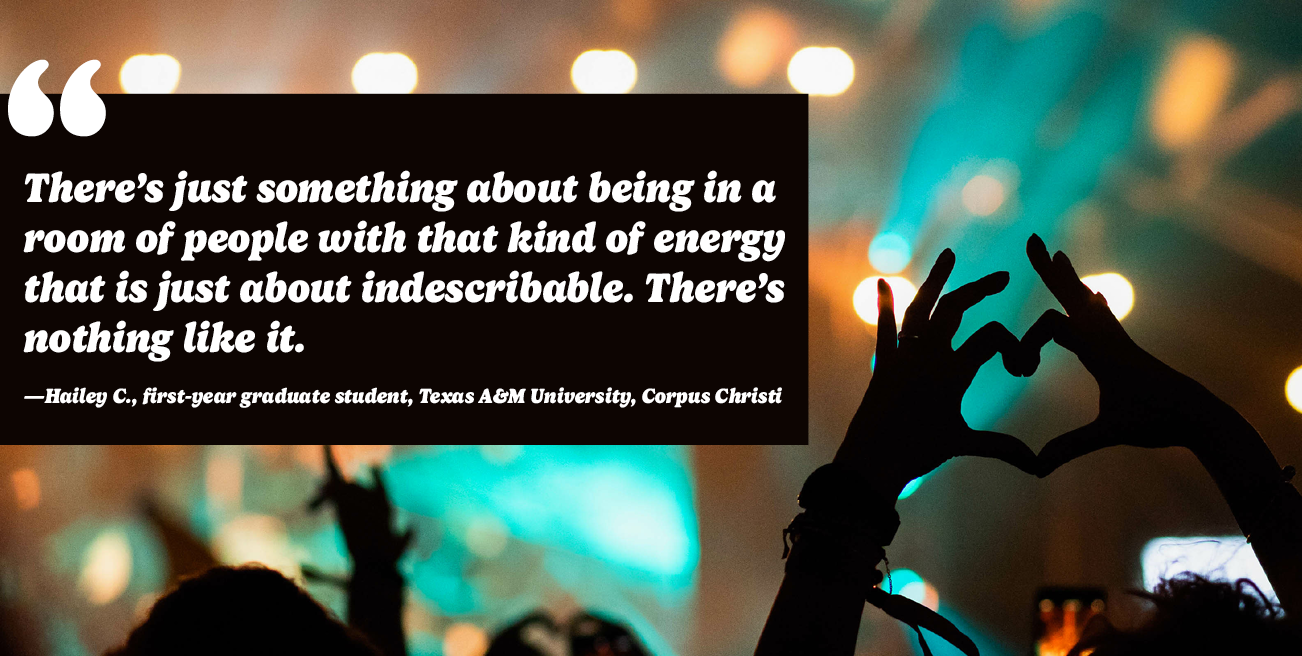
“I love the energy of a good crowd,” says Hailey C., a first-year graduate student at Texas A&M University in Corpus Christi. “It doesn’t matter the size of the event or if I even know the band playing. There’s just something about being in a room of people with that kind of energy that is just about indescribable. There’s nothing like it.”
Most of us would agree that live music provides some seriously positive payoffs: a sense of community, a way to release pent-up stress, and the chance to be fully yourself. Before you grab your fanny pack and fringed boots, check out our top safety tips to help you make this festival season one for the books.
Any kind of large music or entertainment space that holds a sizable crowd can present some safety risks—especially when it comes to harassment, crowd crush, or gun violence.
In December 2017, Our Music My Body (OMMB) surveyed 509 music fans and found that 41 percent reported that they’d been groped at a concert. And in a large-scale 2020 survey of electronic dance music partygoers in New York City, 15 percent of attendees reported experiencing nonconsensual sexual contact at these events.
 There’s power in numbers. Even if you’re just heading to the bathroom or to grab some food, take at least one friend with you. Your group should also have a designated meeting spot where you’ll know to reunite with each other at a certain time or if someone is lost. If you’re at a very large, spread-out festival (think Coachella), you could use the Google Maps or WhatsApp “share my location” functionality to keep track of everyone in your crew. Just know that this feature can quickly drain your phone battery, so don’t share your location for the full day—instead, set predetermined times with your friends to turn it on. Alternatively, if everyone in the group has an iPhone, you can use the Find My app to track each other’s location.
Tip: Wear brightly colored clothing and keep a mental note of what everyone is wearing (or opt for matching outfits, if that’s your vibe).
If you’re going solo to a music event, make sure your phone is charged and accessible at all times, and that at least a couple friends or family members know where you’re headed (including the specific venue and address). Let them know you’ll message them when you’re home safe, and ask them to check in if they don’t hear from you.
Those neon platforms might look amazing in your Instagram feed, but they won’t be on your side if you need to exit a venue quickly. Plan your outfit to include comfortable boots, sneakers, or sandals. Bonus: You’ll probably be able to dance for longer if your feet aren’t hurting a few songs in.
Backpacks and totes can carry plenty of stuff, but they’re bulky and can be a target for pickpockets. Your best bet is a small cross-body bag or a belt bag/fanny pack (but be sure to check venue regulations, since some now have a “clear bags only” policy). Another way to avoid losing items or having them stolen is by packing only the essentials—your phone, an emergency whistle, a form of ID, a debit or credit card, and your keys. If you’re going to add anything to that list, make it an external phone charger: They’re portable, affordable, and can extend your phone’s battery life. It’s also wise to keep a picture of your ID in your phone just in case your physical copy goes missing.
“If your phone doesn’t have good battery life or you’re planning to use it a lot to take photos and videos, an external battery or power bank is so important. Without your phone, you can’t call for help, get directions, hire an Uber, share your location, or get potentially important news updates,” says Jackie Kolgraf, co-founder and editor of United By Pop, an online music community in both the United Kingdom and the US. “There are new battery packs for smartphones that magnetically stick onto the back of your phone and give you 40 to 70 percent more charge, depending on your phone model. It’s a worthwhile investment in your safety.”
When you first arrive at the venue (ideally before everyone is lost in the music and packed elbow to elbow), take a minute to check out where the nearest exits are. If there’s an emergency, knowing the direction of the exit closest to you is crucial, as it can be challenging to navigate in a moving herd of people. It’s also a good time to scope out paramedic stations and bathrooms.
“The merchandise table is a neutral and safe destination for you to go if ever someone is bothering you or following you,” says Ashley Driscoll, founder of GrooveSafe, a nonprofit that aims to stop sexual assault at live entertainment events. “There are generally staff there who can speak up if you need help.”
Watching from the front row can be appealing, but it’s also significantly more dangerous since the crowd tends to push toward the stage as the concert progresses—meaning there’s less space at the front and it can be almost impossible to exit until the concert is done. Crowds at the front also tend to be rowdier, especially in cases where a mosh pit might form. It’s best to be off-center and closer to the edge of the crowd for an easier exit path, if needed. “Don’t discount the high amount of fun and lower amount of stress you’ll have standing toward the back,” says Kolgraf. “You’ll have more space to yourself; easier access to concessions, bathrooms, and the exit; and an overall safer experience—especially in any case of crowd crush. Your safety is more important than TikTok videos from the barrier. Plus, your phone has pretty good zoom these days.”
It’s rare, but if you happen to find yourself in a crowd crush (which is exactly what it sounds like), remember to protect your head and chest. With your dominant arm, grab your opposite forearm and create a “shield” in front of your head and chest. This will help you maintain enough space to breathe and prevent your arms from being pinned to your sides. Don’t push forward, and avoid putting your bag on the ground or bending down to pick anything up—if one person trips, it could cause a dangerous pile.
Some people will be drinking and/or using drugs at live music events, which poses some additional risks—for example, recreational drugs like MDMA or cocaine can sometimes be laced with fentanyl or other synthetic opioids, and even a tiny amount of fentanyl can lead to a (potentially fatal) overdose. If you know someone who may consume drugs or alcohol at a live music event, share these safety tips:
- Drink plenty of water to avoid dehydration.
- Eat regularly; consuming substances on an empty stomach comes with potentially severe risks.
- Never accept an open drink from someone you don’t know or trust, as it could be spiked.
- Bring fentanyl test strips or check the venue for a testing site.
- Know the signs of an overdose and what to do if one happens.
“Never leave your drink unattended to lower the risk of it being compromised, and learn the signs of what happens to someone who has been drugged,” says Driscoll. “Tell a friend or security guard immediately if you feel a sudden change of your physical state such as being dizzy, very tired, or ‘out of it.’” Drugs such as flunitrazepam (Rohypnol, or “roofies”), gamma-hydroxybutyrate (GHB), or ketamine are virtually impossible to taste.
Read more about safe social drinking, including topics such as mixing medications with alcohol and navigating sexual consent as it relates to alcohol use. As a reminder: A survivor of sexual assault is never at fault.
If a tense situation arises and you find yourself in the middle, you can help de-escalate violence before it begins. Remain calm, give the agitated person or people enough space, and change the setting if at all possible (e.g., ask a friend to get some food with you if you sense drama brewing). It also helps to speak slowly and avoid raising your voice. Try to listen and be empathetic, using sentences like “I sense that you’re upset” instead of “calm down.”
“Always scan your horizon and check on your neighbors. The more we start to do this, the more likely we can create safer spaces to make sure everyone around us is having a good time,” says Driscoll. “If someone seems uncomfortable, they probably are. That’s when you can intervene and make sure they aren’t in danger.”
If you witness someone who seems like they may be at risk of harassment or sexual assault, it can be helpful to step in. The five D’s of bystander intervention can help you remember different techniques to use:

If the situation is safe and under control, you could clearly state the facts to help someone out: “They don’t want to dance with you. You should leave them alone.”
 Get someone else to help you out. For instance, if someone is drunk and acting inappropriately, try to seek out a sober member of their group to help them get home ASAP. If they’re alone or nobody is available, ask a security guard for help.
 Divert attention or make an excuse to intervene. If the person in trouble is a friend, this could be as simple as asking them to accompany you to the bathroom or telling them your crew is moving to a different location. If you’re trying to help a stranger, you could interrupt to ask a question (like where the merch stand is or what time your favorite band is hitting the stage).
 If you witness an incident that is already being handled by someone else, you can still be of assistance by documenting it using video or photos, which can serve as helpful evidence if law enforcement gets involved. It goes without saying: Don’t share or publish these without permission.
 This means checking in with someone after an incident. In instances where you can’t help in the moment but saw or suspect something bad may have happened, check in with the person and see if they need assistance finding their friends or getting out of the crowd.
Bystander 101 training: GrooveSafe
8 tips to follow if you’re in a crushing crowd: NPR
Article sources
Ashley Driscoll, founder, GrooveSafe, Stow, Massachusetts.
Jackie Kolgraf, co-founder and editor, UnitedByPop.com, music content producer, SiriusXM, Boston, Massachusetts.
Blum, D. (2022, October 31). What to do if you find yourself in a crowd crush. New York Times. https://www.nytimes.com/article/crowd-crush-safety.html
CampusWell survey, December 2022.
GrooveSafe. (n.d.). GrooveSafe bystander training video. https://groovesafe.org/training
Healthwise. (2021, November 8). Date rape drugs. Government of Alberta. https://myhealth.alberta.ca/Health/Pages/conditions.aspx?hwid=uq2448
Our Music My Body. (2018). 2017 campaign & survey report. Resilience. https://www.ourresilience.org/wp-content/uploads/2018/07/OurMusicMyBody_2017SurveyReport.pdf
Palamar, J. J., & Griffin, M. (2020). Non-consensual sexual contact at electronic dance music parties. Archives of Sexual Behavior, 49(3), 909–917. https://doi.org/10.1007/s10508-019-01568-y
Right To Be. (n.d.). The 5Ds of bystander intervention. https://righttobe.org/guides/bystander-intervention-training/
Turris, S. A., Jones, T., & Lund, A. (2018). Mortality at music festivals: An update for 2016-2017—academic and grey literature for case finding. Prehospital and Disaster Medicine, 33(5), 553–557. https://doi.org/10.1017/s1049023x18000833