Key points
- One-quarter of Canadian adults aged 18-34 are not getting the recommended seven to nine hours of sleep per night.
- Deep sleep is crucial for the cognitive function we need to retain information.
- Research shows that getting enough sleep is tied to better academic performance.
Do you regularly pull all-nighters to finish assignments or study for exams? It’s a common student habit, but it comes with a major downside: Short, irregular sleep patterns mean you’re likely to lack deep sleep, a critical component for learning. In other words, skipping sleep can actually counteract all your time spent studying, turning test prep into an uphill battle. If you’re struggling to get the recommended seven to nine hours of sleep per night, you’re not alone—in a recent CampusWell survey, nearly half of student respondents said they get less than seven hours of sleep per night. In the same survey, 42 percent of respondents said they get less than six hours of nightly sleep during finals.
For your best shot at academic success, challenge yourself to sleep for eight hours every night. Before you roll your (weary) eyes, read on to find out how it works and why research shows it’s worth a shot.

“Deep sleep is also known as ‘slow-wave sleep’: It’s the time during sleep when it’s the most difficult to wake a person,” says Dr. Charlene Gamaldo, Professor of Neurology and Sleep Medicine at Johns Hopkins University in Baltimore, Maryland. “During deep sleep, your brain removes ‘waste’ to function more efficiently.”
In other words, this stage of sleep helps the brain clear out some clutter to make space for new information—sort of like deleting files to free up space on your computer’s hard drive. This intake of new information is also known as memory consolidation, which is when your brain converts short-term memories into long-term memories (a.k.a. helping you remember that complex math equation or scientific term when it comes up on an exam).
Think of deep sleep as a smartphone update for your brain. If you skip a few nights, your apps can get glitchy. The deep stage is critical for optimal brain functioning, including memory and creativity, but it’s also important for keeping your basic bodily functions running well.
Here are a few ways that lack of sleep can affect us:
Mood and mental health
You’re more likely to experience feelings of irritability, stress, worry, or sadness.
Physical health
You’re more prone to getting sick, both in the short term (like catching a virus) and long term (chronic illness, such as heart disease).

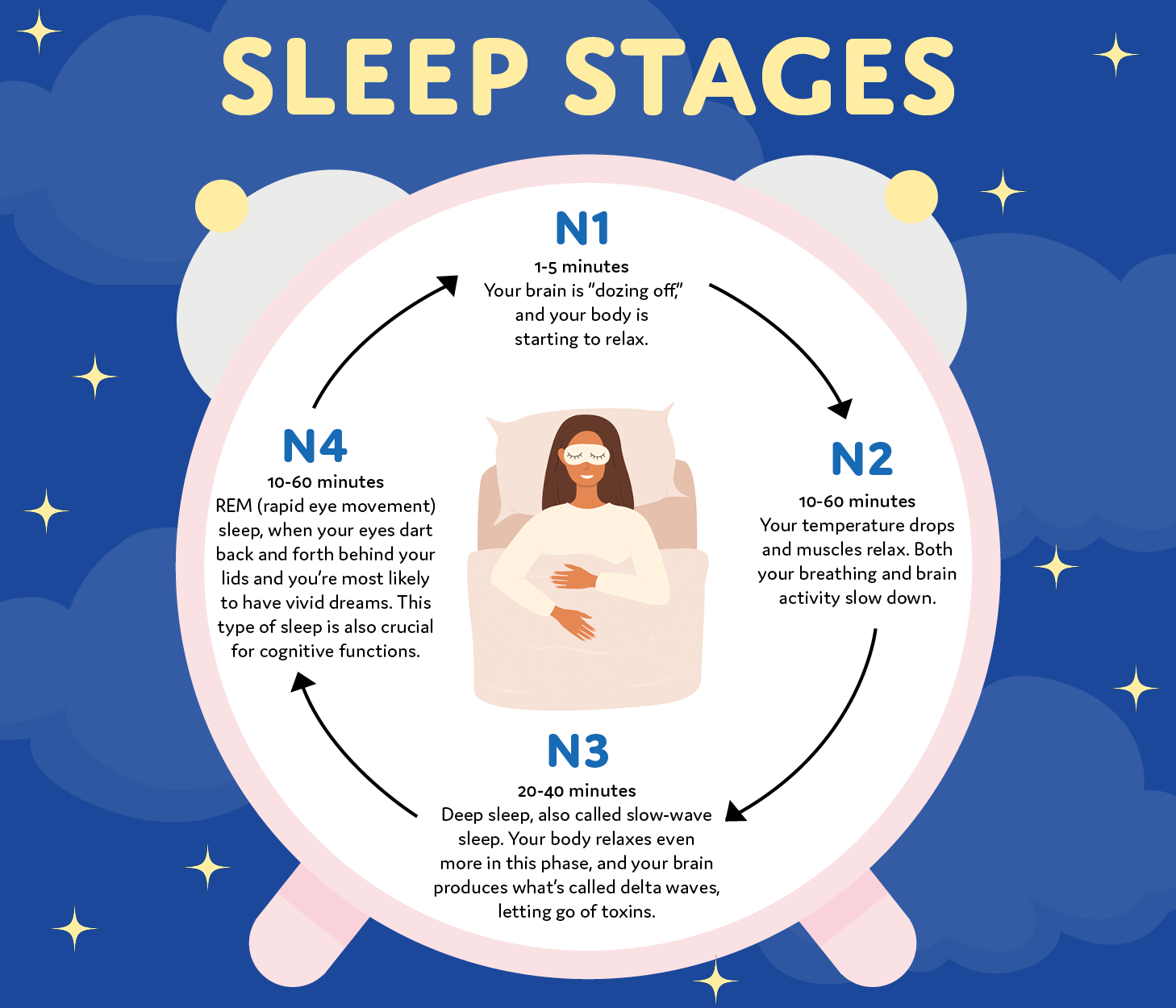
There are four stages of sleep, according to the U.S. National Sleep Foundation. As you can see on this chart, deep sleep occurs in stage N3. It takes time for your body to settle into deep sleep, so you may not get enough if you delay bedtime until the wee hours of the morning (or if you’re experiencing insomnia).
Sleep stages
N1: Your brain is “dozing off,” and your body is starting to relax.
Duration: 1-5 minutes
N2: Your temperature drops and muscles relax. Both your breathing and brain activity slow down.
Duration: 10-60 minutes
N3: Deep sleep, also called slow-wave sleep. Your body relaxes even more in this phase, and your brain produces what’s called delta waves, letting go of toxins.
Duration: 20-40 minutes
N4: REM (rapid eye movement) sleep, when your eyes dart back and forth behind your lids and you’re most likely to have vivid dreams. This type of sleep is also crucial for cognitive functions.
Duration: 10-60 minutes

Your logic might tell you that cramming for an upcoming exam is necessary, but burning the midnight oil could actually hinder your academic performance. One study of 25 undergraduates at a small liberal arts college in the U.S. found that students who slept for eight or more hours during the week of final exams scored significantly higher on their finals than their classmates who did not get at least eight hours of sleep in previous nights.
To boost your chances of better grades, take the eight-hour sleep challenge: Commit to eight hours of sleep during finals week or whenever you have an important exam or other project coming up.

Of course, getting eight hours of sleep isn’t always as easy as it sounds. If you’ve spent the past few days or weeks struggling to fall (or stay) asleep most nights, you may be experiencing insomnia. This isn’t uncommon—we all have trouble with sleep from time to time—but if it’s interfering with your life, consider getting help from a professional.
Cognitive behavioural therapy for insomnia (CBT-I) has been shown to improve sleep for those suffering from insomnia. CBT-I generally includes helping you reframe any false or fear-based feelings you might have about sleep, as well as education on better sleep habits.
CBT-I is generally combined with practical relaxation techniques. If you’re suffering from insomnia, here are a few to try:
Practise breathing exercises
There are many types of breathing techniques that promote relaxation crucial for sleep, such as our 9 magic breaths meditation or 4-7-8 breathing exercise.
Meditate
There’s an endless list of guided meditations on YouTube or on mobile apps (try Calm or Headspace). Also be sure to check out our selection of meditation exercises, including this bedtime full-body scan.
Try hypnotherapy
Hypnosis doesn’t work on everyone, but there’s evidence to suggest that it’s a useful tool for improving sleep quality. One small study of women found that the hypnotic suggestion to sleep deeper actually led to increased deep sleep in participants. If you’re going to try hypnotherapy, make sure you seek out a trained professional.
Write out your worries
 If you close your eyes and your thoughts begin racing, it might keep you awake for longer than you’d like. “The act of writing out whatever is on your mind offloads those thoughts onto paper so that your brain stops ruminating about them as much,” says Dr. Michael K. Scullin, Sleep Researcher and Associate Professor of Psychology and Neuroscience at Baylor University in Waco, Texas. “I keep a pad of paper and a pen by my nightstand and use this strategy when I’m going through a season where there’s a lot on my mind.”
Keep a consistent sleep/wake schedule
You’ve heard it before, but it’s worth repeating: Sticking to a similar bedtime and wake time most days can really benefit your brain. Life happens and schedules get thrown off, but irregular sleep patterns are associated with poorer academic performance, so it’s a good idea to try to go to sleep and wake up around the same time each day.
Get enough sunlight and exercise during the day

Getting sunlight during the day can help your body fall asleep at night. In the winter, when sun exposure is limited, make sure you’re getting enough vitamin D (take a supplement if needed and OK’d by your health care provider). Regular exercise has also been shown to improve sleep quality—another reason to try to fit in a daily outdoor activity.
Create an ideal sleep environment
Keep your bedroom at around 18°C (65°F) to avoid overheating at night, and (if possible) invest in a quality mattress or bed linens if yours aren’t cutting it in terms of comfort. You could also consider blackout curtains to minimize light.
Manage your time
“Better to go to sleep earlier and wake up early to study than the other way around,” says Annabell B., a third-year undergraduate student at St. Mary’s University in Calgary, Alberta. “You cannot get back time to sleep, but you can always fit in studying somewhere else.”
Minimize distractions
Check your smartphone’s screen time usage and you might be shocked at how much time you spend passively consuming mobile content (no shame, but some of those precious hours could be spent sleeping!). When you’re doing schoolwork with your phone off or in the other room, schedule an alarm so you can reward yourself with a phone break to check in with friends or social media.
“Minimize distractions and shut off your phone or the TV while studying,” says Jamie F.*, a second-year graduate student at University of Wyoming in Laramie. “Allow time for fun, too, so you don’t feel off-balance between work and life.”
Try the Pomodoro method
“I use a Pomodoro timer method to study in 30-minute increments,” says Whitney A., a second-year graduate student at Berry College in Mount Berry, Georgia. “This helps me to be productive and get a lot done during the day.” This technique involves chunking work into 25- to 30-minute sessions, with a break in between. See the “Find out more” section for a free online Pomodoro timer.
*Name changed
Why sleep?: Sleep on it Canada
Getting a good night’s sleep: Anxiety Canada
Helpful hints for better sleep: University Health Network
Bedtime calculator: American Academy of Sleep Medicine
The best apps for sleep: Sleep Foundation
Article sources
Charlene Gamaldo, MD, Professor of Neurology and Sleep Medicine, Johns Hopkins University, Baltimore, Maryland.
Michael Scullin, PhD, Sleep Researcher and Associate Professor of Psychology and Neuroscience, Baylor University, Waco, Texas.
CampusWell survey, January 2022.
Choi, J. H., Lee, B., Lee, J. Y., Kim, C.-H., Park, B., Kim, D. Y., Kim, H. J., & Park, D.-Y. (2020). Relationship between sleep duration, sun exposure, and serum 25-hydroxyvitamin D status: A cross-sectional study. Scientific Reports, 10(1). https://doi.org/10.1038/s41598-020-61061-8
Cordi, M. J., Pysch, D., Schlarb, A. A., & Rasch, B. (2014). Deepening sleep by hypnotic suggestion. Sleep, 37(6), 1143–1152. https://doi.org/10.5665/sleep.3778
Friedrich, A., & Schlarb, A. A. (2017). Let’s talk about sleep: A systematic review of psychological interventions to improve sleep in college students. Journal of Sleep Research, 27(1), 4–22. https://doi.org/10.1111/jsr.12568
Kline, C. E. (2014). The bidirectional relationship between exercise and sleep: Implications for exercise adherence and sleep improvement. American Journal of Lifestyle Medicine, 8(6), 375–379. https://doi.org/10.1177/1559827614544437
Liu, Y., Wheaton, A. G., Chapman, D. P., Cunningham, T. J., Lu, H., & Croft, J. B. (2016). Prevalence of healthy sleep duration among adults—United States, 2014. Morbidity and Mortality Weekly Report (MMWR), 65(6), 137–141. https://doi.org/10.15585/mmwr.mm6506a1
National Institutes of Health. (2019, August 13). Brain basics: Understanding sleep. National Institute of Neurological Disorders and Stroke. Retrieved January 21, 2022, from https://www.ninds.nih.gov/Disorders/patient-caregiver-education/understanding-sleep#4
Newsom, R. (2020, October 22). Cognitive behavioral therapy for insomnia (CBT-I). Sleep Foundation. https://www.sleepfoundation.org/insomnia/treatment/cognitive-behavioral-therapy-insomnia
Newsom, R. (2021, June 24). How blue light affects sleep. Sleep Foundation. https://www.sleepfoundation.org/bedroom-environment/blue-light
Newsom, R. (2021, September 20). Sleep debt: Can you catch up on sleep? Sleep Foundation. https://www.sleepfoundation.org/how-sleep-works/sleep-debt-and-catch-up-sleep
Okano, K., Kaczmarzyk, J. R., Dave, N., Gabrieli, J. D., & Grossman, J. C. (2019). Sleep quality, duration, and consistency are associated with better academic performance in college students. Npj Science of Learning, 4(1). https://doi.org/10.1038/s41539-019-0055-z
Phillips, A. J., Clerx, W. M., O’Brien, C. S., Sano, A., Barger, L. K., Picard, R. W., Lockley, S. W., Klerman, E. B., & Czeisler, C. A. (2017). Irregular sleep/wake patterns are associated with poorer academic performance and delayed circadian and sleep/wake timing. Scientific Reports, 7(1). https://doi.org/10.1038/s41598-017-03171-4
Public Health Agency of Canada, (2019, September 6). Are Canadian adults getting enough sleep? https://www.canada.ca/en/public-health/services/publications/healthy-living/canadian-adults-getting-enough-sleep-infographic.html
Scullin, M. K. (2018). The eight hour sleep challenge during final exams week. Teaching of Psychology, 46(1), 55–63. https://doi.org/10.1177/0098628318816142
Scullin, M. K., Krueger, M. L., Ballard, H. K., Pruett, N., & Bliwise, D. L. (2018). The effects of bedtime writing on difficulty falling asleep: A polysomnographic study comparing to-do lists and completed activity lists. Journal of Experimental Psychology: General, 147(1), 139–146. https://doi.org/10.1037/xge0000374
Suni, E. (2021, December 20). Stages of sleep. Sleep Foundation. https://www.sleepfoundation.org/stages-of-sleep