
Key points
- Several studies link attending faith-based services with living a longer life as well as short-term mental and physical health benefits.
- You don’t necessarily have to be part of a religious group to get these benefits—social connectedness is key.
Where do you turn when things are hard? For many, it’s to religion or spirituality—a quarter of people surveyed by a 2020 Pew Research poll said that their faith had become stronger because of the coronavirus pandemic, while only 2 percent said their faith had weakened.
It turns out there’s a strong link between attending religious services and health. Those who regularly attend religious or spiritual services and are part of a faith-based community appear to live longer. In a 2017 study published in JAMA Internal Medicine, a team of researchers analyzed data spanning 16 years from over 70,000 US women between the ages of 30 and 55. “We found that those who attended religious services regularly were 33 percent less likely to die over the 16 years of follow-up,” says Dr. Tyler VanderWeele, a professor of epidemiology at the Harvard T.H. Chan School of Public Health. “We also found that those who attended religious services regularly were 27 percent less likely to become depressed; about 50 percent less likely to divorce; and were five times less likely to [die by] suicide.” This study was limited in that it included a mainly white population, but similar studies have also found a link between attending religious services and living longer among other racial/ethnic groups, such as Hispanics and African Americans.
Source: Idler, E., et al. (2017). Religion, a social determinant of mortality? A 10-year follow-up of the Health and Retirement Study. PloS One.
“Something about the communal religious experience seems to matter. Something powerful takes place there. Something that enhances health and well-being,” says Dr. VanderWeele.
Dr. VanderWeele points out that simply identifying as spiritual or religious may not have significant health impacts. Studies suggest that the link may have more to do with the close social ties religious groups offer, since a plethora of research finds that social connectedness is key to increasing your chances of living a long and healthy life.

There are four sets of factors that may explain why people who are religious or spiritual tend to be healthier and live longer, says Dr. Howard Friedman, a professor at the University of California, Riverside, and author of The Longevity Project.
Social ties
Being plugged into a community has huge benefits for your health. Health professionals have been studying the power of positive social ties for years and have found that social connectedness—specifically close ties to a handful of people—is a strong predictor of increased longevity and mental health.
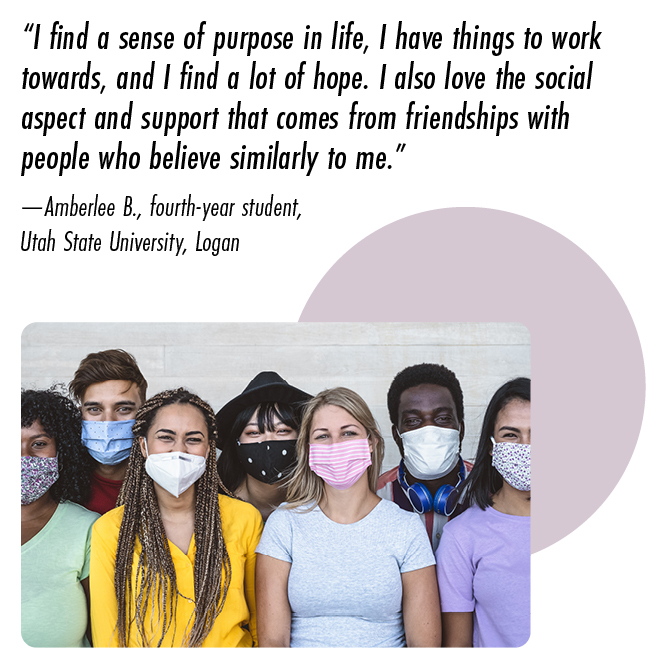 For many people, religion or spirituality is largely about connection. “Whether at religious services, communal groups, or community services to help others, these individuals tend to maintain stronger social networks, which is an excellent predictor of health and longevity,” says Dr. Friedman. “Friendship networks that help others also tend to be the most beneficial types, with other healthy, spiritual people involved.”
In other words, hanging out with people who have a shared set of altruistic values often found in religious groups could be a stronger boost for your health than hanging out with people with a shared affinity for football. “It may be that forms of community participation that [involve] a shared set of values, unified purpose or mission, and a long history have larger effects on health than those that do not have these things,” says Dr. VanderWeele. “So we might expect participation in a religious group, or maybe a volunteer or political organization, to have larger effects on health than, say, showing up weekly for a card game.” Just keep in mind that most community groups, including religious ones, are not able to meet in person until the pandemic has ended.
Mental health
There’s no doubt that certain religious communities can be harmful “when they involve such things as indoctrination, irrationality, abuse, fear, or even cult-like activities,” says Dr. Friedman. However, “it is also clear that many organizations that have a spiritual theme are focused around promoting goodness and thriving.” These spiritual groups can foster optimism and resilience—two traits that can help you be happier and live longer.
 Studies have also found a link between attending religious services and depression. A study using the same data set of 70,000 women published in the Annals of Behavioral Medicine found that those who frequently attended religious services had the lowest risk of depression. “We see evidence for strong effects on depression, but much less so with anxiety,” says Dr. VanderWeele, who was one of the authors on the study. “With anxiety, it is possible that religious service attendance brings peace to some but causes stress for others.”
Healthier habits
A third set of factors linking spirituality to a healthier life comes down to the fact that religious groups simply tend to promote healthy habits. “People who are more spiritual tend to drink less alcohol, avoid smoking and drug abuse, and stay physically in shape and in touch with nature,” explains Dr. Friedman. “So when trouble strikes, they may sleep better, reach out to others, and avoid drowning their troubles in alcohol, drugs, overeating, and other destructive behaviors.”
This may be what’s behind at least one of the so-called “Blue Zones”—five communities on Earth where people live the longest and are healthier than average. In Loma Linda, California—the only Blue Zone in the US—a third of the population identify as Seventh-Day Adventists, which is a religious group that believes in treating the body as a temple. They don’t smoke or drink, eat little or no meat, and get plenty of exercise.
“[My spirituality] keeps me in check and disciplined in ways that benefit me positively.”
—Lionardo C., fourth-year student, Maria College of Albany, New York
Worldview
 Finally, there’s the way in which a religious or spiritual group can shape your worldview—and specifically how you handle challenging times. “When you consider life events as learning opportunities and opportunities for growth, you tend not to get upset. You approach stressors with a mindset of ‘What can I learn? Where is this leading me?’” says Dr. Helen Lavretsky, a professor of psychiatry at the David Geffen School of Medicine at UCLA in Los Angeles, California.
In other words, believing that everything happens for a reason or that there is a greater purpose for your life can help you avoid distress. “The combination of the teachings, the relationships, and the spiritual practices over time gradually alters behavior, creates meaning, alleviates loneliness, and shapes a person in ways too numerous to document,” says Dr. VanderWeele.
Is joining a church, mosque, temple, synagogue, or other place of worship the key to a happier, healthier life? For some, it may be. “My view with regard to the individual implications of the research is that, for the roughly half of all Americans who do believe in [a higher power] but do not regularly attend services, the relationship between service attendance and health may constitute an invitation: an invitation back to communal religious life,” says Dr. VanderWeele.

If you’re not part of an organized religious group—and don’t want to be—that’s totally fine. There are plenty of other ways to tap into the benefits that religion can provide in a way that works with your life and your beliefs.
Join a volunteer group.
The health benefits associated with altruism aren’t exclusive to a certain religious group (or believing in a specific deity). Volunteering is also associated with decreased levels of depression and stress and increased longevity and sense of purpose.
Check out your campus interfaith council.
If you’re compelled by the idea of joining a religious group but aren’t necessarily attached to one particular doctrine over another, see if your school has an interfaith council, where leaders from various campus religious groups meet to work together.
Adhere to healthy living practices.
Spirituality is just one way you can improve your health and happiness—and it’s certainly not the only way. If you’re motivated to live a healthier life, you can do that by spending time in nature and with friends, avoiding alcohol and smoking, getting plenty of sleep, and prioritizing happiness.
Article sources
Howard S. Friedman, PhD, distinguished professor, University of California, Riverside, and author of The Longevity Project, Los Angeles, California.
Helen Lavretsky, MD, professor of Psychiatry In-Residence, director, Integrative Psychiatry Clinic, David Geffen School of Medicine at UCLA, Los Angeles, California.
Tyler J. VanderWeele, professor of epidemiology, Harvard T.H. Chan School of Public Health, Harvard University, Cambridge, Massachusetts.
Ellison, C. G., Hummer, R. A., Cormier, S., & Rogers, R. G. (2000). Religious involvement and mortality risk among African American adults. Research on Aging, 22(6), 630-667.
Gecewicz, C. (2020, April 30). Few Americans say their house of worship is open, but a quarter say their faith has grown amid pandemic. Pew Research Center. https://www.pewresearch.org/fact-tank/2020/04/30/few-americans-say-their-house-of-worship-is-open-but-a-quarter-say-their-religious-faith-has-grown-amid-pandemic/
Holt-Lunstad, J., Smith, T. B., & Layton, J. B. (2010). Social relationships and mortality risk: A meta-analytic review. PLoS medicine, 7(7), e1000316.
Idler, E., Blevins, J., Kiser, M., & Hogue, C. (2017). Religion, a social determinant of mortality? A 10-year follow-up of the Health and Retirement Study. PloS one, 12(12), e0189134.
CampusWell, December survey, 2020.
Laird, K. T., Krause, B., Funes, C., & Lavretsky, H. (2019). Psychobiological factors of resilience and depression in late life. Translational Psychiatry, 9(1), 88. https://doi.org/10.1038/s41398-019-0424-7
Li, S., Stampfer, M. J., Williams, D. R., & VanderWeele, T. J. (2016). Association of religious service attendance with mortality among women. JAMA Internal Medicine, 176(6), 777–785. https://doi.org/10.1001/jamainternmed.2016.1615
Li, S., Okereke, O. I., Chang, S., Kawachi, I. et al. (2016). Religious service attendance and lower depression among women—a prospective cohort study. Annals of Behavioral Medicine, 50, 876–884. https://doi.org/10.1007/s12160-016-9813-9
Macvean, M. (2015, July 11). Why Loma Linda residents live longer than the rest of us: They treat the body like a temple. Los Angeles Times. https://www.latimes.com/health/la-he-blue-zone-loma-linda-20150711-story.html#:~:text=Studies%20have%20shown%20that%20Seventh,one%20in%20the%20United%20States.
Mayo Clinic. (2017, May 18). Helping people changes lives: The 6 health benefits of volunteering. https://www.mayoclinichealthsystem.org/hometown-health/speaking-of-health/helping-people-changing-lives-the-6-health-benefits-of-volunteering
Saeri, A. K., Cruwys, T., Barlow, F. K., Stronge, S., et al. (2018). Social connectedness improves public mental health: Investigating bidirectional relationships in the New Zealand attitudes and values survey. Australian & New Zealand Journal of Psychiatry, 52(4), 365–374. https://doi.org/10.1177/0004867417723990
Seppala, E. (2014, May 8). Connectedness & health: The science of social connection. The Center for Compassion and Altruism Research and Education. http://ccare.stanford.edu/uncategorized/connectedness-health-the-science-of-social-connection-infographic/