Key points
- Bi erasure is the exclusion of bisexual+ identities (pansexual, queer, etc.) when discussing issues related to sexual orientation.
- People experiencing bi erasure have reported increased anxiety, depression, challenges when communicating with healthcare providers, and other negative consequences.
- Believing bi+ individuals and listening to their stories is the first step toward inclusion and can lead to greater change.
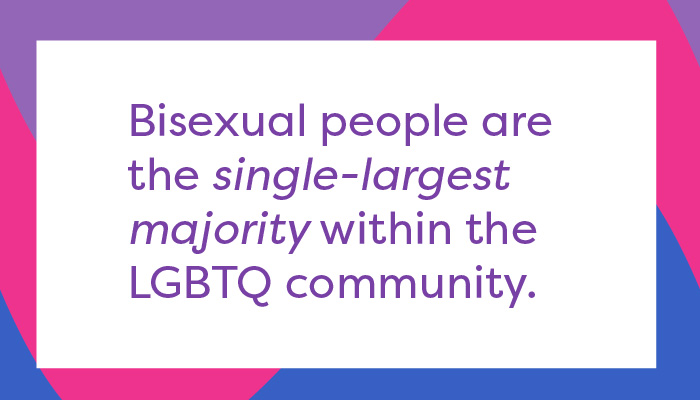
Bisexual people are the single-largest majority within the LGBTQ community, according to the Human Rights Campaign. Yet instead of being celebrated, bi+ individuals (an umbrella term encompassing other identities with the potential to be attracted to more than one sex and/or gender, such as queer or pansexual) contend with identity erasure. In honor of Bi Visibility Day, let’s take a closer look at bisexual erasure and how to be more supportive and inclusive of bi+ identities.
What is bi erasure?

Bisexual erasure, often shortened to bi erasure, “is leaving bisexual people out when you’re talking about possibilities of sexual orientation,” says Dr. Lauren Beach, a professor of LGBTQ health at Northwestern University who has been a leader in LGBTQ activism since they were in college.
“It can be refusing to say the word ‘bisexual’ on TV, or acknowledging bisexuality but not validating it as an identity,” says Dr. Beach. There are also “negative connotations with the term, such as [saying] bisexual people are greedy, cheaters, confused, untrustworthy, [or] can’t pick a side.”
This implicit and explicit invalidation of bisexual identities results in a general disrespect and lack of understanding of bi+ individuals.
What impact does bi erasure have?
Any form of prejudice has negative consequences, and bisexual erasure is no exception. A 2019 study on bisexual health published in the Archives of Sexual Behavior found that instances of identity invalidation and invisibility among bi+ individuals correlated with increased anxiety, depression, and overall emotional distress.
The Human Rights Campaign has also found that bi+ individuals are less likely than gay or lesbian individuals to disclose their sexual identity to a healthcare provider. This means that in a healthcare setting, bisexual individuals may be struggling with the adverse health effects associated with discrimination, as well as the strain of not feeling comfortable openly communicating about their health.
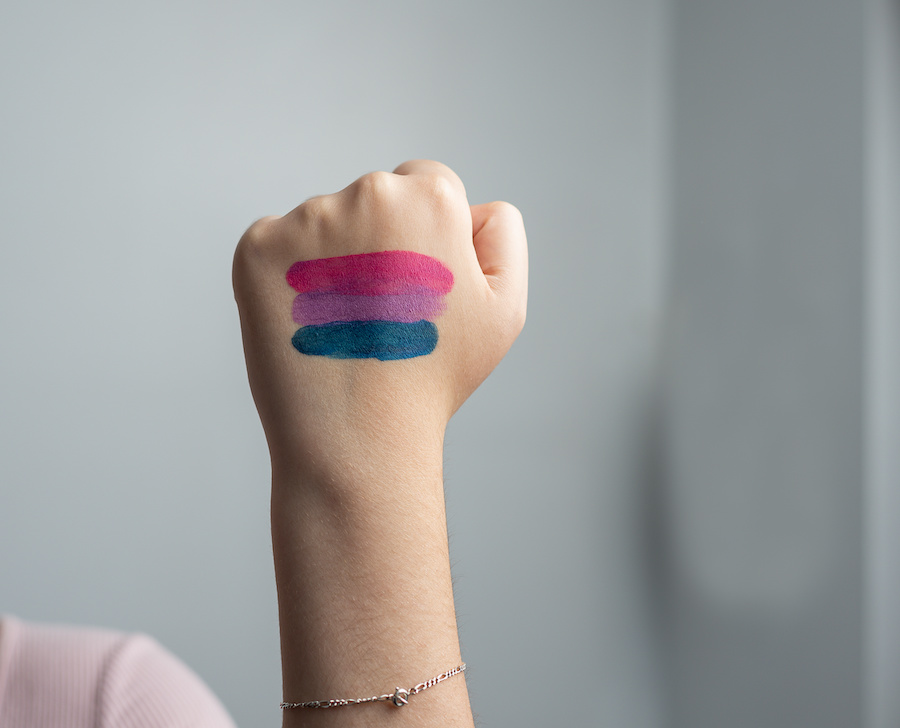 On an individual level, bi erasure can strain relationships and make it difficult to find support. “I’m currently dating a male-identifying person, so it does feel sometimes like I have to remind people that I’m not straight,” says Julia T.*, a second-year student at Mount Royal University in Calgary, Alberta in Canada. The pressure to justify one’s identity and the right to occupy LGBTQ spaces can make the opportunity to build community seemingly impossible.
Addressing common misconceptions about bisexuality
To better understand bi+ identities, let’s clarify some of the myths and arguments that perpetuate bi erasure.
Bisexuality includes identities that are outside of the gender binary
In 2020, leading bi+ activist Robyn Ochs teamed up with GLAAD to petition Merriam-Webster.com to change their definition of bisexual. Ochs offered her own definition of bisexual (widely accepted in the bi+ community) for reference: “The potential to be attracted—romantically and/or sexually—to people of more than one sex and/or gender, not necessarily at the same time, not necessarily in the same way, and not necessarily to the same degree.”
In the definition, bisexuality recognizes more than just the binary genders. Additionally, “saying ‘bi is binary’ or ‘bi is not trans’ erases the intersection of bisexuality and transgender identities,” says Dr. Beach. “Critiquing the word bisexual [as being only applicable to the traditional sex and gender binaries] is tied to a worldview that would deny people that are beyond binaries.”
Merriam-Webster.com has since changed its definition of bisexual to recognize multiple genders, an important step toward acknowledging the expansiveness of bi+ identities beyond the binary. (If you’re interested in learning more about queer terms and identities, check out queerundefined.com, a crowd sourced dictionary created by and for the LGBTQ community.)
Bisexuality is not just a phase
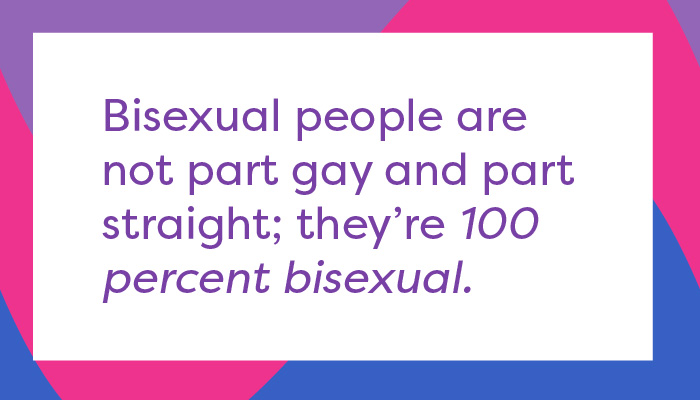
Bisexuality is often talked about as a sort of stepping-stone between or a mix of being gay and being straight. This is a form of bi erasure. “Bisexual people are not part gay and part straight; they’re 100 percent bisexual. You can’t disarticulate people into identities that they don’t hold,” says Dr. Beach.
Recognizing and respecting bisexuality as a unique identity is a key step to pushing back against bi erasure.
Bisexual people are an important part of the LGBTQ community
 Another way the validity of bisexuality is challenged is through heterosexual privilege, which is the idea that bisexual people benefit from being “straight passing” in some relationships. Insisting that bisexuality is only valid in certain instances (such as same-gender or same-sex relationships) is a method of gatekeeping and implies bisexuality is a performance, not an identity.
As Dr. Beach said above, someone who is bisexual is bisexual 100 percent of the time. This is true regardless of their relationship status or the (perceived) gender of their partner.
How can we be more inclusive of bi+ identities?
 “In general, the LGBTQ+ infrastructure needs to talk about bisexuality,” says Dr. Beach. Include bisexuality when discussing things like safe zones (spaces that are explicitly designated as LGBTQ-friendly), and “learn about what bisexuality is, not just what it isn’t.” But don’t stop at understanding on an intellectual level.
We have to “move beyond the conversations about identity, experience, and existence, and into policy,” says Dr. Beach. This means including bi+ people in leadership and events and respecting their perspectives. Further, bisexuality has to be understood as intersectional: “If you don’t have bi people of color and bi trans people as leaders,” Dr. Beach says, “you are erasing bisexuality.”
When someone tells you they are bisexual, believe them. Don’t question or challenge their identity, and include them in conversations about LGBTQ issues. Building that trust and support will ultimately lead to greater change and a more inclusive society. If in doubt, “lead with [bisexual] people’s lives and how they see themselves,” says Dr. Beach.

Self-care for people experiencing bi erasure
If you find yourself on the receiving end of biphobia or other stigma, it can be incredibly difficult to participate in the larger work of ending bi erasure. That’s OK—take care of yourself first. As we’ve heard before: You can’t pour from an empty cup.
Healing happens in a community, Dr. Beach says, and it’s important to find that. “Try to find a bisexual coming-out group, or a conference like the BECAUSE (Bisexual Empowerment Conference: A Uniting, Supportive Experience) Conference. Listening to others talk about their identity can be validating because it’s the opposite of erasure.” Reach out to the LGBTQ center on your campus if you need a place to start.
 Other ways to care for your mental well-being include seeking out art and media with positive bi+ representation, joining bi+ groups/forums on social media platforms (e.g., Reddit), or connecting with counseling resources on campus. And the most important step of all? “Be kind and compassionate,” says Dr. Beach. “Listen to what you say about yourself to yourself, and give yourself permission to be vulnerable and experience self-compassion.”
*Name changed for privacy
Accelerating bi+ acceptance: GLAAD
Misty Gedlinske’s Bisexuality: The Invisible Letter “B”: TEDxOshKosh
Find a bisexual support group: MeetUp
Learn more about the bi+ community: Bisexual Resource Center
Article sources
Lauren Beach, PhD, research assistant, professor, and activist, Northwestern University Feinberg School of Medicine, Evanston, Illinois.
Doan Van, E. E., Mereish, E. H., Woulfe, J. M., & Katz-Wise, S. L. (2019). Perceived discrimination, coping mechanisms, and effects on health in bisexual and other non-monosexual adults. Archives of Sexual Behavior, 48(1), 159–174. https://doi.org/10.1007/s10508-018-1254-z
GLAAD. (2020, September 23). Why Merriam-Webster.com updating the definition of bisexual matters on Bisexual+ Visibility Day and beyond. https://www.glaad.org/blog/why-merriam-webstercom-updating-definition-bisexual-matters-bisexual-visibility-day-and-beyond
Human Rights Campaign. Bisexual FAQ. https://www.hrc.org/resources/bisexual-faq
Human Rights Campaign. Health disparities among bisexual people. https://assets2.hrc.org/files/assets/resources/HRC-BiHealthBrief.pdf?_ga=2.211873044.1863182164.1620785126-683516052.1615930159
San Francisco Human Rights Commission LGBT Advisory Committee. (2011). Bisexual invisibility: Impacts and recommendations. San Francisco Human Rights Commission. https://sf-hrc.org/sites/default/files/Documents/HRC_Publications/Articles/Bisexual_Invisiblity_Impacts_and_Recommendations_March_2011.pdf